We need your help now

Support from readers like you keeps The Journal open.

You are visiting us because we have something you value. Independent, unbiased news that tells the truth. Advertising revenue goes some way to support our mission, but this year it has not been enough.

If you've seen value in our reporting, please contribute what you can, so we can continue to produce accurate and meaningful journalism. For everyone who needs it.

What parts of Ukraine could Vladimir Putin ask for in exchange for an end to the war?

The proposal could be on the table ahead of a mooted meeting between Putin and Volodymyr Zelenskyy.

UKRAINIAN PRESIDENT VOLODYMYR Zelenskyy held talks with his US counterpart Donald Trump in Washington last night aimed at bringing about an end to Russia’s war in his country.

The meeting, which took place alongside several European leaders, was worlds apart from the disastrous scenes seen in February, when Trump and his vice president JD Vance rounded on Zelenskyy in the Oval Office.

Despite assurances from Trump that Russian president Vladimir Putin accepted Western security guarantees for Ukraine at a summit in Alaska last week, there was little mention of any potential ceding of land by Ukraine. 

It is believed that Putin wants Ukraine to give up some of its territory in the east of the country in order for Russia to end the conflict.

It’s understood that in exchange for this, Moscow would agree to “freeze” the front line in regions where Russian forces hold swathes of territory, but not the regional capitals.

But what land is Moscow seeking, and how likely is it that Zelenskyy would even consider conceding territory?

What territory does Russia want?

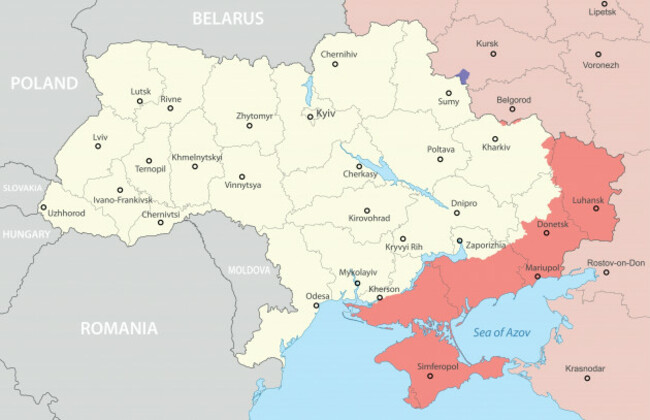
Putin is understood to have told Trump last week that he wants Ukraine’s Donetsk and Luhansk regions, also known as the Donbas. These areas have seen the deadliest battles of the war so far. 

The regions run from Mariupol in the south all the way up to the northern border with Russia. Before the invasion, they were home to over six million people, but the remaining population is now difficult to determine due to millions having left since the start of the war. 

During the Soviet era, the regions had a heavily industrialised industry, particularly for coal and steel production. They also have a significant proportion of farmland. 

politicalmapofukrainemarkingdisputedterritoriesinredincluding A map of Ukraine marking the disputed territories in red, including Crimea, Donetsk, Luhansk, and parts of Zaporizhzhia. Shutterstock Shutterstock

In September 2022, Russia held “referendums” and illegally annexed Donetsk, Luhansk, Kherson and Zaporizhzhia – the same thing it did in Crimea in 2014. It has been trying to capture all of the Donbas since then, but it has never had any of the four regions fully under its control.

Why does Putin want the Donbas?

Donnacha Ó Beacháin, Professor of Politics at DCU who has worked and researched in the post-Soviet region for over two decades, told The Journal that Russia controls almost all of Luhansk and the majority of Donetsk.

“But there are important cities which they don’t hold and haven’t been able to take, despite the three-and-a-half years of full-scale invasion,” he said. 

He said that while both regions are predominantly Russian-speaking, they do not have an ethnic Russian majority.

“There is this attempt by the Kremlin always to conflate Russian speaking with ethnic Russian. When I was there giving lectures for over a number of periods in Donetsk, the students I met there were Russian-speaking Ukrainians,” he said.

“That’s borne out by census figures, it’s borne out by opinion polls in terms of self-identification. Of course, there are people who identify as Russian as well, but the demographics have shifted a lot since the war. A lot of people have left.”

Given their locations, Ukraine fears that Russia taking control of Donetsk and Luhansk would be detrimental to its defence and would allow Moscow to regroup and begin attacks deeper into the country.

“It’s a substantial piece of territory, and it’s very well fortified,” Ó Beacháin said.

“It includes cities like Kramatorsk and Sloviansk, which, if the Ukrainians were to hand them over to the Russians, it would mean that Ukraine would be much easier to attack in the future.”

What are the conditions like under Russian occupation?

For those still living in occupied Donetsk and Luhansk, the regions are treated as parts of Russia.

The Russian constitution recognises them as Russian territories, and has forced Ukrainians in the regions to adopt Russian passports. Weather forecasts shown on Russian television will include those regions as part of Russia, even though they don’t control all of the territory. 

Moscow has been encouraging people to move to some cities in the region in order to rebuild them, including Mariupol. The city was taken by Russian forces after a brutal siege three months into Russia’s invasion. Ukraine estimates over 25,000 people were killed. 

Recently, Russian influencers have shared content from Mariupol suggesting that life there is normal, something that has been disputed by Ukrainian residents. Other recent reports show there are acute water shortages in some parts of Donetsk, with residents pleading with Russia for help

The brutality of what happened in Mariupol serves as a warning to others living in the occupied regions not to act out.

“As in any regime, some will cooperate. Some will keep their heads down. They won’t resist, but they don’t want the current situation,” Ó Beacháin said. “Some will be actively trying to resist. But the difficulty in resisting, of course, is the punishment can often be death, so you don’t get really active acts of defiance if people can avoid it.”

Along with encouraging Russians to populate the regions, the educational curriculum has been completely changed to a Russian one, with the Ukrainian language banned.

“It’s only recently acquired and they don’t know how long they will hold it for, because the battle lines shift as time goes on. Some parts, like Kherson, were captured and then had to be handed back to the Ukrainians because of their military advances.”

How likely is it that Zelenskyy will give up territory?

Almost impossible, according to Ó Beacháin. 

The Ukrainian president has repeatedly said that he would not be willing to hand over any of his country to Putin. Ukraine’s constitution outlines that changes to its territory can only be made through referendums. 

“The Ukrainian constitution is quite clear in the territorial definition. You couldn’t possibly have a situation where a President could sign over territory. It would be unconstitutional,” Ó Beacháin said.

“It would be impossible in the foreseeable future to have a referendum of any legitimacy, because millions of people have left Ukraine. Many people are under occupation. How would you have a referendum that would be recognised and legitimate?”

The chance that Russia would abide by a ‘land for peace’ agreement is low. The Budapest Memorandum in 1994 saw Russia agree to respect Ukraine’s sovereignty and borders in return for Kyiv giving up its nuclear arsenal. It went on to invade Crimea. 

The subsequent Minsk agreements were also broken when Putin recognised Donetsk and Luhansk as Russian before the full-scale invasion of Ukraine in February 2022. 

I don’t think it’s an exaggeration to say you would have something approaching civil war in Ukraine, were any Ukrainian government just to hand over territory that was in Ukrainian hands now.

Ó Beacháin added that doing this would also be “political suicide” for Zelenskyy. 

“I can’t see him doing it, unless he feels that he could do it almost like an act of personal self sacrifice, recognising that his political career is over… but he doesn’t strike me as somebody who would avoid responsibility at critical moments.”

What happens next?

Putin and Zelenskyy have both said they are prepared to meet each other after the meeting in the US yesterday – but whether a territorial swap is on the cards remains to be seen.

French President Emmanuel Macron expressed that such a decision would potentially send the wrong message, even though it would be for Ukraine to make.

Addressing whether Zelenskyy would be forced to give up territory to Russia, Macron said it was “up to Ukraine”.

“Ukraine will make the concessions it deems just and right,” he said, but added: “Let’s be very careful when we talk about legal recognition.”

“If countries… can say, ‘we can take territory by force’, that opens a Pandora’s box.”

Part of the problem for Zelenskyy and Ukraine is a potential lack of American support from this point onwards.

Ó Beacháin said the US “already have one foot out the door” when it comes to supporting Ukraine, with Trump repeatedly blaming his predecessor Joe Biden for the conflict and Secretary of State Marco Rubio telling NBC News days ago that it’s “not our war”. 

“Essentially, Trump’s big threat is ‘we’ll walk away’, but it’s clear that they’re walking away anyway,” he said.

Readers like you are keeping these stories free for everyone...
Our Explainer articles bring context and explanations in plain language to help make sense of complex issues. We're asking readers like you to support us so we can continue to provide helpful context to everyone, regardless of their ability to pay.

Close
JournalTv
News in 60 seconds