TheJournal.ie uses cookies. By continuing to browse this site you are agreeing to our use of cookies. Click here to find out more »
Dublin: 10 °C Tuesday 21 May, 2013

Factory fires kill more than 310 in Pakistan

Massive fires have gutted factories in Pakistan’s two largest cities, killing hundreds of people and prompting calls for an overhaul of industrial safety standards.

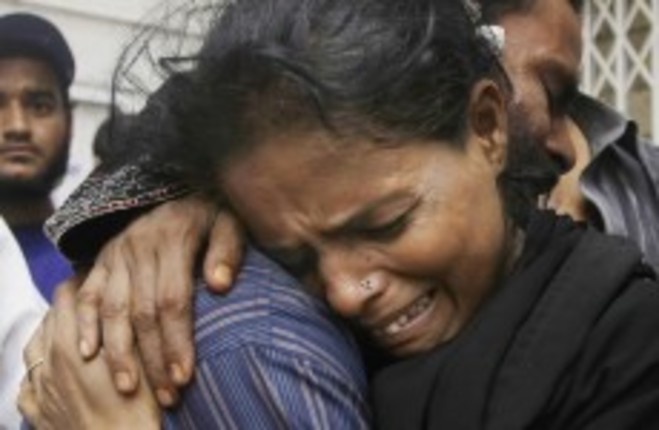
Family members mourn the death of a man outside a mortuary in Karachi, Pakistan, Wednesday, Sept. 12, 2012
Image: Fareed Khan/AP/Press Association Images

MORE THAN 310 people have perished in fires that gutted factories in Pakistan’s two largest cities, in tragedies that prompted calls for an overhaul of poor industrial safety standards, officials said Wednesday.

At least 280 people died at a garment factory in Karachi, in the worst blaze in decades to hit Pakistan’s biggest city, just hours after 21 died at a shoe factory in Lahore, close to the Indian border.

Dozens of others were hurt in Karachi as they jumped out of windows from the four-storey building to escape the blaze that began Tuesday evening in a bid to save their lives, as sobbing relatives of trapped workers scuffled with police overnight.

Search for bodies

“The death toll is 289. This is not final, search for more bodies continues,” the city’s top administration official, Karachi Roshan Shaikh, told AFP as more victims were recovered.

City police chief Iqbal Mehmood had earlier put the toll at 240.

Karachi fire chief Ehtesham Salim said rescue workers were finding large groups of bodies on the lower floors of the factory.

“Our firefighters are finding bodies in greater numbers from the lower floors of the factory,” he said.

“We didn’t find bodies in ones or twos, but in the dozens, which is why the death toll is increasing so alarmingly,” he added.

Salim said the fire probably originated on the ground floor, giving those workers in the basement and on that level less time to escape.

Abdus Salam, a doctor at Karachi’s Civil Hospital, said at least 65 workers suffered broken bones after jumping out of windows.

Pakistani Interior Minister Rehman Malik said he had ordered an inquiry into both fires, as officials said the factory in Karachi in particular had been flimsily built, lacked emergency exits and had developed cracks in the walls.

No emergency exits

“It was packed like a box with little room left for ventilation. There were no emergency exits,” Salim said.

According to workers, the factory produced underwear and plastic utensils.

Salim said the disaster was Karachi’s “biggest fire in terms of deaths in decades”.

In January 2009, 40 people were killed, more than half of them children, when a fire engulfed dozens of wooden homes in Karachi’s impoverished Baldia neighbourhood.

The garment trade is vital to Pakistan’s shaky economy.

According to central bank data, the textiles industry contributed 7.4 per cent to Pakistan’s GDP in 2011 and employed 38 per cent of the manufacturing sector workforce. It accounted for 55.6 per cent of total exports.

Noman Ahmed, from the NED University of Engineering and Technology in Karachi, said few industries and businesses implement the law on safety and fire exits, finding it easy to avoid because of lack of effective monitoring.

“Most of our shopping centres and markets too have no safety mechanism, which the authorities should review seriously, otherwise it could cause graver tragedies in future,” he said.

Mohammad Saleem, 32, who broke a leg after jumping out of the second floor, said he and his colleagues were hard at work late Tuesday.

Cause of the fire unknown

“It was terrible, suddenly the entire floor filled with fire and smoke and the heat was so intense that we rushed towards the windows, broke its steel grille and glass and jumped out,” Saleem told AFP.

“It was extremely painful. I saw many people jumping out of windows and crying in pain for help,” he said.

Around 150 employees were working at the time in one of the factory’s three round-the-clock shifts, Saleem said.

Officials said the cause of the fire was unknown but Rauf Siddiqi, the industry minister for the southern province of Sindh of which Karachi is the capital, said the owner was under investigation for negligence.

“We have ordered an inquiry into how the fire erupted and why proper emergency exits were not provided at the factory so that the workers could escape,” Siddiqi said.

In Lahore, flames also trapped dozens of workers in a shoe-making factory, killing 21 and injuring 14 others, local officials and medics said.

Tariq Zaman, a government official, blamed the blaze on a faulty generator.

- © AFP, 2012

Read: Pakistani girl who was accused of blasphemy released from jail

Read next:

Comments (9 Comments)

  • Unfortunately these events are all too common in the garment and shoe industry, Bangladesh has had high numbers of factory fires and following concerted pressure by local and international unions employers, government and multinational companies have started to engage to improve fire safety and create a welfare fund for victims and there families.
    The problem in Pakistan is that the Government has suspended factory inspections, used anti terrorism laws to suppress trade unions who have been attempting to highlight these issues and demand a living wage, combined with ruich influential employers who regularly flout employment law
    For the posters who ask who these factories where supplying too, you should ask yourself why do companies such as dunnes, pennies, tesco, M&S, Next, Gap etc refuse to disclose their suppliers list because they live in fear of the public knowing what conditions are like in these factories, its extremely hard to and resource intensive to find out who produces in each factory, in these cases it will come out but the problem is that the multinationals will deny responsibility and are more interested in pr exercises such as opening bank accounts for women workers rather than paying workers a living wage so they can put money in their bank accounts.

    The consumer has to wake up to the fact there is no such thing as cheap goods someone, somewhere is paying a price

    Reply
  • Who were they making the shoes for? I think it’s important people know. Nothing is going to change unless the customers are made aware of exactly how their shoes are manufactured for them.

    Reply
  • The question everyone will be asking next is were they chained in a sweatshop sewing sneakers and shirts for Walmart, Gap, Polo, Adidas etc

    Reply
  • Unbelievable, the poor people

    Reply
  • Horrific

    Reply
  • Apparently the ground floor windows were barred, no fire escapes

    Reply
  • how tragic…

    Reply

Add New Comment