TheJournal.ie uses cookies. By continuing to browse this site you are agreeing to our use of cookies. Click here to find out more »
Dublin: 15 °C Sunday 19 May, 2013

Japanese government fears meltdown at second Fukushima nuclear reactor

Authorities are pumping seawater into a second reactor, amid fears of a second hydrogen explosion at the nuclear plant.

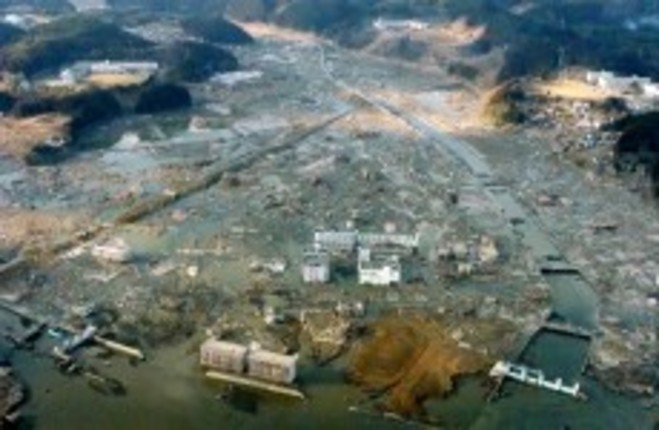
The coastal town of Minamisanriku, which lies around 55 miles away from the main epicentre, and where up to 10,000 people are missing.
Image: AP

THERE ARE NEW fears of a nuclear meltdown at the stricken Fukushima I nuclear power plant in Japan today, after authorities said they had begun to pump seawater into a second reactor at the plant.

The primary and backup cooling systems at the number 3 reactor were damaged in the aftermath of Friday’s earthquake and tsunami, and the plant’s operator TEPCO now fears that the temperatures in the reactor could result in a second hydrogen explosion, similar to that which destroyed a containment building around another reactor yesterday.

The government has warned that a meltdown at the number 3 reactor is now a distinct possibility.

That blast, at the number 1 reactor, is not thought to have damaged the reactor itself, with TEPCO insisting that the steel casing that houses the reactor itself remaining intact.

In spite of this, however, radioactive leakage has been observed near the site and a total of 19 people have now been hospitalised for radiation exposure.

Further reports suggested that a leak in the reactor had caused the co0ling fluid around the energy rods to leak out, briefly exposing the rods before new water could be pumped back inside.

Though the plant is relatively close to the seafront, thereby making sea water a fairly predictable source of emergency coolant, the tactic is a fairly unusual one – indicating the unprecedented gravity of the situation facing the plant.

Some air has been intentionally vented from the number 3 reactor building, in order to ease the pressure on the containment building and avoid a second explosion in as many days.

The International Atomic Energy Agency have begun distributing iodine tablets to those evacuated from the 20km exclusion zone around the plant, hoping to combat any radiation poisoning of the thyroid gland, which is particularly susceptible to such poisoning.

The exclusion zone remains in effect around the plant. Last night, many of Japan’s symbolically large buildings – such as the Tokyo Tower, the main city call in the country’s capital – turned off their lights in order to preserve power, given the disruptions from power manufacture at the Fukushima plant which supplies the city.

Japan’s meteorological agencies have listed tsunami advisories for the country’s coastal areas, as the number of aftershocks in the waters off the east coast begins to subside.

Authorities fear that the death toll as a result of the first primary 8.9-magnitude quake, and the following tsunamis, could reach 10,000 in the prefecture of Miyagi alone.

As many as 9,500 people are still unaccounted for in the prefecture’s coastal town of Minamisanriku, which had a total population of around 17,000, and which lies around 55 miles from the epicentre of the major earthquake.

Around 7,500 residents from the town were housed in emergency shelters before the main tsunami struck, but authorities say they have not been able to make contact with the rest of the town’s population.

The confirmed death toll at the time of publication was 977, with a further 1683 people confirmed injured.


Read next:

Comments (8 Comments)

  • My heart goes out to them!

    Reply
  • The only radioactive material being released that is of concern is iodine 131 which the tablets [remember the ones issued by our wonderful and caring government ?]can take care of.
    This iodine 131 will decay in 40 days.The illegal toxic dumps dotted around Ireland won’t. ;-)

    Reply
    • Q: What about the radiation released? Is it dangerous?

      A: It would appear that some of the nuclear fuel in FD1 has melted and released gaseous fission products to the interior of the reactor. These would include xenon, krypton, and iodine. There are about seven isotopes of xenon that are radioactive and would be released in such an incident, with atomic masses of 133, 135, 137, and 138, along with three isomers, 131m, 133m, and 135m. With the exception of the isomers, each of these xenon atoms will decay into cesium and some into other elements past cesium. There is also krypton but its radioactivity and decay products are of less concern.

      Xenon itself is not particularly dangerous. It is a noble gas and is not concentrated in the body. Cesium is more of a concern. Here are the seven decay sequences:

      Xenon-131m will decay to stable xenon-131.
      Xenon-133m will decay to radioactive xenon-133.
      Xenon-133 will decay to stable cesium-133.
      Xenon-135m will decay to radioactive xenon-135.
      Xenon-135 will decay to very mildly radioactive cesium-135.
      Xenon-137 will decay to radioactive cesium-137.
      Xenon-138 will decay to radioactive cesium-138 and then quickly to stable barium-138.

      Of all of these, the decay of xenon-137 to cesium-137 is probably responsible for the most risk, but xenon-137 decays so quickly that the mobility of cesium-137 is limited. I do not think this poses much risk because it can’t get far. The xenon-135 has a longer half-life (9 hours) but decays to a nearly harmless form of cesium (135). I think this poses almost no risk due to the very long half life of cesium-135.

      http://energyfromthorium.com/2011/03/12/japanese-earthquake-qa1/

      Reply
  • The risk of meltdown is extremely small, and the death toll from any such accident, even if it occurred, will be zero. There will be no breach of containment and no release of radioactivity beyond, at the very most, some venting of mildly radioactive steam to relieve pressure.

    http://bravenewclimate.com/2010/05/04/dv82xl-2/

    There is no credible risk of a serious accident. All reactors responded by insertion of control rods to shut down their nuclear reactions. Thus, power levels in all cases dropped quickly to about 5% of maximum output, and the nuclear chain reaction ceased (i.e., all units are subcritical).

    http://bravenewclimate.com/2011/03/12/japan-nuclear-earthquake/

    Three Mile Island accident = no fatalities and no perceptible increase in any cancers.

    Currently natural gas storage tanks are ablaze at the Cosmo oil refinery in Ichihara city, Chiba Prefecture, near Tokyo – over 100 have died.

    Reply
    • Am I correct in saying that the temperature inside the unit is 750*C ? The shielding is designed to take 2000*C

      Reply
    • Fox news has this on their site
      “LATEST UPDATE: Top Japanese government official says a ‘partial meltdown’ is likely under way at a nuclear power plant, as nearly 170,000 evacuate the area in fear of radiation exposure and police say more than 10,000 people may have already died”

      The worst piece of copy on any newspaper since………………………………maybe yesterday.

      Reply
    • The Japanese PM has just made a statement asking the international media NOT to compare this to Chernobyl.
      I’ve been reading up on this all morning and most of the apocalypse stories are being disseminated by eco evangelists and their media mouthpieces along with media ‘embedded’ in sectors with vested financial interests that will use this terrible event (earthquake and tsunami that is) to make a profit plus finally Godlike Productions (possible CIA psy op forum) is pumping out some awful crap (as are Above Top Secret) – a lot of it being stirred up with hyperbolic reporting from mainstream media – full of false equivalences BTW.

      Reply
    • In reply to the temperatures question – apparently it is acceptable for temperatures to reach 950°C (in a system designed to cope with up to 2000°C – in fact it’s the Next Generation reactors that ARE designed for this but the Japanese saefty systems are enhanced beyond regular international standards because of earthquake threats).

      Reply

Add New Comment