TheJournal.ie uses cookies. By continuing to browse this site you are agreeing to our use of cookies. Click here to find out more »
Dublin: 11 °C Friday 24 May, 2013

Great Famine victims remembered at national commemoration

Taoiseach linked Ireland’s ‘generational memory’ about Famine years to the country’s fight against root causes of hunger.

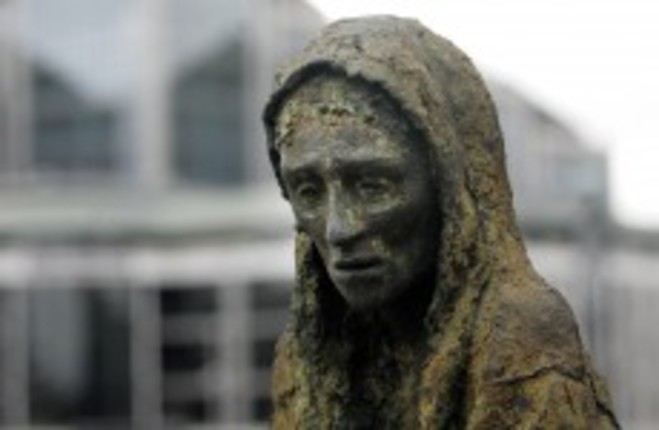
The Famine memorial sculpture by Rowan Gillespie in Dublin city.
Image: Sam Boal/Photocall Ireland

NATIONAL FAMINE Commemoration events are underway in Drogheda today to mark Ireland’s devastating Great Famine of the mid-19th century.

During the Famine years, Drogheda was the second-largest port of departure for Irish people to emigrate.

The populations of Ireland fell from 8.5 million in 1845 to 6.6 million in 1851, of which over one million emigrated.

Today, a 90-minute walk from Oldbridge House in Drogheda towards North Quay commemorates the exodus of families from all over the country through the port at Drogheda.

Speaking at the commemoration ceremony in Drogheda this afternoon, Taoiseach Enda Kenny said that a key aspect to Ireland’s recognition of the Great Famine is its ongoing work “to address the root causes of hunger”.

Ireland “has become a leading global advocate in the fight against hunger,” he said.

It is that generational memory that supports Irish Aid and all aid agencies to bring not just food but hope, self-reliance, compassion and dignity across the Developing World. A major priority of Irish Aid is to support global efforts to reduce hunger.

Minsiter for Arts, Heritage and the Gaeltacht Jimmy Deenihan, who is also the chair of the National Famine Commemoration committee, thanked the people of Drogheda for their role in remembering the victims of the Famine and for their “rich appreciation of their history”.

Meanwhile, Drogheda’s Highlanes Gallery is hosting a ‘Forgotten Voices’ exhibition by the OPW/NUI Maynooth Archive and Research Centre which shows documents belonging to the Strokestown Estate Archive (Co Roscommon) from the Famine years.

The exhibits include census records, emigration lists and pleas from starving tenants for assistance.  ’Forgotten Voices’ runs until 30 May.

The National Famine Commemorations have taken place in Dublin, Skibberean in Co Cork, Murrisk in Co Mayo, and Clones in Co Monaghan in previous years.

Read next:

Comments (26 Comments)

  • There was no famine in Ireland. The potatoe crop failed all across Europe. The british government took all other crops and livestock out of the country under armed guard. It was an attempt to kill off the native irish catholic population.

    Reply
    • I have to agree with you , I would prefer it was called The Great Hunger ! There was food in the country but the ordinary working person (then called peasants) were working for the wealthy overlords .

      Reply
    • For balance, Presbyterians and other dissenters (Quakers, Baptists etc) were also discriminated against under the penal laws and many of their number also starved and/or were forced to emmigrate.

      Reply
  • No amount of historical revisionism can change the fact this was genocide, plain and simple.

    Reply
  • They should stop calling it a famine . Instead it should be called the great genocide

    Reply
  • It is a disgrace to the memory of those that were starved to death to refer to this as a “famine”. Dictionary definition of a famine: “1.extreme and general scarcity of food, as in a country or a large geographical area.”

    This was not the case in Ireland at the time of our “famine”. Food was plentiful but exported to Britain while Irish people starved to death.
    The potato crop failed all over Europe yet no other country suffered the loss of life we did.

    The media in Britain at the time depicted us as half human/half animal. We were shown to be savages. It was indeed an attempt at genocide. Evictions were rife and people were left to starve.

    We were the only European peasants that had a growing population due to our nutritious diet of potatoes where other peasants ate mainly bread. As a result we were very fertile and the British viewed our population explosion as a problem. Exporting food out of Ireland while the Irish were starving was indeed a means of reducing the population.

    That is genocide. Ugly but true. The truth isn’t always palpable to a former colonised country. But the Truth remains the Truth!

    Reply
  • The Hopi indians sold everything they owned, including the few who owned gold teeth who allowed their teeth to be extracted, and donated everything to us. We never hear much about their sacrifice and I think I know why. They were not not rich, or powerful, and still are not. They donated the equivalent of a quarter of a million pounds in today’s money. The only other doner to give so much was queen Victoria herself. Whatever else we decide to do regarding remembering the famine, we should never forget the self sacrificing role the Hopi Indians played from afar. A monument to their humanity, which went above and beyond any call of duty, before any such ideals were even heard of, deserves a special mention, and a perennial reminder.

    Reply
  • We are not the only nation that has had this happen.
    The same thing was done to the Ukranian people in the 20s, it is known as the Holodomor, the Ukranian Word for Famine Genocide.

    Http://www.holodomor.org

    Reply
  • Millions left to die.
    It’s a much bigger story than titanic.
    It deserves a bigger interpretive centre and our very own version of Ellis island except in reverse

    Reply
  • Genocide, plain and simple.

    Reply
  • genocide[ jen-uh-sahyd ]
    noun
    1. the deliberate and systematic extermination of a national, racial, political, or cultural group.

    Reply
  • People starved because they did not have access to food. That is a famine. The causes of this lack of access to food do not change that it was a famine. Famine defines the result, not the cause.

    Before an event can be classed as genocide, there must be documented proof that the primary intent of the British Empire was to wipe out as many of the Irish people as possible. There must be intent. If the aim was to maintain their level of production in Ireland by ignoring the needs of their cheap workforce, this is negligent and highly immoral, and they should accept the blame, but it would not be genocide. Genocide does not mean “mass killing”.

    Reply
    • Agree. The famine was actually a result of Lord John Russell’s government’s slavish devotion to free market economics. It was a huge national tragedy, and a monument to the colossal ignorance and callousnness of the British, but I still wouldn’t call it genocide. That being said, the former Lord Mayor of Dublin who described it as a “shared British-Irish” experience was a moron of the first order. As one commentator said at thw time, it was like equating the Holocaust to a shared German-Jewish experience. The British to blame? Definitely. Deliberate genocide? No.

      Reply
    • Sir Charles Edward Trevelyan, 1st Baronet, KCB (2 April 1807 – 19 June 1886) was a British civil servant and colonial administrator.
      was appointed in 1840 as assistant secretary to HM Treasury, and served to 1859, during both the Irish famine and the Highland Potato Famine of 1846-1857 in Scotland. In Ireland, he administered famine relief, whilst in Scotland he was closely associated with the work of the Central Board for Highland Relief. His inaction and personal negative attitude towards the Irish are widely believed to have worsened the Famine.[1] In the middle of the Irish famine, Trevelyan wrote that the famine was a “mechanism for reducing surplus population,” a view apparently influenced by the thought of Thomas Robert Malthus. Trevelyan wrote:
      “The judgement of God sent the calamity to teach the Irish a lesson, that calamity must not be too much mitigated… The real evil with which we have to contend is not the physical evil of the Famine, but the moral evil of the selfish, perverse and turbulent character of the people.”[2]
      In another letter dated 29 April 1846, Trevelyan wrote:
      “Our measures must proceed with as little disturbance as possible of the ordinary course of private trade, which must ever be the chief resource for the subsistence of the people, but, coûte que coûte (at any cost), the people must not, under any circumstances, be allowed to starve.”[3]

      If this doesn’t sound like a well orchestrated plan to deliberately starve a population, then i don’t know what proof you need.

      Reply
    • When the country is full food, and exporting it, that is not famine. It is enforced starvation by cruel social engineering. That’s not just negligent or immoral, it’s genocide, the definition of which is “The deliberate killing of a large group of people, esp. those of a particular ethnic group or nation”

      The British may have sent the Army in to “deliberately” kill people (like in other circumstances), but their policy makers certainly did deliberately kill people.

      Sir Charles Trevelyn (the man in charge of administering “famine” relief)
      “The judgement of God sent the calamity to teach the Irish a lesson, that calamity must not be too much mitigated… The real evil with which we have to contend is not the physical evil of the Famine, but the moral evil of the selfish, perverse and turbulent character of the people.”

      He also also said the famine was a “mechanism for reducing surplus population”

      Reply
    • @ Cal – thanks for this. CET obviously thought a spot of ethnic cleansing would be a good idea. The next step would be to link these letters to other official documentation to show that these were not just his personal, and quite twisted, opinions, but were also governmental policy.

      I want to make it very clear that what occurred in Ireland was primarily caused by British policy and was brutal, ignorant and most of all unnecessary. What I have a problem with are claims made without any reference to objective evidence. That is what is called an opinion, not a fact. If I can be shown evidence that The famine was an attempt at ethnic cleansing, then yes, I’ll say I’m incorrect and it was an act of genocide. But when commenters simply state it was genocide, and reply with a variant of “because I say so”, it demeans the debate for all sides. Sorry for being pedantic, but emotionally based arguments don’t seem to be helping anyone in Ireland at the moment….

      Reply
    • John, I think you’re being a little too pedantic there.

      Trevelyn was the man appointed by the Government to deal with the problem. How can you argue that these are just his views as an individual since the evidence shows he made his opinions clear in letters, writing and verbal statements? He wasn’t replaced or reprimanded in any way. That indicates to me that his views were widely endorsed by the establishment of the time.

      Ireland was supposed to be part of the union. If this had occurred in County Surrey, do you really think the response would have been the same? (and that Punch would have had the same cartoons?)

      Reply
    • mattoid 13/05/12 #

      Not trying to excuse what happened, but there is no evidence to suggest that it was a deliberate genocide, more a blind following of capitalist idealism (as illustrated by the last quote attributed to Trevelyan above) combined with a widely held belief at the time that the reports of famine in Ireland were wild exaggerations of the true situation (there is a huge body of evidence to suggest that the ‘establishment’ didn’t even realise how bad things were in Ireland).

      Reply
    • mattoid 14/05/12 #

      @Cal
      You shot your argument in the foot with your quote [3] from Trevelyan when you’re trying to make a case that it was a deliberate and planned genocide. You may not like my previous post (you’re not alone judging by the thumbs) but any objective historian cannot disagree with it. Proinsias is spot on. The folk memory and popular belief is of course very different, but that doesn’t mean its true.

      Reply
  • There are hungry people in Ireland today. The politicians may be able to look back but are blind when looking around them today. Wake up Enda.

    Reply
  • Spot on Declan.

    Reply
  • famine[ fam-in ]
    noun
    1. extreme and general scarcity of food, as in a country or a large geographical area.
    2. any extreme and general scarcity.
    3. extreme hunger; starvation.

    Reply
  • Saw Kenney on the news saying for the rich there was food in the shops had to laugh 200k plus experiences mr kenney your doing alright for yourself.

    BTW folks Queen Victoria donated a serious amount of money to Ireland from her own funds for those saying it was attempted genocide. Did you never hear of potato blight?

    Reply
  • Happy Famine day

    Reply

Add New Comment