TheJournal.ie uses cookies. By continuing to browse this site you are agreeing to our use of cookies. Click here to find out more »
Dublin: 13 °C Monday 20 May, 2013

How a citizen protest movement is stopping evictions in Spain

The citizen-run Platform for Mortgage Victims helps people who can’t pay their mortgages and says it has blocked almost 600 evictions so far.

A Madrid family reacts when they hear their eviction has been suspended earlier this month
Image: AP Photo/Daniel Ochoa de Olza

THE WALLS OF the apartment are cracked and patched with damp, but the faded family photographs of Maria Luisa Brana, her husband and their four children, are still hanging.

Eight months ago the five of them – all jobless, like millions in Spain’s recession – faced being thrown out for failing to pay their mortgage.

Unlike many families, they have beaten the odds.

With legal help from the PAH, a citizen protest movement fighting against a wave of evictions across Spain, they managed to get their order to leave cancelled.

“No one else would listen to me. You feel powerless. At the same time you know that you owe that money and you feel guilty,” said Maria Luisa, a 52-year-old with grey hair and a piercing gaze.

The campaign provided legal support and persuaded the bank to let the family stay in their home and pay rent.

Maria Luisa bought the apartment in Villaverde, a working class suburb of Madrid, in 2005 during Spain’s building boom.

Three years later, when the boom went bust, the family was all unemployed and Maria Luisa had €140,000 of debt. Their home was seized by the bank.

She recalls the “shame and anger” she felt as she and her husband, an unemployed cook, and all her grown-up children feared ending up in the street.

“I am not a delinquent,” said Maria Luisa, a former food-handler. “I didn’t pay because I was poor.”

Like many homeowners facing eviction in Spain, she turned in desperation to the citizen-run Platform for Mortgage Victims (PAH).

She now lives on unemployment benefits of €420 a month, “plus what my father-in-law gives,” she told AFP.

The family pays a social housing rate of €350 a month secured for them by the PAH, with the right to inhabit the apartment for seven years.

“It’s still not much relief. If I get one month behind with the rent, they’ll take the apartment,” she said.

Economic worries aside, she had a heart attack a few weeks ago.

Spain Financial Crisis Eviction

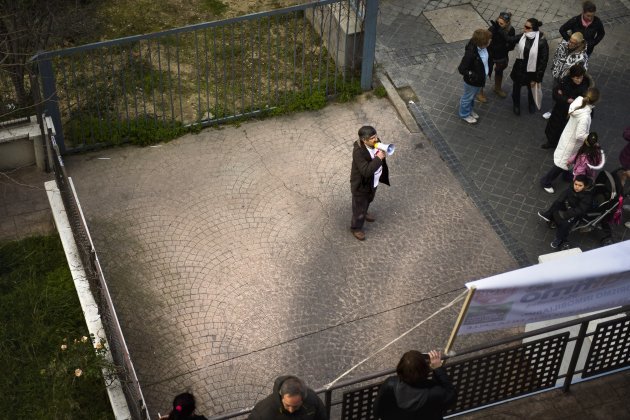
A member of the Mortgage Victims’ Platform (PAH) waits for police to come to a flat earlier this month (AP Photo/Daniel Ochoa de Olza

Under current Spanish law, a bank can pursue a borrower for the remaining balance of a loan if the value of the seized property does not cover it.

“Spain has one of the most unjust laws, which leaves people totally unprotected with their mortgage,” said Ada Colau, a spokeswoman for the PAH.

“People did not get into debt on a whim,” but were encouraged to by public policies that tolerated banks offering easy loans during the construction boom, she said.

Judicial authorities say banks in Spain have issued 350,000 eviction orders against private or commercial mortgage-holders since 2008. About half are estimated to have been carried out, according to media reports.

Spain Financial Crisis Eviction

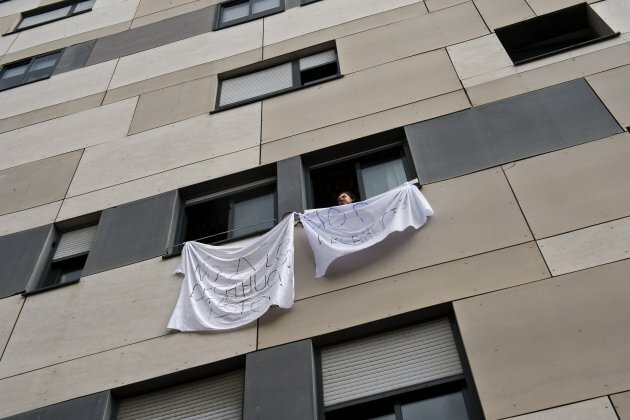
A woman waits for the police to come for her eviction in Madrid earlier this month (AP Photo/Daniel Ochoa de Olza)

PAH this month succeeded in getting parliament to consider a new law, backed by a petition with 1.4 million signatures, to end evictions and let insolvent homeowners write off their debts by surrendering their homes.

Over the past four years the movement has campaigned by turning up in crowds outside the homes of evictees and sitting on their doorsteps to try to stop police and bailiffs throwing them out.

It says it has blocked nearly 600 evictions – in various cases, like the Branas’, securing a deal for them to stay and pay rent.

Joining the rebellion, unions of locksmiths and firemen have started refusing to help bailiffs open the insolvent homeowners’ doors.

“We were leaving families with children in the street. We ended up acting as executioners,” David Ormaechea, president of the Locksmiths Union, told AFP.

This month in the northwestern city of La Coruna, firefighters were called to help evict an 85-year-old woman who had defaulted on her rent.

A crowd of protestors gathered outside the apartment to block the eviction. When the firefighters arrived they refused to open the door and some of them joined in the protest.

Fire brigades in other regions have since followed their example.

“The only thing we do is help citizens,” said Pedro Campos, a fireman in Madrid.

“We only enter a home when there is danger inside. Getting a woman of 85 out of her home is not a situation of danger.”

- © AFP, 2013

Read: Europe-wide report says austerity is not working >

Read: Shatter says Troika deal will not increase repossessions >

Read next:

Comments (78 Comments)

  • Our FF Goverment encouraged home ownership, they also encouraged investers, anybody remember section 23? irish people made mistakes no doubt, but our past goverment have a lot to answer for, it was their policys that stoked the fire.

    Reply
  • Won’t happen here ,too many begrudgers.

    Reply
    • Too many keyboard protestors.

      Reply
    • It is happening here!!! http://www.antievictiontaskforce.com/

      Reply
    • @ Charlie Delaney, thank you for posting the link. We are truly one community. Evictions are anathema, they are an obscenity and especially when the residential property market was a huge Ponzi type scheme. Irish people may be slow to mobilise, we may not like to stand apart but what may start as a minority position may become a majority viewpoint providing the means used are peaceful and do not alienate the potential supporters.

      One of he main issues in Croagh Park II was the unaffordable morgue debt burden.

      Reply
    • “Morgue” debt was intended as “mortgage” debt but it is obvious that my spell checker is vastly more intelligent and insightful than I am.

      Reply
    • Fair play to these brave people!!!
      Fair play.
      As all that our own “fine leaders and protectors” care about, is protecting corrupt/criminal banks and their own salaries and pensions.
      (and the fact that their spoilt stoogeen kids will pick up some cheap repos, so that they can build their buy to let portfolios on the quiet)
      Snout nosed Sleeveens.

      Reply
    • There are approx 150,000 distressed mortgages in Ireland.
      Noonan, Honahan, Kenny, Elderfield, Farrell, Reynolds and Co make their veiled threats on Repos, trying to shake out a few bunches of keys from the odd weak and ill informed homeowner.But do you really think that these soft handed, pale faced conmen have the guts or the resources for violent mass evictions???
      Come on schiesters let’s see what you’re made of!!!
      Bring it on!!!

      Reply
  • Here is an interesting video from the UK “THE PEOPLE v THE BANKS: Conviction beats Eviction” its a bit long – 28 minutes, but worth watching. http://www.youtube.com/watch?v=FPKOa-5GPPg

    Reply
  • Successful forcible evictions require the assistance of An Garda Siochana, Solicitors, Court Officials, Bailiffs and others. Any person who collude in removing a distressed borrower and their family from their home should be deeply ashamed of themselves.

    Do we support our fellow citizens. Will we show solidarity?

    There are many legitimate and lawful ways to frustrate these evictions. The methods go the Irish Land League can be adapted and improved by Social Networking, information exchange, video recording evictions, monitoring repossession sales, lawful picketing, embarrassment campaigns, published league tables of the main offending banks, peaceful demonstration and these measures can be applied at each stage of the process.

    Do not enrich yourself on the backs of the misery of others. You are better than that.

    Reply
    • Yes let’s all be responsible for the poor financial choices of others.

      Reply
    • @ Eric De Red, yes, the poor financial choices of the greedy bonus driven bankers, the Central Bank of Ireland watchdog that was turned into a lapdog by the IBF and by the disastrous economic policies of the Government and its pro cyclical policies. Those who are responsible, not the trusting borrowers, should be held to account.

      Do not victimise the victims.

      Reply
    • You haven’t answered my question. Infuriating as it is, blame isn’t going to get us out of this although I agree that an example could be made of those responsible. But why should the hard pressed taxpayer bail out another group of people who borrowed too much?

      Reply
    • Eric De Red.
      Blame?
      The banks acted criminally/fraudulently.
      Just because the government are currently colluding with them in this criminality/fraud, does not mean that this case is closed.

      Reply
    • Those are just slogans. No bank tricked anyone into taking out a mortgage. The banks made bad business decisions in lending too much to people who should never have been allowed to borrow.

      Reply
    • @ Colin C , ahh, you are not familiar with the over valuations of residential property by Bank commissioned valuation reports, the insistence that borrowers borrow more than they sought, the hook in incentives, the bonus driven pushing of mortgages and the collusion of the Banks in pumping up the residential propery market, the 100 per cent and above lending, the high pressured selling of extortionate loans on excessively priced property, the initial lower interest rates, then hiked up, interest only mortgages for the first five years, the add ons of lending over 20 years for short term consumables, 40 year mortgages to 50 year olds and on and on. Look back on the old brochures.

      Long queues outside new developments, banks doing investor packages, banks sponsoring property shows and television marketing of excessive loans. The Banks were willing participatory in the giant Ponzi scheme.

      There is so much else that can be said on the role of the banks in exploiting the natural and ingrained wish of the Irish to own their own homes when rental laws are so disadvantageous to tenants.

      Who were the supposed experts on lending? It was supposedly the banks.

      Reply
    • Colin C 02/03/13 #

      Richard, I have no doubt you are well meaning and sincere. but the problem here is that there really are no “banks”. The banks are now just a front for us, the taxpayers. You can argue all you want about what the government and the banks should have done with bond holders etc., but we need to deal with the reality. You want to transfer a massive amount of money to those who were lucky or prudent enough not to have been caught in unsustainable debt. I bought my house 1 month before the market peaked. I am in negative equity, but I can afford my mortgage because my wife and I decided that it was not a good idea to take on more debt than we could manage. That same month, there are people all around me who bought bigger houses and are now struggling. Now, you want me, as a prudent taxpayer to have my taxes raised, not to pay for health and education, but to let these people off the hook. That is the bottom line.

      My suggestion is to get people out of houses they couldn’t really have afforded backin 2006, and downsize. If they want to get debt relief, then the asset has to be liquidated, and rented back if necessary. Note that there is a big difference between eviction and repossession. I don’t want anyone out on the street. But I want people to take responsibily for their own affairs and stop knocking on my door to pay for their mistakes as well as my own.

      Reply
    • Colin C 02/03/13 #

      Sorry, transfer “from”, not “to”.

      Reply
    • Very well said Peter
      After all there comes a time in every ones life where they will think of the choices they have made , make sure you can live with your conscience.

      Reply
    • @ Colin C , lost my comment while posting it. I will keep this shorter.

      The money over lent by the banks is largely gone in the sense that it is irrecoverable. The measures proposed will not release much capital, debt to rent will not produce capital to reduce debt and will only transfer title in diminishing value residential properties to the banks. Can’t pay is its own defence and trading downwards won’t release enough capital to have a meaningful impact on the solvency of the banks.

      If families are dispossessed, this will have a devastating impact on the last vestiges of confidence.

      It does not harm me to seem my neighbours left undisturbed in their homes. I do not want to see them dispossessed. This is my line. It would be intolerable for me to see repossessions and evictions. I will oppose that by radical measures. I want to see the end of the old society, Ahern,, Cowen, Dunne, Fitzpatricjk, Neary, Fingleton, Hurley, and others.

      I just don’t see how the middle ground or any similar solution can fix the crisis. It can’t be fixed. We can only try to ameliorate the consequences.

      Reply
    • Colin C 02/03/13 #

      You want me to pay for bigger houses than I have, for people who couldn’t afford them in the first place who could have bought smaller homes. They have the option to downsize. If my taxes are to be raised, I want it to be spent on health and education, not more bailouts. At the end of the day, my “radical”response will be to leave this country to try to live somewhere where my taxes are not being handed over to private individuals to pay their debts as well as my own.

      Believe me, there are a lot of us who feel this way. We’re willing to pay what’s needed to keep roofs over our fellow citizens heads, but we are not willing to fork out for them to hold on to retain sizeable assets. That is a reasonable balance. Your approach is not economical, just or sensible.

      Reply
    • Colin C, I took the time to read over all of your comments because U had a feeling that I might be missing something. I am clearly missing something because I fail to see how any of your measures will practically improve or mitigate the mortgage debt crisis in any way or help to shore up the insolvent balance sheets of the banks.

      I can understand your emotional resentment that when the musical chairs stopped, some were left in the position of being in homes larger and more luxurious than their reasonable requirements. These houses have become proverbial money pits and the owners are certainly paying the price.

      I would support a trade down solution but the problem is that under current law this is unworkable because of the need to be able in most cases to redeem your mortgage out of the proceeds of sale. Even if a less than full redemption is carried out the deficit is carried over and renders the purchase of a smaller home in a less attractive location unviable.

      Higher spending on health and education will require higher income taxes on Scandinavian lines. I am a Social Democrat and would support that but I accept that this is a minority view in Ireland.

      The point that you are not addressing is that the over lent money is lost, gone, spent on vastly over priced assets.

      As for emigration, most emigration is involuntary but some is voluntary in the sense of escaping the noose of excessive mortgage debt. It is one solution, a drastic one.

      Of course if you are in negative equity as you say, you will not be able to clear your mortgage debt if you emigrate but you could rent your home or else abandon it. I would be reluctant to try to persuade anyone not to emigrate. It has occurred to me to do so but I propose to sit it out here in he hope that at least our values will improve now that the dosh is gone.

      The reality which I am confronting is this. The damage is done. That is unjust, it is unfair and it is uneconomical but it is sad and inescapable reality. The solutions proposed don’t do anything appreciable to enable the over leveraged banks contract their lending exposure. Focusing on the unfairness of someone having a nicer home tan yours which they can’t now afford is not contributing to dealing with the reality and the consequences if that inescapable reality.

      Reply
    • Colin C 02/03/13 #

      Well then, where we agree is that downsizing is a solution. In the example I gave, I believe the debt is unsustainable and unfortunately the taxpayer via the banks will take a hit. It’s only a question of when. The only area where we appear to differ is that you are absolutist on no repossession. I believe my neighbour should go into a bankruptcy process where they emerge in a few years with a clean slate, with a roof over their heads then, and until then. But if I, as a taxpayer am going to take that hit, then so does the owner of a large asset. This is a reasonable compromise which is ruled out by your “no repossession” dogma.

      My view is that we must have personalised solutions that involve everything from simple mortgage extensions, to bankruptcy and repossession. There are a lot of solutions in between. This is not emotional. This is logical and sensible. Believe that it is your “no repossession” mantra, and mixing images of famine evictions with stories of modern repossession that is the emotional one.

      Reply
    • @ Colin C (re: your opinion of my comment)
      I’m sorry I have to disagree, they are not slogans.
      These bank’s traded while insolvent and broke liquidity limits/laws (an offense that carries a prison sentence).
      On a more human level, they are directly responsible for thousands of financial stress related suicides and depopulating the country faster than the famine.

      As we have this conversation here tonight Colin, there are children going to bed hungry because of the acts of these criminals. Many have done so for the past 5 years.
      5 years ago, our government went into the houses of
      the Developers, Bankers, Bondholders ex TD’s and Senior Civil Servants
      and using Irish taxpayers funds
      they made sure that all of the above conmen were ALRIGHT FOR CASH, so that they could BALANCE THEIR BOOKS.
      When is Noonan and Co. going to go into the homes of young native Irish families (the victims of these banks) and ask if they are O.K. Colin??

      Just to note Colin with all the €10′s of Billions spent on these criminal banks. No homeowner has got a write off yet.

      Whatever about you and your neighbors in your €700k per house enclave.
      We are talking about the majority of people here.
      People with 100k-250k mortgages and in many cases a lot less.
      People with basic mortgages on basic homes.

      Be grateful for your health and situation Colin.
      I for one will not kick decent average honest Irish families when they are down.

      Reply
    • Colin C 02/03/13 #

      I’m not kicking anyone when they’re down. I’m ok with debt write down off, but not where the person retains the asset. I am all for people having homes to live in. What you write is all mummy and apple pie stuff. The Irish state could not afford the bond holder bailout, and it sure as hell cannot afford another wholesale homeowner bailout on top of that. Of course we will take another hit as some homeowners will have to get write downs. Recognising the need to do that is just recognising what is an inevitability. I think I.ve written all I can above on why. End of day, I have huge sympathy for people in trouble with their mortgage. I know I.m lucky in some ways, and very unlucky in others. I’m down hundreds of thousands, but I can still afford my mortgage. What this problem needs is realists, and while I don’t think the politicians have it completely right, neither do you. The reality is that there is not enough cash in the country for wholesale write downs, and Europe/IMF is not going to lend it to us for that purpose. But I do agree we wouldn’t be in a much better position if it were notmformthe madness of September 2008.

      Reply
    • Colin C 02/03/13 #

      Oh, and I am not in an 700 thousand euro house enclave. I paid nothing like that for my home. This particular couple did, and they had no need to. They were not “just trying to buy a home”. this was full Celtic tiger madness.

      Reply
    • Thanks for your input Colin.
      However your proposed solutions (that might suit your fortunate situation) are just a tad bit protracted and about 5 years too late for the half a million victims of these heinous criminals.
      And maybe just a tad bit difficult for a useless bunch, of over the hill, self serving, bankerpuppet politicians to administer for the good of the Irish People.
      Did you ever consider politics, banking or even bank regulation as a career Colin?

      Reply
    • @ Colin C, you are not engaging with my points and you are ignoring that the damage is already done. Your proposals simply don’t provide a solution. Downsizing will not repair he gaping Titanic holes in the Balance Sheets of the Banks.

      On your accusation of emotionalism, you are incorrect. The emotional element is the fear that someone might, by getting assistance, end up with what you perceive as a bête deal. I regard involuntary repossessions and evictions are equivalent. Reposessions are when an owner loses their home. Eviction is when a tenant loses their home. The end consequence is the same. I am not emotional. My objection is a moral and principled objection to the criminally irresponsible lenders adding to the misery by punishing the victims of he very crisis which was created by the banks. The banks mugged home buyers on the initial lending. This should not be repeated. I note that you have not even attempted to rationalise how your measures will improve the situation. They won’t. But let not repossessions worsen an already dire situation.

      The difficulty here is that you think that mortgage to rent schemes, forfeiture of ownership, transfers of title to homes to banks will address the problem. They will not have any appreciable effect. The problem is too great in scale and depth. The market was dishonest to start with.

      Why should the victims lose even more having being scammed in the first place?

      There is also the qualitative danger of social exclusion, social disruption, undermining of the sense of security of families and the associated problems of stress and family decay.

      Bankruptcy and repossession may make you feel better but these are not solutions or even partial solutions. Repossession is cruel, useless, unnecessary and hugely damaging. Spain shows us the way.

      As for others sitting in a better home than yours, you need to get over that. This emotion is colouring your entire perspective and obscuring your insight into this terrible mess.

      Reply
    • @ GatheringYourMoney, I wish that I could have expressed my points as cogently, concisely and as effectively as you have. The Banks acted fraudulently and criminally as you rightly say and they should not be allowed evict distressed borrowers.

      The practical consequences of mass repossessions have not been thought through by the supporters of these harsh measures.

      I favour people before banks, people before politicians and people before authority and institutions.

      Reply
    • Thanks Peter.
      It’s just so disgusting seeing decent Irish people being tortured into early graves by criminals and the government that supports them.
      And it’s even more disgusting seeing these unfortunate people’s neighbors ignorantly cheerleading this vile travesty.
      Although I think most people deep down would prefer to see their friends, neighbors and family members in good health and free from this torment.
      All the best.

      Reply
    • @ GatheringYourMoney, I fully endorse what you say. It is depressing to see people who should feel outraged by what has been perpetrated by banksters and their allies supporting such cruel and unfair policies. I notice that those who support repossessions selectively take a few exceptional cases, Shane Filan, but will not accept that may ordinary, average and innocent borrowers deserve our collective support.

      You make a very good point that deep down most people don’t want to see their neighbours in misery. Voluntarily Changing home is a very stressful experience. I can’t even start to imagine how it must feel for a family to be forced to lose their home. To lose it because a fraudulent bank is pursuing its pound of flesh pours acid into an open wound.

      Reply
  • Any person in Ireland who buys a repossessed home knowing the the previous owner was evicted shows a complete absence of social solidarity and decency.

    We have organised a group of 23 individuals, more to follow, and we will peacefully record the details of such buyers, collate public domain information on them and post the information to a website hosted outside of Ireland by a non Irish group who have agreed to provide this facility. There will be a list of the top 10 each week.

    A retired solicitor is to help us obtain the title transfer details. This will be public domain information. There will be no breach of Data Protection legislation and full access will be given so as to ensure records are accurate and up to date.

    Persons who buy at public auctions will be photographed. Their photos, occupations and details will be posted.

    I urge people not to buy an eviction home from a bank or lending institution.

    Reply
    • Yes Peter, let’s dump this problem onto the taxpayer. Who do you think will have to pay for all the mortgage defaulters, whether they are so because of no fault if their own, or sponges who think the world owes them something?

      Reply
    • @ Eric De Red, repossessions and evictions will not provide a solution and will actually exacerbate the problem and accelerate the current recession. Flooding the market with repossessed property will solve nothing. It will drive down property values, still over valued, further but it will do nothing to repair the insolvent balance sheets of the banks.

      The measures which will have some efficacy are:

      1. Aligning mortgage repayments to a sustainable level.
      2. Avoid a glut of vacant repossessed homes.
      3. Don’t flood the rental market with desperate families seeking to rent and thereby increasing rents due to increased demands.
      4. Properly assess capacity to repay and seek the maximum reasonable level of repayment. This will have to exclude Property Tax. Better some repayments than no repayments.
      5. Change mortgage law so that anyone who leaves a repossessed home, is absolved of the unpaid balance of the mortgage, effectively the US system of foreclosure.

      The problem is that the damage is done. The Regulator, the Central Bank of Ireland, totally failed in its prudential regulatory function, read Fingers, read Anglo Irish Republic etc. the mortgage impairments of the Banks are such that they already need a second bail out.

      The difference between us is that I don’t blame the vast majority of the home borrowers. They were suckered by a sick Ponzi Scheme. NUI Maynooth has done a supercomputer economic analysis of this. Irish residential property prices were inflated by a factor of between 4 to 6 times their supply demand value has there been a properly functioning market. This topic alone could consume a 600 page treatise.

      The Banks and the CBI who created this problem are the culprits, not the unfortunate borrowers or the taxpayers.

      I was lucky to have bought before the great madness but my heart goes out to the victims who bought since 2001 especially. They have been put into penury through no fault of their own.

      The residential property market was fraudulent. Even today, after Alsops auction results residential property prices are still higher than commercial property prices as a multiple of rent. Crazy.

      Stand firm against compulsory and imposed repossessions. It is time for us all to support each other. The Banks, the Government, the Regulators and most politicians are not friends of the people. They have their own agenda. Now is the time for altruism and even idealism. I’m all right Jack is not a sensible policy.

      Every family evicted damages us all. Evictions did not provide a solution in Spain. Evictions will not provide a solution in Ireland. We need to pull together.

      Reply
    • I agree with your analysis of how we got into this mess just not how we will get out of it. If we offer everyone in financial trouble a free pass we will bankrupt the banks and the country along with it. We have already done this when we bailed out the bondholders. You advocate that we should do this again?

      Reply
    • @ Eric De Red, there is no solution because the problem is too great and was allowed fester for too long. The challenger is not to make a dreadful situation even worse.

      No one can or will get free passes. The victims have already lost and lost very badly. They have lost such equity as they contributed to their homes, the improvements, the vast expense in continuing costs because a spatial strategy was not implemented, unsuitably and poorly specified housing in unsuitable locations and no prospect of an exit unless they abandon their homes and escape abroad.

      There was an unholy and indecent alliance of politicians, greedy developers, irresponsible bankers and lapdog regulators, all feeding hungrily from the trough.

      We are all collectively stuck in a terrible mess and the only sin of the victims is that they were induced into paying extortionate prices for their homes. The solution is not to cripple further these victims. We have seen the Spanish suicides, the destroyed families, the consequences of social exclusion.

      Now we should not be expected to stand idly by as the banks which were permitted to destroy us, pick like vultures on the carcasses of those who they have financially destroyed.

      Enough is enough. We must stop our fellow citizens from being further victimised. The Government and its experts have no special insight, no infallibility, no special wisdom and no ability to construct a solution for this intractable crisis. Repossessions will wreak further devastation and will indirectly lead to the final destruction of the banks. Tempting as that is, the price is too great.

      I warned the Government of this incipient crisis in 2003 , again in 2007 and then from 2009 onwards I wrote to all TDs. Sadly, most people think conventionally and about what appear to be “obvious” solutions but these so called solutions will not work.

      If you study the Quarterly Reports , Statements of the Banks, which include the mortgage impairments reported to the Central Bank of Ireland, you will easily identified that the true scale of the problem is not yet identified.

      The problem will worsen and the Banks are already insolvent in a true sense.

      It is time to draw the curtains on the days of greed.

      Reply
    • Colin C 02/03/13 #

      Peter, I’m one of those who bought in the boom, and doing everything I can to keep the mortgage payments going out every month. I’ll be fckd if I’m going to be paying for everyone else’s oversized houses as well. Seriously, the Irish taxpayer has already paid for enough mistakes. At some point people need to take responsibility for their actions, and not pretend they were all pushed into taking out ridiculous mortgages. Restructure debt, write-off a portion if it’s less costly than repossession, or repossess and rent back. Those are the options for those who cant afford the house they live in. It’s sometimes harsh, but nobody is going to be offering mortgages in this country if everyone knows that debtors can walk away when it suits. We also need a functioning mortgage market, and unfortunately, that requires that repossession is a last resort.

      Reply
    • @ Colin C, I have sympathy for your predicament and the only solution is a coherent and weighted mortgage debt attenuation programme, which discriminates according to need and circumstance. There may be a few anomalies in such a programme but he overall effect will be beneficial.

      The problem in this noughties period was the collaboration of the banks, regulator, politicians and professionals in an asset bubble which was inflated more and more to bursting point. Irish residential property prices are still vastly over priced if you take a multiple of rental values. This was an exceptional period of gross and dishonest conduct in the mortgage market and that is why exceptional measures are required to alleviate the effect and consequence of over lending.

      We have to do a debt recalibration based on capacity to repay or else this mill stone of mortgage debt will give us a two decade recession.

      I appreciate what I am suggesting is counter intuitive but flooding the property market with repossessed homes will only help the scavengers and the vultures.

      Reply
    • Colin C 02/03/13 #

      Whatever a weight mortgage debt attenuation program is, at the end of the day I know money will be taken from me, and given to some less prudent. Probably those living in the bigger houses around me.

      Reply
    • @ Colin C, if you borrowed heavily during the boom, you might actually benefit from a mortgage debt attenuation scheme.

      What were called the Pope’s children need inter generational support and that should come from those who were fortunate to buy in the previous decades.

      Leaving a large number of families submerged in mortgage debt for the next 20 to 30 years is going to have a hugely adverse impact on the economy.

      It is possible that some households may unfairly benefit but the resentment of others getting a perceived advantage is inhibiting a sensible and pragmatic solution for the benefit of all. We don’t want a second Japan.

      Reply
    • Colin C 02/03/13 #

      Probably not Richard, because in trying to deal with my negative equity, I had been trying to pay down the mortgage a bit faster. Something made possible by the fact that I didn’t over stretch in the first place. Now I realise I might have been very stupid, and would have been better off spending the money on myself while I waited for someone else to pay my debts.

      What people need to realise is that losing ownership of an asset you probably could not have afforded in the first place is not the end of the world. If it’s rented back to you, and residual debt is written off through bankruptcy, then that is a good result in the circumstance. What the general populace will not tolerate is seeing people hold on to huge assets while getting debt write down, and maybe even selling on that asset in a few years with no clawback on the write down. All of this while health and education budgets are being slashed and taxes are rising.

      The solution is not repossessions or no repossessions. It’s somewhere in between. Repossession has to be an option to prevent people going from cant pay to wont pay.

      Reply
    • @ Colin C, lucky you. I could never afford to accelerate my loan repayments. I could never afford to do it however hard I tried. You are in a very fortunate position. You should keep doing that and unlikely most of the victims you will eventually own you’re home free of any mortgage. That is your shrewd financial planning and you should feel happy about that. You are one of the wise virgins.

      There are very few, if any, won’t pays, the strategic defaulters. A MABs counsellor showed me a useful technique, a ratio, for discerning a voluntary non payer but she said that so far they have not come across one of the mythical strategic defaulters. We hear of them but there is no empirical evidence that they actually exist.

      My focus is on he practical side. In time perhaps those people who were scammed may have to pay the price by having a partial loss of ownership but that does seem a horribly cruel consequence for being suckered by the experts. There is a lot of “well, that’s just your hard luck, buddy” around these days.

      Reply
    • Colin C 02/03/13 #

      It’s not lucky me, at all. I am down 100′s of thousands. This is a true story. Anonymous for good reason, but if you care I will show you the exact house for sale on daft right now. A neighbour of mine built an enormous house when I bought mine. Valued at one stage at over significantly 700 thousand (being vague here for privacy reasons). We couldn’t figure out how they were affording this, as we new what jobs they had, and in fact one of couple was a pretty ‘casual’ worker, shall we say. Even when the economy was booming. Now, I believe they are in trouble. The house is for sale, but they have not reduced the asking price in 3 or 4 years. They’re asking boom prices for it, presumably to try to cover the mortgage debt. Now, in your world, my taxes should go to relieving their debt while they continue to live in an enormous house. And in a few years, when I have paid every cent of my mortgage, they get to sell it on and ride off into the sunset? Seriously? Again, I don’t want these people on the street. No financial mistake deserves that. But they could easily rent a very reasonable property in the same location at a fraction of their mortgage. Why should I or any tax payer pay for them to retain such an enormous asset, when they were the reckless ones, and they have reasonable options?

      Reply
    • @ Colin C, you are lucky in the sense that you have true security of tenure in your home and the day of full redemption is closer than for many others. I have no doubt at all, since you bought near the peak that you can only be down many 100s of thousands. Like many others you were suckered into paying vastly more than the true worth of your property and most of the rest of us were or would have been suckered likewise.

      As for your unwise neighbours, they are lumped with a massive mortgage. They don’t have much option open to them but it is humanly understandable that they found it hard to reconcile to taking their losses. They are victims, less wise and prudent than you are, but victims none the less and we have to find space in our hearts to empathise with them. One thing is sure the Bank will not get its loan back or anywhere near it. This is just one example of so many examples of how the Banks have a massive insolvency problem.

      The damage is done. Now we are seeing the increasing manifestation of that damage with countless instances of real misery. The point is that the damage is irreversible, even in the real life and no doubt accurately stated example. The financial neutron bomb has exploded. Now we can only try to lessen the severity of the impact on the victims.

      Reply
    • Whats up Mr C.
      Are you P**sed off because you were stupid enough to use your own money to buy into this Ponzi Scheme?
      Although you probably “forgot” to mention that you “won” your large deposit out of the same Ponzi Scheme in the first place.
      Should have held onto your winnings while you had them Mr C.
      Tut
      Tut
      Tut

      Reply
  • Will 02/03/13 #

    Free stuff for everyone, yay!

    Reply
  • I WONDER, WHEN WE WILL START SAME THING IN IRELAND???????? IT’S ABOUT THE BLOODY TIME HERE!

    Reply
  • bigmac 02/03/13 #

    But its a short victory because banks can still flip the apartments at auctions (they sell the flat at a 50% discount and the person still pays the bank the rest of the mortage) or hold.onto it have it valued at full market value to recieve the bail out and the person still pays the mortgage so for the banks its a win win situation, but nothing about the suicides in the last evictions or the retired oaps.who went garontor on their childrens mortgages and now are being evicted, or look up the “preferentes” case where banks sold toxic products to their customers as savings plans and their money is locked up forever or as private shares in the banks and are worth nothing, they are classed as investors so have.no rights as customers

    Reply
  • Tús Nua 02/03/13 #

    The banks wrecklessly threw money at people whilst politicians encouraged it and now the crap has hit the fan people who will struggle have been hit wit obscene taxes and cuts so the reality is the banks and goverment are to blame and the struggling home owners are the victims that want to pay the mortgage but the government have constantly stripped any disposable income therefore making it harder so if the government did the right thing and helped them out we wouldnt have this problem and people like STEPHEN CHURCH wouldnt be here trolling everybody

    Reply
    • Colin C 02/03/13 #

      ‘Threw money’. Welll, personally I wasn’t offered a mortgage until I walked in and applied for one.

      Reply
    • I received many unsolicited offers of loans from Bank of Ireland and AIB. Permanent TSB offered to give me a increased consolidated mortgage and I was told that I could get a very high multiple of earnings because of my employment. As an old fellow looking at being squeezed out of my job due to age, I declined.

      I know people who obtained loans of 8 times. Gross earnings. That was criminally reckless.

      Irish residential property prices were not a function of supply, demand, availability, earnings, rental value but were a function of grossly excessive lending by irresponsible bonus driven bankers. None of he old style bank managers would have contemplated this kind of lending.

      Reading Fingers today. Yikes! It was far worse than I thought. Pure greedy madness. It makes me realise the correct spelling of banker is *anker.

      Reply
    • Spot on Peter.
      I personally know 2 single people in 2 different instances who obtained 10x times their income mortgages from Ulster Bank.
      This was common practice in our local branch.

      Reply
  • So her and her husband and 3 grown up children get 420 a month in benefit, and the new rent for her home is €350 a month.

    And she’s saying that its still a worry.

    Unless my sums are wrong she has €2100 coming into the household with the primary outgoing being €350, ie 16% of the households income – translating to a ‘mortgage’ repayment of 16%.

    The family will be struggling obviously, but she has got a hell of a result here.

    I’m sure a lot of Irish families dream about having a deal like that.

    Reply
  • Mortgage victims, come on who comes up with this stuff.

    Its peoples own fault if they cant afford their mortgage

    Reply
    • Your right Stephan because people’s pay hasn’t been cut,taxes haven’t risen and new levies/charges haven’t been introduced.

      Reply
    • Caboose 02/03/13 #

      Too young to remember the boom years I suspect.

      Reply
    • That could be the most stupid comment I’ve read on this site.

      Reply
    • Medication time stephen.

      Reply
    • I would b too young to have got caught up in the boom and property, the way I look at it is I had a lucky escape. You can’t blame people, wanting to have a home or even someone investing in a small portfolio of properties. If it is someone’s family home, then no even I can see that they were tricked by a culture that was in Ireland at the time.
      Now I do have a problem with the property developers lent millions and millions by the likes of Irish nationwide and the rest and we all picking up the tab. If I’m picking up the tab for them, I don’t mind a bit of relief for me fellow citizen in poverty for helping out all these banks.

      Reply
    • I had work during the boom and I reckon someone else in my position would have tried to get mortgage despite the fact it was a go-nowhere job with a company who operated like it was the 1980’s. I dont begrudge people who got mortgages however and feel most were unscrupulously persauded by their lenders. I recall looking for a simple 1000 euro overdraft and a bank employee straight away trying to persuade me to get a 5 grand loan. Make the banks wait.

      Reply
    • Stephen, you either don’t understand economic cycles , or you are stupid or you are a troll. I would say most likely, you are stupid.

      Reply
    • @ Justin, I checked out Stephen Church’s comments. His comments merely indicate moderate cognitive impairment, ideological obsessiveness as well as a failure of comprehension. Oops, I am slow. Now I know what you mean by “stupid”.

      Reply
    • Dead right Peter , he’s too thick to be trolling.

      Reply

Add New Comment