TheJournal.ie uses cookies. By continuing to browse this site you are agreeing to our use of cookies. Click here to find out more »
Dublin: 11 °C Sunday 19 May, 2013

My favourite speech: Paul Murphy MEP

Continuing our summer series on TheJournal.ie of public figures’ favourite speeches, Paul Murphy MEP picks a speech by socialist Karl Liebknecht.

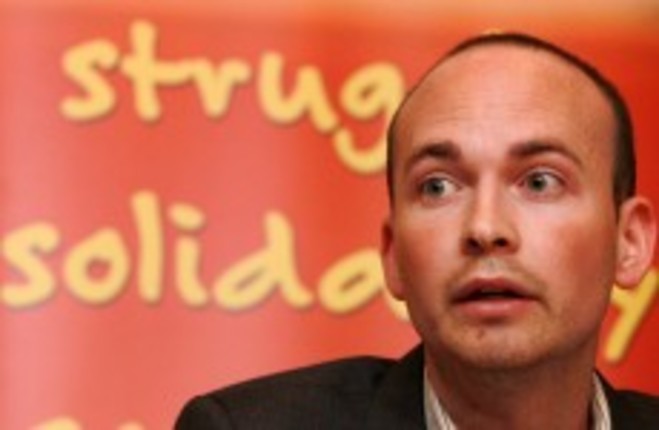
Paul Murphy MEP
Paul Murphy MEP
Image: Sam Boal/Photocall Ireland

THE AUTHOR AND former presidential speechwriter Peggy Noonan once said: “A speech is poetry: cadence, rhythm, imagery, sweep! A speech reminds us that words, like children, have the power to make dance the dullest beanbag of a heart.”

One can not underestimate the power of a good speech or the effectiveness of a speech’s key line.

With that in mind, over the course of the summer TheJournal.ie is asking some of the most prominent figures in Irish society from politicians to sports stars to nominate their favourite speech of all time and tell us why they like it so much.

Today: Socialist Party and United Left Alliance MEP for Dublin Paul Murphy. He writes:

In December 1914, socialist Karl Liebknecht wrote a speech explaining why he voted against funding for World War I. This speech was never delivered, being banned by the President of the Reichstag, was not printed in the Parliamentary report and no German newspaper published it. Instead, it was printed as a leaflet and distributed within Germany.

It is a seminal speech because this is at the start of World War I, a war waged in the interests of the various imperialist powers in which over 16 million people died. Across Europe, workers’ parties like the SPD in Germany and the SFIO in France, supported their ‘own’ capitalist classes.

They all justified this with reference to ‘defence of the fatherland’ or ‘defence of democracy’ when in reality it was a capitulation to national chauvinism and a betrayal of their internationalist principles.

This betrayal shocked revolutionary socialists such as James Connolly, Scottish socialist James MacLean and Lenin, who thought that the edition of the SPD’s newspaper announcing their support for the war was a forgery.

With betrayal all around him, Karl Liebknecht stood firm. He argued against supporting the war within the SPD at the time of the first vote on 4 August 1914, but then mistakenly obeyed party discipline and voted for the war credits providing funding for the war.

In December 1914, he broke that discipline, placing the interests of the German and international working class before the bureaucracy of the SPD and was the only member of the Reichstag to vote against war credits.

He correctly dismissed the argument that this war was for the ‘defence’ of German people and puts forward the interests of working class people across Europe – to fight for “a speedy peace, a peace without conquest.” He used his speech to appeal to German workers to actively oppose this war.

Although isolated at the time, Liebknecht’s stand was heroic and absolutely vindicated by the barbaric results of the war. Outside the parliament he engaged in vigorous activity together with other genuine socialists opposing the war, raising the slogan “the main enemy is at home”.

As the results of the war became clear, he received more and more support for his anti-war position. Two years later, on May Day 1916, he addressed tens of thousands of workers in a demonstration against the war, shouting “Down with the war! Down with the government!” before being arrested.

At the end of the war, with the impact of the Russian revolution in 1917, revolutionary socialist ideas gained a mass audience in Germany with the potential for working class people to change society.

In 1919, Liebknecht participated in an uprising of workers in Berlin. Together with socialist Rosa Luxemburg he was captured by right-wing paramilitaries known as the Freikorps and assassinated at the orders of the SPD government.

Thus, he was ultimately effectively killed by those who had betrayed the German workers back in 1914. He died for his principled stand. However, his actions gave confidence to millions of German workers to struggle for socialist change in the knowledge that betrayal is not inevitable.

Even today, every year in Germany tens of thousands mark the deaths of Liebknecht and Luxemburg on 15 January.


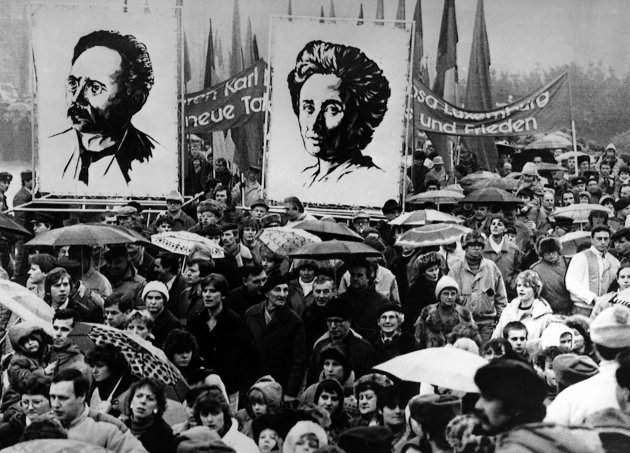
Demonstrators in East Berlin carry portraits of both German socialist Karl Liebknecht and political activist Rosa Luxemburg in 1988, during a protest march against their assassination in 1919. (AP/Press Association Images)

Below is the speech that Karl Liebknecht delivered on 2 December, 1914:

My vote against the War Credit Bill of to-day is based on the following considerations. This War, desired by none of the people concerned, has not broken out in behalf of the welfare of the German people or any other. It is an Imperialist War, a war over important territories of exploitation for capitalists and financiers.

From the point of view of rivalry in armaments, it is a war provoked by the German and Austrian war parties together, in the obscurity of semi-feudalism and of secret diplomacy, to gain an advantage over their opponents. At the same time the war is a Bonapartist effort to disrupt and split the growing movement of the working class.

“The German cry: ‘Against Czarism!’ is invented for the occasion – just as the present British and French watchwords are invented – to exploit the noblest inclinations and the revolutionary traditions and ideals of the people in stirring up hatred of other peoples.

“Germany, the accomplice of Czarism, the model of reaction until this very day, has no standing as the liberator of the peoples. The liberation of both the Russian and the German people must be their own work.

“The war is no war of German defense. Its historical basis and its course at the start make unacceptable the pretense of the capitalist government that the purpose for which it demands credits is the defense of the Fatherland.

“A speedy peace, a peace without conquests, this is what we must demand. Every effort in this direction must be supported. Only by strengthening jointly and continuously the currents in all the belligerent countries which have such a peace as their object can this bloody slaughter be brought to an end.

“Only a peace based upon the international solidarity of the working class and on the liberty of all the peoples can be a lasting peace. Therefore, it is the duty of the proletariats of all countries to carry on during the war a common Socialistic work in favor of peace.

“I support the relief credits with this reservation: I vote willingly for everything which may relieve the hard fate of our brothers on the battlefield as well as that of the wounded and sick, for whom I feel the deepest compassion.

But as a protest against the war, against those who are responsible for it and who have caused it, against those who direct it, against the capitalist purposes for which it is being used, against plans of annexation, against the violation of the neutrality of Belgium and Luxemburg, against unlimited rule of martial law, against the total oblivion of social and political duties of which the Government and classes are still guilty, I vote against the war, credits demanded.

Read more from our ‘Favourite Speeches’ summer series

Read next:

Comments (25 Comments)

  • Peggy Noonan said it “once”, thejournal has said it a few dozen times since Easter.

    Reply
  • I would not have much time for the politics of Paul Murphy but I do admire that instead of going for one of the bog standard socialists he pick Karl Liebreckt who was probably one of the sole dissenting voices against WW 1.

    Reply
  • While I commend the journal for doing something different and asking public figures about their favourite speeches, the responses have been cliched and predictable.

    Reply
  • Mr. Murphy needs to learn from some of the mistakes he made during the no campaign. Time to shake-up a little.

    Reply
  • Karl Liebknecht’s speech is partisan and misleads the uninformed as to the real causes of the war. Paul Murphy does nothing to correct this as he uses it to bolster support for his partisan political view. That said, elements of Liebknecht’s speech point at the social upheaval facing all of Europe at that time.

    The Freikorps were the Wiemar Republic’s equivalent of the Black and Tans given a similar free reign and they brutally suppressed the socialist/soviet movements in post war Germany. The real story is allegorical of brutality of the elite which has been suppressed to protect their image. Gullible eejits are easily fooled because of laziness when it comes to the study of history.

    Reply
    • The ‘real causes of the war..’, Blaithin, were imperial competition for resources and British determination to maintain its empire without sunset against the rising power of industrialising Germany. If the speech is ‘partisan’, it is partisan against imperial war fed by the fodder of the dispossessed, in order to further fatten the obscenely obese rich.
      Seems to be the basis of the speech. Whats your version?Methinks the lady protests Mr Murphy(an opponent?) rather than the speech and its content.

      The humiliating ‘peace’ of Versaille contributed to the rise of Nazism, mainly because France insisted on crippling German ambition for a share of the global spoils. Britain and the US were more ready to allow the Nazis join their WASPish club(as they now have, Germany being increasingly engaged in the resource-wars of the 21st).

      The Great Game continues today under the rubric of the Project for a New American Century, a fair translation of sunsetless empire into the foreseeable future..or even millennial reich.

      Reply
    • ..and lazy historians namecall opposing interpretations as ‘gullible eejits’..rather than offering evidence of a possible misread..which every history student is capable of.

      Reply
  • Meaningless speech appeals to meaningless MEP .

    Reply
  • WWI and the misery it caused turned people to communism.

    So while Liebknecht and Lenin opposed this sort of thing, they had no problem benefiting from its results.

    Reply
  • Opposition to WW1 may have been a good thing, his commie desire to fight a war against society wasn’t.

    Reply
    • It was not a war against society..its capitalism that announced ‘there is no such thing as society’, remember.
      Unless you consider the High Society of social parasitism to be ‘society’.

      Reply
  • He picked a safe speech…easy to do 100 years later. Typical politician.

    Reply
    • Typical politician? How many politician do you know that are not welcome in a dictatorial country for supporting workers struggle and strike, that are jailed in a foreign country for solidarity with the hungry and poor, that goes to workers meetings and demonstrations to call for international solidarity of the workers and poor – and gets the average worker’s wage for doing all this?

      Do you know a typical politician like that..?

      Reply
    • Typical politician? How many politicians do you know that were not actually elected?

      Reply

Add New Comment