TheJournal.ie uses cookies. By continuing to browse this site you are agreeing to our use of cookies. Click here to find out more »
Dublin: 16 °C Wednesday 19 June, 2013

Polish archbishop condemns “dangers of pagan Halloween”

Archbishop Andrzej Dziega denounced dressing up as ghouls and ghosts for the 31 October festival as a “promotion of paganism”, and of death.

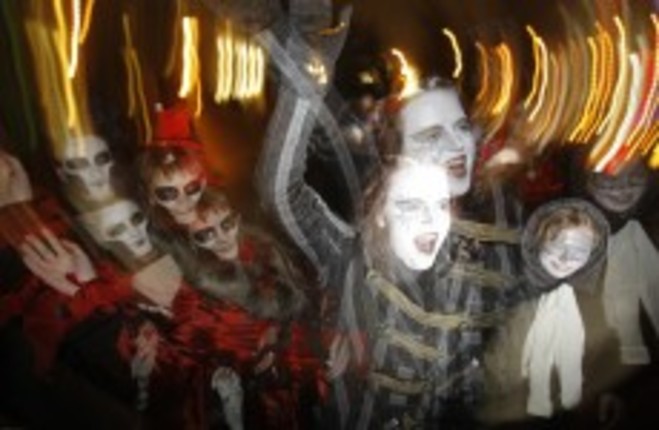
Halloween revellers in Minsk, Belarus last year.
Image: AP Photo/Sergei Grits

WHETHER YOU ARE a school child that loves dressing up like Dracula and scaring neighbours with the threat of a ‘trick or treat’, or an adult that gleefully grabs the chance to dress up as a well-known personality, Halloween is generally perceived as a lot of harmless fun.

However, a Polish Archbishop from the diocese of Szczecin-Kamien in northwest Poland does not seem to see the funny side of this age-old celebration.

Archbishop Andrzej Dziega issued a three-page statement on Sunday – to be read out at all congregations across the diocese – condemning the “dangers of pagan Halloween” and its “world of darkness, including devils and vampires”. It was all very Bram Stoker indeed.

Archbishop Dziega said he was saddened to “see a growing wave of Halloween celebrations in Poland in recent years”.

He said that he was particularly concerned about Halloween activities being organised in schools, which he added could “even destroy the spiritual life” of children.

Halloween celebrations in Polish schools have become increasingly popular in recent years as a new generation grows up with a love for US culture and fashion.

“Promotion of paganism”

Moreover, the Archbishop had less sympathy for adults that might want to dress up in ghoulish costumes on 31 October. Adults did not “understand the spiritual danger” of the event, he said.

The Archbishop added that Halloween was a “promotion of paganism” and the “culture of death”.

Halloween falls just one day before one of Poland’s largest religiously observed bank holidays. All Saints Day on 1 November, or ‘The Day of the Dead’ as it is called in Poland sees millions of Poles pay their respects to their deceased relatives by lighting candles at their graves.

For the Polish Catholic hierarchy, the fun-filled antics of Halloween on 31 October are at odds with the country’s traditional day of mourning on 1 November.

Local online news source ‘Moje Miasto Szczecin’, which published the statement, has been inundated with comments both in support of, and deriding, the Archbishop’s attack on Halloween.

Journalist and film-maker Liam Nolan lives in Poland. His site is at liamnolanmedia.com and he tweets here.

  • Share on Facebook
  • Email this article
  •  

Read next:

Comments (60 Comments)

  • The Polish holiday All saints day ” The day of the dead ” sounds like Halloween to me which is a Irish Pagan festival not American…
    Halloween was where they druids would throw bone in to a fire (bonfire) and what ever way the bones landed or ended up meant a prediction for the future.
    Halloween also was to do with spirits going to the afterlife and the fires were to help with this which sounds like “the day of the dead ” to me.
    The Catholic church couldnt get rid of the pagan festivals properly so they changed their holidays to fit in with the pagan rituals.

    Reply
    • Passage from holybibly.com

      During the Middle Ages (about 600 years ago), the Roman Catholic Church at that time, decided to make the change-over from pagan religion to Christianity a bit easier, and therefore allowed the new converts to maintain some of their pagan feasts. It was agreed, however, that from now on they would be celebrated as “Christian” feats. So instead of praying to thwir heathen gods, they would now pray to, and remember the deaths of saints. For this reason the church decided to call November 1 the “Day of All Saints,” and the mass to be celebrated on that day “Alhallowmass.” In consequence of this, the evening prior to this day was named, “All Hallowed Evening” which subsequently was abbreviated as “Halloween.” In spite of this effort to make October 31 a “holy evening,” all the old customs continued to be practiced, and made this evening anything BUT a holy evening!

      Reply
  • What’s wrong with being a Pagan ?

    Reply
    • Sounds like he’s jealous cos the pagans have nicer gowns this season.

      Reply
    • Not too shabby either for a cult that uses an instrument of torture and execution as its symbol…and whose main celebration centres around a cannibalistic ritual of consuming body and blood.

      I won’t go into their history of burning non-conforming questioners and recycling recidivist child abusers.

      And Varadkar has announced he wants their opinions on the new child protection referendum.

      Look out kids..don’t matter what ya did…

      Reply
  • The Catholic Church is doing a really great job in one area: becoming more and more out of touch with normal people, be they believers or not.

    Reply
  • This bishop thinks that only priests, bishops etc should be allowed to dress up in weird costumes.

    Reply
  • Sure is it not the ones dressed up as priests that most people are afraid of?

    Reply
  • If paganism is so bad, why are most Christmas traditions co-opted from pagan winter solstice traditions?

    Reply
  • Reg 31/10/12 #

    Don’t you just love the irony of Archbishop Dziega!

    Reply
  • Yeah because dressing up at Halloween is a lot more serious than perpetrating/covering up institutionalised child abuse . Seriously what fu*king planet are these people living on??????????

    Reply
  • Mark 31/10/12 #

    Tut Tut! St Patrick encouraged Hallowe’en to continue! It is Irish after all! (A Celtic festival to be more precise) I think they’re just jealous of us abroad!

    Reply
    • It’s considered an Irish/Scottish holiday as it is historically observed by Gaels (Celtic). Scottish people historically come from a mix of Picts and Gaels who formed the Kingdom of Alba. It’s also popular with the Manx who are Celtic as well.

      Reply
    • It’s one of the midpoints, this one being between the vernal equinox and the Winter Solstice. It’s also smack bang in the mushroom season, methinks this may have it’s relevance in the myth that at this time of year the gap between the living and the dead is weaker, which leads into the tradition of Samhain.

      Reply
    • Not just observed by Gaels, Kevin, but also by the Brythons (modern day Welsh, Cornish and Bretons) who know it to this day as Calan Gaeaf in Welsh, Kalan Gwav in Cornish and Kalan Goañv in Breton. And the Manx are not just Celtic, but Gaels as well (albeit a Norse-Gaelic mix).

      Reply
    • @Brian – Gaels are a Celtic people. Irish, Scottish, Welsh, Manx, Cornish, and Breton are Celtic languages. As for Samhain I know most of those countries celebrate Samhain but it is considered an Irish/Scottish holiday and is historically a Gaelic tradition.

      Reply
    • As a Celtic scholar and a speaker of three Celtic languages (Irish, Manx and Breton) I know who the Gaels are. They are one of two current subgroups of the Celtic people. The other group being the Brythons. Each of these countries celebrate Halloween with their own customs. The Manx, for example, have Hop-tu-Naa, while the Welsh have their traditional singing for the Hwch Ddu Gwta (a tail-less black sow) and the tradition of boys dressing up as girls and girls dressing up as boys. Documented evidence shows that the festival was commonplace in Roman times, not just in Ireland and Scotland, but throughout the British Isles and even celebrated in mainland Europe as far south as the Alps (by the various Gallic Celtic tribes). The common theme in this entire area was the lighting of bonfires, celebrating entering into a New Year, and remembering the dead (as it was at this time that it was believed that the gap between this world and the Otherworld was at its weakest). Many of the traditions we have today associated with Halloween are not Irish or Scottish. Pumpkins are the modern day equivalent of the ancient Brythonic will-o’-the-wisp which comes from the ancient Welsh pwca. Bobbing for apples comes from Ancient Rome as the apple was associated with the Roman goddess Pomona. Trick-or-treating comes from all over the British Isles with its origins in both the Irish Láir Bhán and the Welsh Mari Lwyd. Try reading The Stations of the Sun by Ronald Hutton for information on Halloween throughout the British Isles. To say it’s an Irish/Scottish holiday is only partly true. To say it was a Celtic holiday, however, is entirely accurate

      Reply
    • Either way English, Welsh, Scottish, Irish, Manx, Bretons, and Cornish people historically descend from the same people; DNA has shown that our ancestors came from Iberia (what we refer to as the Celts). Which I assume you know. I know it is a Celtic holiday but it is considered to have started with the Gaels (who are Celtic as we have said); regardless if the Celts brought it with them to Ireland or not it’s still an Irish/Scottish holiday. The only reason Halloween was popular in the United States was because of Irish and Scottish immigrants not because of Italians or people from the Alps. I like to believe history when it says it’s a Gaelic/Celtic holiday vs. it goes back to the Romans and now the Italians can claim it as their own holiday. The people of the Ireland and Britain are a unique people and are overall different from the rest of Europe when it comes to culture, traditions, and appearance wise. If one says it’s a Gaelic holiday then therefore it is a Celtic holiday of course. If were going to go back that far then we might as well add African traditions/holidays to the list.

      Reply
    • Actually, it is now accepted in academic circles that the peoples of the British Isles are descended genetically from populations who migrated from Iberia. The Celts, however, were never a homogenous ethnic group. Instead, Celtic culture was simply a culture which was adopted by the native inhabitants of the British Isles and other territories (similar to the way the Irish adopted many English cultural aspects when we were part of the British Empire, including the English language). Celtic culture started in the Alpine region of Switzerland, Austria and France (La Tène and Halstatt cultures). I don’t disagree with you as to the reason why Halloween is today popular. Halloween was originally very popular throughout Britain too but lost its popularity after the early 1600s as a direct result of Guy Fawkes (although it never lost its popularity in Scotland or the Isle of Man). When his plot to blow up parliament failed it was decried as a popish plot. As the Catholic Church had accepted Halloween as a Catholic feast Halloween lost its attraction and Bonfire Night was moved to the 5th of November to coincide with the events of the Gunpowder Plot. If you read what I wrote I never stated that Halloween goes back to the Romans. I simply stated that the tradition of bobbing for apples goes back to the Romans and their Pomona holiday which occurred around the same time as the Celtic *samani and was adopted by the Celtic holiday (in a similar manner to how other pagan customs were adopted into Christian holidays). I don’t see how your “African traditions/holidays” fits in. They may have similar holidays and traditions (I don’t know) but they certainly weren’t at any stage incorporated into the Halloween tradition. If similarities exist then they are more than likely simply coincidental. You say it’s a Gaelic holiday, but that ignores the Brythonic element from which we also get many of the customs associated with Halloween.

      Reply
    • I know that we were influenced by Celtic culture and that they weren’t a homogenous group. Being Irish I still consider myself Celtic; the meaning of being Celtic is associated with the peoples of the Celtic nations. So yes technically we are not Celtic by blood but what we consider Celtic really is are Iberian ancestors. Sorry I thought you were inferring that Samhain is originally Roman. The African comment was sarcasm as humans started out originally in Africa so where do we draw the line on which tradition belongs to which group; that was tied into me misinterpreting your Roman comment. I understand other customs have been added to Halloween but I’m referring to the holiday’s original origins. It is historically Gaelic and is referred to as a Gaelic festival. Just like Kilts are considered a Celtic symbol but they are originally Scottish not Irish regardless of Kilts being a symbol of Gaelic culture/traditions in Scotland.

      Reply
  • …..I fancy a nice cup a tea and a chunky slice of buttered brack after reading that……hope I find the ring :)

    Reply
  • The Catholic Pope said something similar a few years ago about Harry Potter. The cultural disconnect between them and their ‘flocks’ are widening daily.

    Reply
  • I would say that ET was the first exposure the world outside Ireland and the States got of Halloween, it’s been slowly growing in popularity around the world since then, the Simpson’s and various other TV shows all doing their part. When I was growing up even the English didn’t seem to be aware of it, but now it seems be taking over from Guy Fawkes night there..

    Reply
    • It is no coincidence that Guy Fawkes and bonfire night in England is just a few days after Halloween,the gunpowder plot to blow up parliament was regarded as a popish plot. And to demonise the plotters and excuse the Ghoulish method of execution bonfire night (Halloween) was moved to 5 nov and renamed Guy Fawkes .The politics of the day.

      Reply
  • Halloween is Irish so STFU Catholic Church and your dumb archbishop. Long Live Samhain!

    Reply
  • But sure is the Catholic Church itself not a death cult that promotes the eating of their saviors flesh, the drinking of his blood and the teaching that life is suffering and guilt until you die and only then can find paradise.

    Reply
  • ‘The promotion of death’- what a bizarre claim from an organisation that uses an image of a dead man as their symbol.

    I often wonder why they didn’t/don’t use the image of the unrepentant Jesus standing in front of the High Priests instead? Perhaps the focus on pain and suffering is a distraction from a possible other reading of the same story; the one involving principled resistance to conformity and power?

    Reply
  • god bless them pagans

    Reply
  • Catholic church is jealous of the lure of pagan customs. They want to be the only voodoo show in town.

    Reply
  • Get a handle on the paedos then get back to us.

    Reply
  • LOL the CC must feel it’s monopoly on controlling by fear and guilt is under threat.

    Reply
  • I feel an Inquisition coming on.

    Reply
  • These people have little to worry them, that’s all I can say- pity they weren’t so concerned about child abuse!!

    Reply
  • They fight with our tradition since they were introduced to my country by will of the polish ruler, prince Mieszko in X century. Christianity was not as welcomed as in Ireland. There was fire and blood, there was like active 200y of antichristian resistance. Our Slavic customs and traditions survived longer, some are still there. Our day with kinda helloween-like meaning is called day for souls, but christians change name, date a little, and they convert it into christian meaning, that is all saints day. Other name of that day, most original would be Dziady, which mean very old people, in sense ancestors. Main difference is that we, Slavs, had not so much sense of humor, not as much as Celts. It is not as funny as here, and never was. Day or rather night was to call ancestors for advice, support and unity. In exchange food and drink was offered to them. Fire and smoke were transparents of the communication. That was to understand our roots, who we are and where we are from. Certainly not to give tribute to some foreign christian saints. But things changed, very few understand origin of that tradition, even less continue to do it. So for me that bishop is just antislavic roman carholic person, no authority he has over me. But people changed too. 1000 years of catholic indoctrination makes these changes, and now people who kept our tradition longest, these from country side, they recognise superiority of bishops like that one. It makes me sad. So forgive me for what I see there, and that I will celebrate Dziady our old way. I would wish to see in Poland, some day, that there is respect for past and origin of tradition as I see here.

    Reply
  • By the lack of “Catholic” posts can I assume even the Irish flock are embarrased by the silly langer’s comments?

    Reply
  • What are we supposed to do on Halloween, play basketball?

    Reply
  • “The Archbishop added that Halloween was a “promotion of paganism” and the “culture of death”, says old man in a dress.
    They’ve some neck. He talks about a culture of death, but many christians believe in god because they want to go to heaven, when they die. This is the main selling point. Eternal bliss, re-united with loved ones.
    If something sounds too good to be true, it generally is. Case in point: e-mail scams involving ‘inheritance’ and some of your money up front to process said ‘inheritance’.
    A fool and his money are easily parted.

    Reply
  • As my lord god Shane McGowan has decreed, f youse all

    Reply
  • “Halloween falls just one day before one of Poland’s largest religiously observed bank holidays. All Saints Day on 1 November”

    How odd. Halloween is on eve of All Hallows day.

    Who really needed that pointed out to them?

    Reply
    • Barry 31/10/12 #

      Of course they forgot that they merely created all saints day to try and take away from Halloween, but it never worked and they are still crying about it :)

      Reply
    • The two days are related, it’s unclear what absorbed who how and where. It’s lost in the mists of time and theories abound.

      All Hallows Eve, though, has to occur just before All Hallows Day. The clues are in the names.

      Reply
  • In the US more money is spent on this holiday than any other bar Christmas. We know witches were midwives who often came to help with cats (to clear the birth room of rats and other vermin), brooms, to clean the place up, and boiled water in pots to sterilize the place.

    They were especially persecuted by the Roman Catholic church when they spoke out against the importation of cane sugar as it was addictive and unhealthy. The church was making a fortune off this commodity from the islands worked by slaves owned by them and started to impose the death penalty on these women for telling the truth.

    No wonder this pompous Polish prelate doesn’t want us check it out. Here in the US many religious orders owned scores of slaves, even up to my granny’s time, and fought giving them freedom after our civil war, claiming separation of state from church. In your country they just carried on the slave trade as the Madeline laundries and other monkeyshines.

    They run protection rackets in Africa today employing extortion from information they get in confessions. Most African priests have one or more wives as nobody would trust them if they claimed to be celibate. All this is slowly seeping out and is a shock to all but the devout, who are too holy to care.

    Reply
  • Pot, kettle, etc.

    Reply
  • Yeah…I’m so scared!

    Reply
  • They celebrate holloweem everyday in the Vatican. Just look at the dresses.

    Reply
  • What if I dress up as a priest?

    Reply
  • Backing the wrong horse again church – eh? If anything Halloween is getting bigger every year and the kids adore it.

    Maybe feeling threatened then.

    Reply
  • Bigots still rule . :-(

    Reply
  • God is alive and well….

    …and working on a less ambitious project.

    She has gone back to gardening.

    Reply
  • How about a promotion of communal values in the face of catholic repression, imperialism, and Fine Gael blueshirt
    Fascism?

    Reply

Add New Comment