TheJournal.ie uses cookies. By continuing to browse this site you are agreeing to our use of cookies. Click here to find out more »
Dublin: 9 °C Wednesday 22 May, 2013

Japan probes alleged cover-up at nuclear plant

It’s claimed workers were forced to underreport the amount of radiation they were exposed to so they could stay on the job longer.

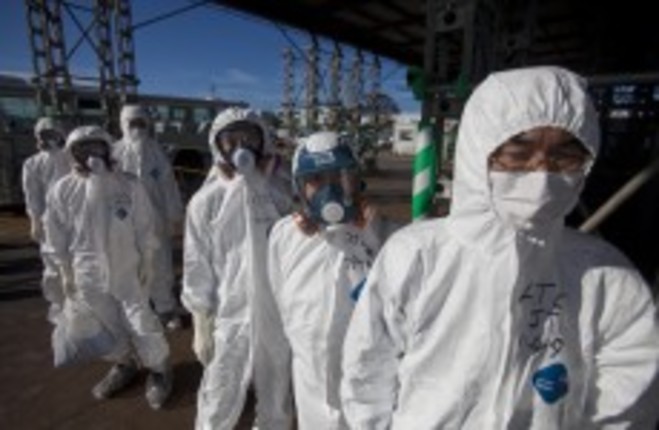
File photo (2011) shows workers in protective suits and masks wait to enter the emergency operation center at the crippled Fukushima Dai-ichi plant
Image: AP Photo/David Guttenfelder

JAPANESE AUTHORITIES ARE investigating subcontractors on suspicion that they forced workers at the tsunami-hit nuclear plant to underreport the amount of radiation they were exposed to so they could stay on the job longer.

Labour officials said today that an investigation had begun over the weekend following media reports of a cover-up at the Fukushima Dai-ichi plant, which suffered multiple meltdowns following the March 2011 earthquake and tsunami disasters.

A subcontractor of plant operator Tokyo Electric Power Co, or TEPCO, acknowledged having nine workers cover their dosimeters with lead plates late last year so the instrument would indicate a lower level of radiation exposure.

‘Widespread’ practice

The investigation marks the first time the government has looked into the case, believed to be part of a widespread practice at the plant since it was hit by the worst atomic crisis since Chernobyl.

The government more than doubled the emergency radiation exposure limit soon after the accident, but lowered it back to the previous level in December. The law now sets the exposure limit at 50 millisieverts per year, or a five-year total of 100 millisieverts.

Dosimeter readings are crucial personal records that determine how much longer a worker can stay on a plant job. Work at highly contaminated areas could quickly eat up a worker’s quota.

The issue reflects a growing concern among the government and TEPCO about how to secure a continuous flow of workers to finish cleaning up the plant. Officials say it will take about 40 years to decommission the plant’s four wrecked reactors — three with melted cores and another with a spent fuel pool in a shattered building.

Onsite inspections

Labour officials made onsite inspections at the Fukushima plant to examine dosimeter readings of the workers and other records, said Yasuhiro Kishi, an official at the Fukushima Labor Bureau.

Health and Labor Ministry officials repeatedly issued warnings to TEPCO during the first few months of the crisis about the company’s lax oversight of workers’ exposures. Officials have also said TEPCO had several workers share a dosimeter not just early in the crisis when the equipment was in short supply due to tsunami damage, but even after a full stock had been regained.

Takashi Wada, president of Fukushima-based subcontractor Build-Up, acknowledged this weekend that the dosimeter falsification had taken place. He said a supervisor of the group of nine workers came up with the idea when his dosimeter alarm went off during his short preview visit to the area where the workers were assigned.

“We should have never done that,” Wada told an interview with TBS network broadcast Saturday.

Read: Fukushima accident a ‘man-made’ disaster>

Read next:

Comments (2 Comments)

  • A cover up? Just one? There has not been an iota of truth telling in government, media or industry since the tsunami damaged the plant. The full story may never be known.

    But I hope the Japanese people will not stop pressing for answers and for improved protection for their health.

    Reply
  • The press is complicit in the cover up off the humanitarian crisis in the region. The nuclear poisoning of the civilian population of the region is many times worse than we are led to believe and all the while the governments loyalty is to big business. Disgraceful and very sad future some of Japanese young and unborn

    Reply

Add New Comment