TheJournal.ie uses cookies. By continuing to browse this site you are agreeing to our use of cookies. Click here to find out more »
Dublin: 15 °C Sunday 19 May, 2013

Column: 5 tips to deal with cyberbullying

Online harassment is a concern to young people and parents who aren’t familiar with certain technologies – but there are practical ways to deal with cyberbullying, writes Pat Forde.

Pat Forde

Earlier today, an action plan on bullying was launched by Ministers Ruairi Quinn and Frances Fitzgerald: the plan sets out 12 actions, which the Minister for Education and Skills and Minister for Children and Youth Affairs said will help prevent and tackle bullying in primary and second level schools.

AS WE ARE all too keenly aware, bullying is an issue in many young people’s lives and a concern for parents all over Ireland. For many adults, too, the workplace can become a very inhospitable environment. Recession has brought with it many economic difficulties for families but, for others in some workplace environments, it had brought with it an acceptance of certain types of bullying behaviour that some vulnerable people have to endure.

Cyberbullying

Cyberbullying is a one of the primary concerns of parents and can be a little bit of a grey area for parents who are not familiar with the technology. I have worked with groups where cyber-bullying was an issue where it had been done both anonymously and openly. Social media sites such as Facebook are a reality in young people’s lives and as such parents should do what they can to learn some basic skills and safety information.

I was recently invited to Facebook’s European Headquarters to discuss internet safety and cyber-bullying. While this is a concern to many parents there are many existing safeguards that can be used to protect people online – we do not allow our kids to play on the street without teaching them to cross the road safely, similarly we should take some time to teach our kids how to enjoy a safe online life.

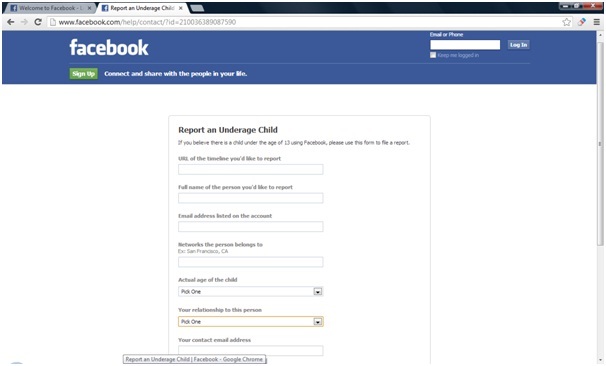
1. Is your child old enough to be on Facebook?

The minimum age for users is 13. If you are concerned that your child is using Facebook and they are not old enough, Facebook provides the utility for a parent or other family member to remove the profile of an underage user.

Screengrab shows how to report an underage user to Facebook

FB1

2. Reporting abuse

All parents give their kids and teens their contact phone number just in case they ever need to contact them. But do your kids know your email address – or the email address of an adult they can trust? Cyberbullying, like other forms of bullying, sometimes requires adult intervention to help resolve it.

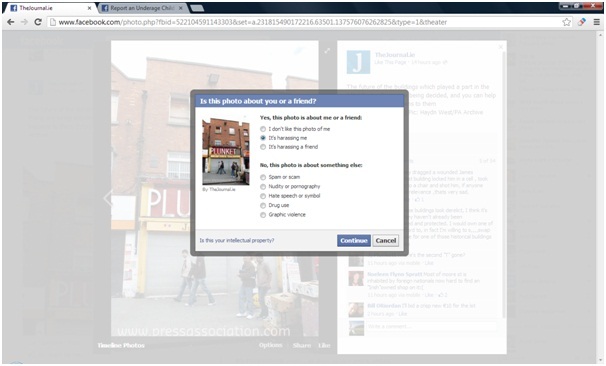
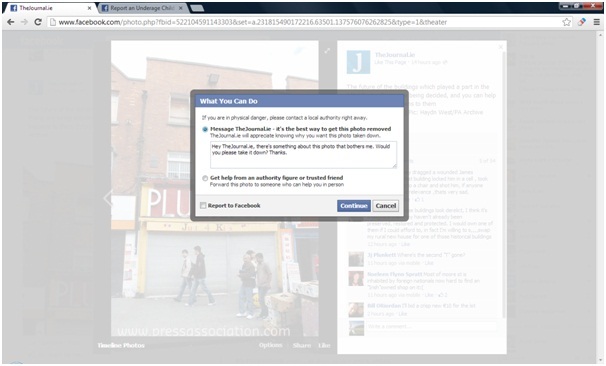
Social reporting on Facebook is a way for users to quickly ask for help from someone they trust. If your teenager sees a post or photograph on Facebook that bothers them, or which might be harassing them or someone they know, there are a number of possible useful actions they can take. They have the option of reporting photos directly back to the person who uploaded it, which can be useful if something was put up with no harm or embarrassment intended.

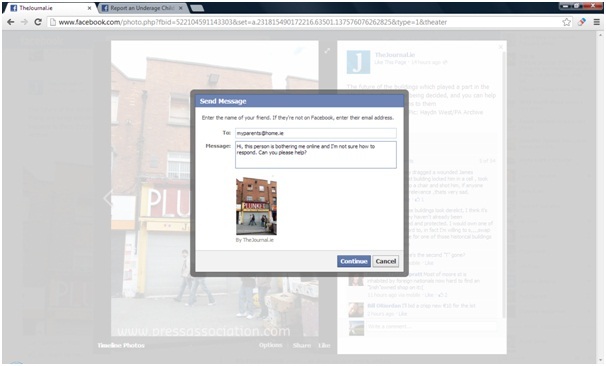
For more concerning posts, an option is available to report directly to Facebook. Importantly, an option is also available to send a copy of the post to an adult they trust. This can be very useful for teens, as many cases of bullying can be very subtle so the option of sending a copy to someone you trust who can help is very positive. The person they ask for help does not need to be on Facebook – all they need is an email address.

Screengrab shows how to report a harassing photograph

FB2

Some advice given by Facebook to users feeling threatened

FB3

How to forward the image to someone you trust

FB4

3. Friends, Friends and even more Friends.

While working with teens and some adults it’s amazing to see the pride some have in the number of online friends they have on social media sites. While a positive social circle is really important for young people, a recurring issue I see with groups is the fact some young people are Facebook friends with those they wouldn’t bother with in real life – individuals they don’t get on with or, in some cases, people or groups who have bullied them or their friends.

Online, just as in the real world, we sometimes need to choose the friends we interact with. We don’t stop to chat with people on the street who we don’t like or get on with. Neither do most of us try to hear the comments everybody makes in a crowded room or in a busy schoolyard – yet online we are willing to do this.

In life we sometimes choose to avoid certain people for all types of different reasons; this is a tactic that can be useful online too.

4. Don’t tolerate bullying or abusive behaviour online

Everybody will acknowledge that bullying is wrong, yet many will still tolerate bullying behaviour they see once they are not the target. While some will stand up for the target, most will not because they are afraid or worried that they might become the new target for the bully or lose friends if they do.

Online, the power to unfriend or block people on Facebook is a very powerful tool. This can be done very discretely and privately. I have worked with groups where numbers of individual members unfriended a bullying individual thus removing their audience and their power, which has been very effective.

Similarity, many concerns regarding cyberbullying surround the area of anonymous posts. While Facebook will take measures to remove fake profiles once a complaint is lodged, the real power lies within group tolerance. In many cases of cyberbullying abuse, the offenders are not afraid of any consequences among their peers. They are not afraid because what they are doing online is a symptom of behaviour that going on within their group –  for example, if they have been commenting on or insulting someone during the day, the behaviour was accepted and it is then done online.

5. Tagging and Timeline setting

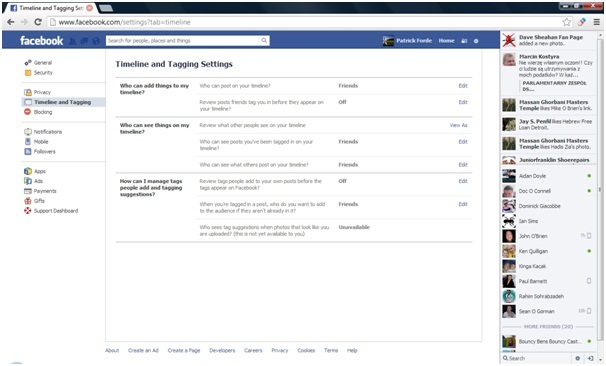
“Tagging” allows users to tag others on their posts or photos so that information appears on their timeline. This is a really popular feature on Facebook  but one which can be a used to torment targets. Tag review allows users to edit settings to approve or dismiss tags, which means the post you are tagged on won’t appear on your timeline until you approve it.

Similarly, users can also change settings to review who can post on their timeline. This option is available through the Account Settings menu.

FB6

A complex issue

Bullying is a complex issue to deal with as there are many different aspects to it. While cyberbullying is a concern, in many cases it is a side effect of behaviour and tolerance within a group that already exists.

The information contained in this article will help users online but if you have any concerns regarding this or other forms of bullying, you can contact the author, Pat Forde, directly.

Further articles on other forms of bullying will be added in the coming weeks.

Pat Forde is a martial arts instructor who has trained with UK Anti Bullying Charity Kidscape to become one of Ireland’s leading anti-bullying figures. Pat says bullying is about power – and he trains individuals to rebalance this power. He has empowered many families, children, teenagers and schools from all over Ireland to deal with bullying by helping them build confidence, self-esteem and assertiveness. Working in schools and workshops, he helps bullying targets and their families. Pat can be contacted at Munster Martial Arts or at patforde1@gmail.com.

Read next:

Comments (20 Comments)

  • Also Regarding cyber bullying – people are stuck in their own heads too much online. We’re not interacting in reality. A hobby is great. A sport, something outdoors, or in the community, a group art class, roller derby, book club, anything. Will make a huge difference.

    Reply
  • Set account to private so only friends can see..problem solved

    Reply
  • Some good points in article for people who have no idea on what steps to take. It is a very serious issue and when young people are taking their own lives due to this. Saying ah sure toughen up and stop being so sensitive. Is not the right way to deal with it.

    Reply
  • Big words CAN hurt you. The Ireland of 2013 needs to talk about anxiety, stress and mental illness. It’s ok not to feel ok and people should feel its ok to talk about how they’re feeling. If you feel no one will listen talk to a psychologist, councillor or if you’re younger and feel your parents won’t understand ask to go to the doctor, speak to them and they may explain to your parents that you wish to see a councillor or psychologist. they’re not scary, they’re lovely (although make sure you choose one who you feel comfortable with, like you’re chatting with a friend) I know it seems very basic, but a healthy diet, some exercise and a good nights sleep can do a lot for mood. And talking (to the right people!!!!) definitely helps.

    Reply
  • I don’t think Facebook has a problem with cyber bullying, it’s “Ask. fm” that’s the real problem. All these big tough bullies get anonymity on this site and it makes it easier for these cowards to abuse people and get away with it.

    Reply
  • Delete Facebook.
    Lawyer up.
    Hit the gym.

    Reply
  • I blog about this (carrollteacher.wordpress.com), if people would read it and give feedback I’d really appreciate it. It’s an issue that’s gone on too long and has found it’s way into the media in the most severe circumstances imaginable.

    Reply
  • Sh**Twit 29/01/13 #

    What about college and university?

    Reply
  • Step 1. toughen up
    Step 2. Know that words cant hurt you
    Step 3. Be grand

    Reply
    • @stephen you couldn’t be more right. Todays youth are over sensetive wussies. Everything is a crisis and every unwanted confrontation makes them of victim of some sort. If they had more to do during the day they would have less time to sit and feel sorry for themselves.

      Reply
  • Ignore bullies, unless it’s physical. Then tell the teacher.

    Reply
  • Thank you for this article which would have been better entitled “the bleedin obvious”.

    Reply
    • Recently attended a school seminar on cyber bullying and was shocked at how unaware a lot of parents where to how the likes of Facebook /askfm and similar sites work.

      The article contains good practical advice , so if anyone knows a parent who may need a bit of a help in this department forward this article on or do it the old school way meet up and chat about it .

      :)

      Reply
  • Cyber Bullies and Stalkers are truly the new Pest of the Millenium. Those online sickos are the very same, which used to spread anonymous and malicious gossip in our communities before the Internet Times.
    Now with practically unlimired choice of victims and a huge platform of possible readership, those sociopaths can outlive their mental disorder.
    And as always,in the end the society suffers under new and stricter legislation cutting our new gained freedom.

    Just like 9/11 created Homeland Security and its negative, but necessary impact, those psychopaths will create new legislation, new policing executive organs and new restrictions.
    In the end we an kiss the “Freedom of speech” in the Internet “goodbye”.
    Cyber Bullies and Stalkers are not only a nuisance, they are Terrorist and should be dealt with accordingly NOW and not when its too late and when there are too many.
    http://www.guenthervomberg.blogspot.com/

    Reply

Add New Comment