TheJournal.ie uses cookies. By continuing to browse this site you are agreeing to our use of cookies. Click here to find out more »
Dublin: 13 °C Saturday 25 May, 2013

Column: Get back on the capall – we should be proud to use the Irish language

The plan is simple: we want to start a revolution and get 100,000 people to use their chuid gaeilge in their daily lives, write Bernard Dunne.

Bernard Dunne

SIX WEEKS AGO, Bernard Dunne’s Bród Club was launched. The plan was simple: we wanted to start a revolution. By the end of the campaign we wanted 100,000 people who spoke little or no Irish in their daily lives to be using their chuid gaeilge again. That was and remains the grand ambition of this project.

We have no big axe to grind, no big statement to make about the Irish language. We just believe that there are people with a latent sense of pride in the language and we want to awaken that.

We’re always keen to point out that Bernard Dunne’s Bród Club is not a learning series. It’s a motivational, inspirational series that seeks to talk to the “Gael” in each of us.

It seeks to rekindle a sense of pride in the language and to turn that pride into something tangible whereby we will be inspired to speak the language again. This appeal to our pride – our bród – is at the very heart of the campaign.

We set ourselves the incredibly ambitious target of getting 100,000 people signed up to the club. We had no idea if we’d even manage to get 1,000 but so far almost 23,000 people have made the commitment. And what have they committed to? It’s very simple really, all we ask people to do is to use the Irish they have.

And we have solid evidence that the campaign is working. Its there in the thousands of tweets, Facebook posts and emails that we have received. We may not have created a revolution – at least not yet – but we have created a new and very lively online community. People are really keen to tell us that they are using their Irish and indeed how they are using their Irish.

Greg Dunne on Facebook:

Spent an hour with the kids playing and TRYING to use as much Irish as possible , we had great fun and was surprised at how many Irish words I remembered , going to make an extra effort to learn more and look into getting into a class, Thanks Brod Club

Lisa Benton (@NecroVamp) March 19th 2012:

@rtebrodclub Nuair a bhí mé ag féachaint ar #brodclub anocht bhí mé ag labhairt as Gaeilge le mo iníon,tá sí 8 mí d’aois,&bhí sí ag gáire!:)

Coláiste na Mumhan (@ColaisteGaeilge) March 19th 2012:

@rtebrodclub Katie Taylor ag troid ar son na Gaeilge. Wouldn’t wanna mess with Katie…..labhair an cúpla focal.

Aine Wimpenny via email:

Dia Dhuit Bernard, Your bród club is certainly ag obair liomsa anyhow, mar bhí brionglóid as Gaeilge agam aréir.

Leo Lalor on Facebook:

Go raibh maith agat Bernard, taim ag abairt cupla focal ar mo FB page agus ta some of my chairde answering as Gaeilge (ex pats!)…I’m starting to remember words I learned over 40 years ago!!

kellysmith (@kellysmith_93):

Is rud amháin é bheith i d’éireannach ach is rud eile bheith I do gheal! @rtebrodclub

Margaret McCarthy (@maggie_may):

Wow! @rtebrodclub @declanorourke sounds even better as gaeilge- Iontach ar fad!

Teresa McCusker (@t_mc_cusker):

Loving the idea behind @rtebrodclub it’s definitely made me think more about the Irish I have

Shannon Grimes:

An-ghleoite ar fad.. thosaigh mé ag muinteoireacht gaeilge do mo neacht Molly, tá sí 19 mí agus anois when I tell her to sit on her “cathaoir” she toddles over to her little cathaoir and sits down.. táim an- bhródúil as an achievement sin!

These are all simple comments and stories really but they are just a tiny sample of what we have received and taken together we believe there’s something special going on. And people have got the message, use what you have, don’t be afraid to make mistakes, don’t be intimidated by the language.

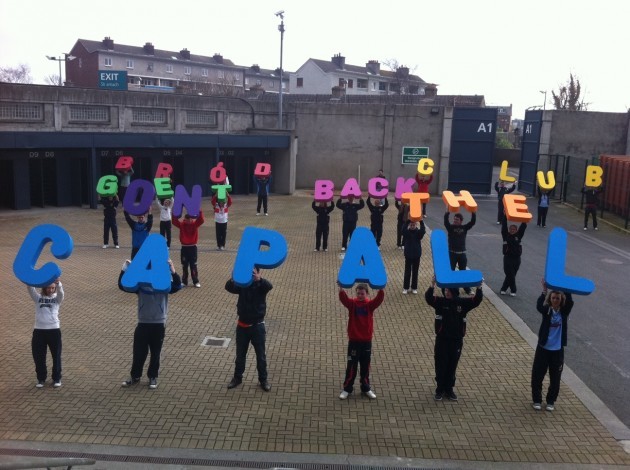
CAPALL pic

The campaign has been a mix of guerilla tactics, charm, celebrity endorsement, publicity stunts, peer pressure, emotional blackmail, local advocacy and digital and social media tools – all to ignite the spark in people to use the language.

We’ve had fantastic artists like the Dublin Gospel Choir, the Republic of Loose, Ryan Sheridan, The Delerentos and Declan O’Rourke – all showing their pride in the language by performing as gaeilge.

We’ve had flashmobs, laser graffiti, bród bingo and singles parties – silly things but all to show people that they have some Irish, even if its only a few words.


(Bród Club flashmob with the Dublin Gospel Choir on Dublin’s Grafton Street. Video: RTE)

We’ve had great support from the corporate community with companies like Irish Pride, Iarnród Éireann, Dublin Bus, Bank Of Ireland, Bus Éireann, Truly Irish, Toni and Guy, Barry’s Tea and Bravo Advertising all coming on board.

We had a range of celebrity contributors, from Paul McGrath to PJ Gallagher to Ray Foley. And it was Fiona Looney who gave us the most enduring catchphrase of the series – get back on the capall – which not only became a slogan, the fantastic Hairy Baby Company in Cork designed a T Shirt around it and sold it at cost price to Bród Club Supporters.

Apart from Twitter and Facebook and the website we also developed some personalised video apps – based on the traditional bete noirs of the Irish language experience – Peig and the stereotypical Mean Múinteoir. These have really caught the imagination of a certain generation of irish people.

All of these things combined have resulted in 23,000 Bród Club supporters and an amazing level of goodwill around Gaeilge.

So we’re heading into the final television programme. But the campaign doesn’t end with the TV series. It will continue online and we will continue to man Twitter, Facebook and the site. So there’s still time to sign up.

Get back on the capall – go to www.rte.ie/brodclub and sign up.

Beir Bua.

Bernard The Journal

Read next:

Comments (95 Comments)

  • This campaign really inspired me to use what Irish I have, I’m far from fluent and am having great fun using my cúpla focal with my fiancé. I also say slán, go raibh maith agat etc. it doesnt cost a cent to use what you have, and I am proud to say I now use what I have. Its been a really fun experience for me and would highly recommend anyone that wishes to give it a go.

    Reply
  • If you use a few words it doesn’t hurt anyone and it might start to inspire you to look up words you don’t know… I say fair play to them.. Tir gan teanga is tir gan anam…. I hated irish in school until one teacher made us speak only gaelige in class and eventually I started understanding more and taking more in and started to love Irish… I think fair play to him be bród!!!!

    Reply
  • The biggest and most embarrassing failure of our education system is the teaching of Irish. We spend 14 years learning a language and come out of it with nothing. It should be taught the same way they teach a foreign language and get rid of those stupid poems and stories and rote learning has failed everyone. I remember for my leaving cert oral being given pages of stuff by my teacher to learn off not knowing what any of it meant. I’d love to be able to speak Irish fluently but our education system is a joke.

    Reply
  • Euro problems aside,it would be such a shame to lose the language.Nobody seems to want to keep their heritage alive and be proud.For my children’s sake I have instilled a love of the language. Being from Scotland,where scots Gaelic is spoken,I think it is important to speak in your native Tongue.Not everything in life is about us competing in European languages!

    Reply
  • Buladh bus

    Reply
  • “I still haven’t found what I’m looking for”…. i bhfad níos deasa as ár bpríomhteanga.

    Well done agus comhghairdeas, a Bhernard.

    Reply
  • Heard him on the raidio not so long ago. Iontach

    Reply
  • I think this is a great campaign on Bernard.. There is really a barrier in Ireland where people are afraid to use even handy phrase in Irish, like ‘slán’, or what not. I say this as someone who probably is no different than most people reading this article.. I didn’t like Irish too much in school. I didn’t hate it or anything, I just didn’t really like the pressure of the subject. I picked it up myself later in life, by setting up a conversational group – and immersed myself in the language.

    I think it’s a positive thing to be able to speak the Irish language. It’s something that you’ll always have with you. I think there’s quite a lot of people who would be able to speak the language, even if they aren’t fluent – just to have a decent grasp to be able to have a friendly chat. And granted, there are people that feeling no attachment to the language too – and that’s fine.

    You can feel Bernard’s passion about the language – and the fact that he’s not fluent makes it all that more powerful. It’s someone people can relate to. I was already well back on the capall before this campaign, but I think it’s a good opportunity for everyone to reflect and think look positively towards a language that is unique to this island, that has been here for over 1,000 years. That fact that it’s still alive today is in some way, a miracle – and we should be proud of the efforts made over the past 20 or 30 years in reviving it.

    Beir bua!

    Reply
    • “Irish” is not unique to this island. It is the same gaelic language spoken in Scotland.

      Reply
    • No it’s not the same Gaelic language spoken in Scotland. It’s quite different actually. Spanish and Portuguese are closer to each other than Scottish Gaelic and Irish are. Ukrainian and Russian are closer to each other than Scottish Gaelic and Irish. Even Dutch and German are closer to each other. Many words hold similar meanings, but there are also many words quite different. On top of that the grammar and syntax is not the same. Plurals are formed differently. There is no eclipsis in Scottish Gaelic, unlike Irish. There is a V-T distinction in Scottish Gaelic not found in Irish. The formation of tenses is different to Irish. Even the quantity of tenses differs. You obviously have no clue what you are talking about, Eric. Perhaps it’s your ignorance which leads you to such hatred towards Irish.

      Reply
    • Eric de Red, you are an utter ignoramus.

      An-fhear, a Bhriain, leag tú do mhéar air – tá mo dhuine go huile is go hiomlán ar mire bánaí.

      Reply
    • Well said, guys like that idiot Eric De Red are pure gobshites who probably weren’t able to learn it in the first place.

      Reply
    • As already highlighted Eric, Scottish Gaelic is not the same language as Irish. It has been maturing on it’s own for about 800 years. While some phrases and words are interchangeable – it is not mutually intelligible. I say this as someone who speaks Irish, and a small bit of Scottish Gaelic.

      So if you’re going to nitpick my posts in future, I’d appreciate it if you’d at least got your facts straight. I’m all for being corrected, but not with incorrect information.

      Reply
  • Must say the bród club has really inspired and given me confidence to use my Gaeilge. I speak it at home and with friends and now text also as Gaeilge (auto correct is not fun!) but now I find I DO have confidence to ask for simple things like a cup of tea/ glass of water in the shops. Most people get flustered panic a bit but still they understand! My funniest experience was in the bank of Ireland last Friday where they have “failte Friday” for the bród club. I plucked up the courage to ask in Irish if many people come in trying to speak in when the woman replies in the strongest English accent “sorry all I can say is go raibh maith agat and slan!” – got a laugh! But at least she was trying!!!!

    So usaid aon Gaeilge atá agaibh- even if it’s the cúpla focail! And sign up to bród club!they give great tips on how to use it!

    Reply
  • Well I’ll say one thing, even though I’m not in the slightest bit interested in their campaign, at least it’s being spearheaded by someone outside of the usual media gombeens who use the Irish language as some sort of phrase bazooka to make us all in awe of their linguistic skills.

    Reply
  • It might be took late for many of us to start speaking it now in any meaningful way but we all can help our kids to speak it by using words and phrases where ever we can.

    Reply
  • I’m ashamed I cant speak Irish.

    Reply
  • i never leave a comment, but i love this, i forgot all i was taught in school, my kids are finding it hard work, 13,11,6, im ok with the simple bits, and im shocked that nobody wants to know, its the only thing left, thats irish, we have given away soooooo much wit been in the eu an all that, its who we are
    try explain to a 6 yr old why we speak english, i want to learn more, would love tourist to visit more irish speaking shops,
    look wat we have now, foreigners (nothing againist em) but they can be loud and proud of their laugh weither we want to hear it or not., we shud be the same, proud and loud, and it might shut em up…
    i love Bernard for this……..

    Reply
  • Irish was ruined for me by the wailing teachers howling pointless poems, prose and fictional stories at us. After Irish class I’d head down the hall for German where we’d focus on grammar and use phrases that were actually useful in daily life. Guten Abends.

    Reply
    • And Ireland was ruined by European economic powers like Germany.

      Reply
    • I’ve heard this canard before.. But the reality is – Irish schools are not producing competent German speakers anymore than they are producing Irish speakers. The prime cause of this is lack of immersion – it’s the only way you’ll ever truly learn to speak a language.

      If someone truly wants to become fluent in German, they will naturally pick it up if they live in Germany. I advise anyone to look at Benny the Irish Polyglot on youtube. He’s an Irish lad who now speaks about 8 or 9 languages. And he did it by immersing himself in the languages, and speaking them from day one – without focusing on grammar. He is a living testament to how powerful immersion is.

      He spends 3 months in each country, and by the end of it – produces a video demonstrating how competent he is. A real interesting chap! Google him.

      Reply
    • Sean that doesn’t explain how children in other European countries are multilingual. Most Dutch people I know speak English as well as any Irish person I know, yet they weren’t immersed in it. Yes the Irish education system is woeful when it comes to languages but its more down to poor teachers and poor methods of teaching with so much hinging on Leaving Cert written exams when we need people to learn to converse in them instead.

      Reply
    • Richard, I have a friend from Amsterdam and they are immersed in English to an extent. English is the second language of The Netherlands. They don’t acquire it just in school – they also acquire it outside school. 70% of the population can speak English – that is why they acquire it so easy.

      Reply
    • Interestingly, I’m learning French and German in college, and a most people in my classes speak a decent level of Irish. I suppose that they’re more interested in languages in general, and engage with the school curriculum more than the usual bunch.

      I agree with Seán – somewhat. Fixing the Irish curriculum will help, but it takes a personal effort to get people to truly learn how to speak it. If you want to truly learn French, read Le Monde every day/weak. Get a subscription to the Alliance Francaise’s library and borrow some books and films.

      If you want to learn German properly, read the Frankfurter Allgemeine. Subscribe to the Goethe Institut’s library (it’s cheaper than the Alliance Fracaise!). Borrow some books and films on a regular basis. I’ve learned most of my French and German this year from newspapers, books and films. Classes can only give you so much.

      For Irish, you’ve got even less of an excuse: watch TG4, listen to Radio na Gaelteachta. Join Conradh na Gaeilge to meet Irish speakers and learners, if you know none. If you’re in a third level college, there’s probably a Cumman Gaelach. What Bród’s doing is absolutely what is needed to preserve Irish. I suspect that for people in continental Europe, who are bombarded with English words from a very young age. Hollywood films and pop music permeate every part of western society. But at the same time, we have to realise that our teachers really don’t inspire students here to make the extra personal effort themselves, which is needed to truly learn Irish or any other language. We need organisations like Bród to make it work.

      Reply
  • This is how you encourage Irish,not by forcing teenagers to learn it and wasting goverment monney!

    Reply
  • It’s great ! A good idea to speak our native language as a hobby and at no cost. Bernard is great. I would like to see more of this and Irish taken out of schools and thought this way. The schools could then teach another more useful language that could be used in other countries while travelling or working. If more people had French or German it would give them a great advantage in seeking work. It souls also boost their confidence. Our standard of English also needs to be improved as the poorer areas are having big problem with literacy levels. Great stuff Bernsrd – congrats.

    Reply
  • Maith thú Bernard. I am not fluent, but have had a renewed interest in the language the past few years and have taken to learning it, so this programme comes at just the right time. I think the fact that it’s based on just using what you have rather than fluency is a great idea, as the initial obstacle I had in learning Irish was getting over the cultural cringe of just saying “Dia duit” or “Go raibh maith agat”. While I would eventually like see Ireland being a bi-lingual society, tús maith leath na hoibre!

    Also, I would just like to point out that the economic arguments against the language just don’t stand up – Do only economically viable languages deserve to survive? And what good is economic wealth without cultural wealth? You can’t take culture to the bank of course, but we are poorer without it.

    Slán, agus go néirí an tádh leat.

    Reply
  • Dave 06/04/12 #

    I’m sorry Bernard, i feel no connection to Irish at all. I just could not get the hang of it in school and I grew to hate it, and the horrible methods used to teach it, despite managing to go on and learn 3 other languages quite succesfully. But good luck and fair play to anyone who does. It’s just been ruined for me.

    Reply
  • Irish is the only true expression of ourselves through language. To lose it is to become detached from our heritage. The people who don’t care about that are simply not informed enough to make decisions about it.

    Reply
  • Dave 06/04/12 #

    Obviously the Gaelgoir mafia are out tonight! Im just telling you my experience! I tried to learn it like anyone else – scraped my pass in the leaving so thankfully i got the University of my choice. If somehow that makes me bad – well, tough. Thats how it was.

    Reply
    • I stated in a post above that there are many nutjobs in both the pro- and anti-Irish camps. Unfortunately, they also happen to be the loudest. Trust me, the majority of us Irish-speakers don’t judge a person on his or her ability to speak Irish. I’m sorry for your experience in learning the language, but glad you got the university of your choice. Most of us Irish speakers would not consider your experiences as somehow making you bad. You’re not.

      Reply
    • Brian
      What is your judgement on the educational system that has failed abysmally in the teaching of Irish? A kid can start being instructed in the language at 4 or 5 yrs of age and emerge from school at 17 or 18 without a clue.

      Reply
    • Brian
      What is your judgement on the educational system that has failed abysmally in the teaching of Irish? A kid can start being instructed in the language at 4 or 5 yrs of age and emerge from school at 17 or 18 without a clue!

      Reply
    • My opinion on the Irish language in our school system is that it is fundamentally flawed. The entire methodology needs to be changed. Rather than focussing on grammar and the written language, oral and aural comprehension should be to the fore. Obviously an understanding of the written element and some basic grammar needs to be learned, but the groundwork has to be there first. Otherwise it’s like building a house by starting on the roof. By the time you get to where the foundation should be you can do nothing about it and the house collapses. The same is happening with our teaching of Irish. Teach the basics first. How to talk and listen. Introduce TV programmes – there’s a wealth of them on TG4, including Irish language versions of kid’s programs such as Spongebob (shudder, but that’s another day’s work), Aifric, etc. Bring in Irish language music such as Kíla and other contemporary artists (rather than the depressing Sean Nós etc.)

      Regarding the éiginteacht or compulsory element. Personally I think Irish should be compulsory for Primary school children. That’s the time when they will pick it up the quickest. In second level as far as Junior Cert Irish should also be compulsory, but should be split into two separate classes – one for written, aural and oral comprehension on the language (compulsory) and one for the literature and history of the language (optional). Beyond the Junior Cert Irish should be optional, but state financed schools should still have a provision for those who want to do it.

      As an aside, I think our English language education also needs a review. All our kids are learning about Hamlet’s soliloquies and depressive nature and Joyce’s virtually impenetrable stories, but they don’t know the difference between “there”, “they’re” and “their”, when to use the apostrophe (its/it’s, and the incessant insertion of the apostrophe in plurals – e.g. two school’s), using sentences such as “I were at the shop”, etc. I think English could benefit from being split into two separate classes too – one for the language and its grammar, and one for its history and literature, with the former being compulsory and the latter being optional.

      Reply
    • Brian
      You speak a mountain of sense. Pity is it’s not happening! It’s only because our kids don’t lie on trolleys in schools that our educational system is not exposed for the shambles that it is!

      Reply
  • Irish first, European second. Went to the zoo today. Asked for a ticket for me fein. The chap behind the counter said slan as I walked away. It is my language and my culture. Its all that we have left of our own, lets not lose it.

    Reply
  • Maith thu Bernard. Nil a lan gaeilge agam but I try to use a cupla focal gach la. Texting is a challenge :-)

    Reply
  • when i lived in the US, i worked with a few lads from mayo and galway who were fluent. it is great to have a language to switch to when you don’t want people to know what your on about….maith an buachaill, Bernard.

    Reply
  • It shouldn’t be compulsory for the leaving cert. it’s holding people back from getting points and courses

    Reply
    • You only use six of your subjects for points and most do seven subjects so it only holds you back as much as any other subject might

      Reply
    • Dave 06/04/12 #

      Irish is a requirement for entry for an NUI college. So yes, it does hold people back. Thats the sad fact.

      Reply
    • Ethnic discrimination!

      Reply
    • @ Eric – as opposed to the requirement that all courses in NUI colleges require English too. Surely, using your logic that could also be construed as ethnic discrimination. If you don’t like it go to any one of the multitude of other colleges and third level educational institutes throughout the country that don’t require it. I’ll tell you what discrimination in Ireland is. Discrimination is some random Dublin D4 bell-end intruding into private conversation and throwing a glass of water over you because you are speaking Irish in Dublin to a friend when the only lingua franca between us was Irish. Discrimination is having to constantly hide the fact that you’re an Irish speaker for fear of attacks in Ireland, either verbal or physical. Discrimination is having the likes of you constantly insult the Irish-speaking community just because you have, for some bizarre reason, a hatred towards the language verging on the fascist. Discrimination is, as citizens and tax payers in this country, constantly having our right to speak our own, and one of the country’s official languages, denied. You have to put up with, what, a few hours a week in school learning a language for only a few years and then the odd story thrown into media spotlight every few months. On the other hand, we Irish speakers have to put up with venom, spite, anger, and outright hatred towards us on a daily and constant basis. Now you tell me where the discrimination lies. If you are so keen on the State ceasing paying for the Irish language, how about we Irish speakers stop paying for your State. Learn a bit of manners and respect for your fellow human beings. Are there nutjobs on the pro-Irish side? Yes, but there are far more nutjobs on the anti-Irish side. It’s about time both groups just fecked off and allowed the rest of us to get on with our lives. I know I’ll probably receive plenty of thumbs down for what I have just said, but I don’t care. I am sick and tired of being stood on by the likes of you, Eric.

      Reply
    • Jeez Brian relax! the only fascism I ever encountered in relation to the Irish language was a primary school principal who beat small defenceless kids black and blue because they struggled with a language that was not considered to be an inherent part of our cultural tradition but a badge (like the fainne) to be worn like an emblem of some crazy fascist national identity. I think Flann O’Brian summed it up nicely in his parody of the whining bullshit (Peig Sayers) we were forced to learn in his book ‘The Poor Mouth’. ‘Phat is your name’ to which the barefoot child replied ‘bootssir’!

      Reply
    • @ John, as someone who doesn’t speak Irish you obviously don’t know what I’m talking about, and I honestly don’t mean that in any condescending way. The discrimination I mentioned above is discrimination I have personally experienced. Regarding what you described – as far as I’m concerned there is no room in any society for that kind of abuse. I also don’t agree with Irish speakers insistence that Irish is somehow the native language of all Irish people and that non Irish speakers should be forced to learn it through coercion or other means. It is the native language for some, but for most it’s not. If English speaking Irish people want to speak English, then, as far as I’m concerned, they should speak English. If they don’t want to speak Irish then that should be entirely up to them. But as a speaker of Irish I would also like the same courtesy extended to us Irish speakers. Yes, I exploded in the comment above, but as I already stated, I am sick and tired of having to constantly bite my tongue. The article is about a group of people wanting to get those with an interest in the language, even if it is only a small interest, active and participating in the language. What’s wrong with that? It costs nothing and builds a bond between what might otherwise be people with no other apparent similar interests. It helps build communities, even if only small ones. There is no compulsion in it. There is no abuse in it. There’s no attack on the English speaking community. Yet, people like Eric decide to come on and attack the language and the speakers of the language for no reason. The more sensible comments have simply talked about whether or not it’s a good idea and what their own experiences were, good or bad, regarding the learning of Irish. If someone doesn’t like the language then that’s fine. Just don’t insult me or other Irish speakers because we speak it. To the likes of me and Ciarán Ó Raghallaigh below, Irish is not a hobby. Irish is my first language, English my second. To me, Irish is an integral part of who I am. It is how my thought processes work. I think in Irish. I dream in Irish. I speak to my family and some of my friends in Irish. It is not some hobby. A hobby is something you pick up and leave at your choosing. For me there is no choice. It is always there. And to have people call you names, throw drinks over you, spit at your feet, smack you across the back of the head, all because you happen to be speaking Irish, is, as you can imagine, the reason why the likes of Eric really make my blood boil.

      Reply
    • Brian
      Thanks for your considered and thoughtful reply. What makes my blood boil is the cack handed way that Irish was taught to English speaking Irish people. The school principal I spoke of came from an native Irish speaking part of the country and to my mind resented our inabilities and used violence to impose his way.
      My mother was a fluent speaker and I learned at her heels but all that was destroyed at the hands of a tyrant and later by a badly chosen curriculum (Peig Sayers etc.) to the extent that the only thing I wrote on my Leaving Cert. exam paper was my exam no. and left.

      Reply
    • I am a very ardent supporter of the Irish language, John. But I totally agree with you regarding your experience of certain Irish teachers. These are the very type of person that are supposed to be defenders of the language and extreme supporters of it, but in my experience, and obviously in the experience of most Irish people, they are the very ones that do the most damage to the Irish language cause. To me it should be about freedom. Freedom to express yourself in whatever language you feel most comfortable. You may not be able to speak Irish. That’s perfectly fine. You may not want to ever speak Irish. That too is also fine. The only way we can move forward on the issue is for those pro-Irish such as the teacher you mentioned to just shut up and treat those who don’t like or want to speak Irish with decency and for those anti-Irish to respect the wishes of those who do. And to those who say it is an integral part of our heritage and those who don’t speak it are somehow betraying that – personally, I say it’s not. Is it part of it? Yes, for some it is an integral part of it. For others though, it’s not. The ability to speak Irish is not what defines an Irish person. It’s our welcoming nature. It’s our communities. It’s our cities, towns, villages and countryside. It’s a common sense of belonging. It’s the support we give our GAA, football, rugby, cricket or whatever other sporting team. It’s the music we listen to and the craic we have in the pub. Anyway, I’m rambling a bit there at the end. :)

      Reply
    • Thanks Brian. You sound like you enjoy it all! Goodnight to you!

      Reply
    • That’s lovely that you dream in Irish Brian. My mam’s family grew up in an Irish speaking family and to this day she can only do sums in Irish. If she’s totting up a bill or counting money out, she’ll have to déan é as Gaeilge.

      I’ve been watching Bernard dunne’s Bród Club and leave TG4 on at times and noticed myself saying go raibh maith agat instead of thanks in shops past week. Even said it getting off the bus last weekend.

      Lean ar aghaidh Bród Club.

      Reply
    • It’s interesting that 95% of the comments are written in English, even those above from the most ardent Gaeilge supporters. Presumably that’s because people want to make their points, and English is the method of communication that almost everybody in this country can understand.

      Reply
    • And in response to the OP, I am at a loss as to why so many people disagree with the sentiment that it shouldn’t be compulsory. Judging by the red thumbs, more than half believe that we should force-feed our children the Irish language!?
      Wow…

      Reply
    • Yes Jim. It was the force feeding that I objected to by walking out of the Leaving Cert Irish Exam as I explained above.
      I found the whole method of teaching Irish to be dreadful, from the fascist type attitude of the stalwarts for the national cause to the subject matter chosen for study, which from my experience reflected an obsession with the misery and moaning that typified our national obsession for self pity.
      I grew up in a household where I remember my mother at the piano playing and singing the loveliest of Irish songs and ballads in a refined and gentle tone that made the language part of the music. I remember her speaking to myself and the farm animals in the same calm gentle tone that settled and soothed. Then school and all that was replaced by a racus, rasping, shrill cacophony of horror.
      Brian is right above, I don’t speak the language (and to be honest, to my shame I suppose, I don’t care). I guess I could make a fair fist of it if I really tried (some bits stick in my head from where I learned enough to get myself to and through college). My girls love the language and I encouraged it, I guess that’s the best I could do giving my own sad experience.

      Reply
    • @Brian

      You have assumed rather a lot about me. It wasn’t me who poured water on anyone nor would I support such behaviour.

      This state since its foundation has taken upon itself a project to convert the ethnic and cultural mix to one determined by itself. It has no right to do this. It compounds its crime with allowing the true Irish language (or languages -the difference between a dialect and a language is somewhat subjective) to die in the communities in which it is still spoken.

      Once upon a time, a long time ago, people stood up to attempt to build a pluralist state. We would appear to have failed.

      I don’t agree with English being compulsory for university courses either, unless of course the subject is taught in English.

      Apologies for the odd bit of trolling. 13 years being told I’m not Irish because I don’t speak someone else’s language can bring this out of you.

      Reply
    • Eric
      I ignored you ’till now because of your bloody trolling but I agree with some of what you say – just say it a bit better next time.
      I remember at a certain stage in my schooling where a particularly obnoxious Irish teacher used to direct the most awful tirade of abuse at kids in my class for no other reason than they were Protestant.

      Reply
  • Fact – English is our language.
    Gaeilge is not our language. Hasn’t been for a very long time.

    The notion of ‘national languages’ is absurd. That is the fundamental thinking that causes the very problem you are trying to solve if you want to revive the language.
    Languages serve a function. End of story.
    Do the South Americans decry speaking portuguese, spanish? the Canadians speaking French? etc.,
    Reviving a dead language on the back of nationalism will never, ever ever ever work.

    The very fact that we have some of the key writers of the 20th Century from this country writing in English only goes to show how phoney and stupid ideas of ‘pride’ and nationalism as regards Gaeilge are.

    Reply
  • I would like to assume that at this economic juncture priorities are more important than the native language. Not knocking irish but foreign languages should be top of the agenda.
    They are the gateway to economic prosperity.

    Reply
    • Well if you actually read up about the Bród Club campaign you’ll find that it doesn’t cost the government, or people who sign up, anything – it’s about using whatever Irish you have.

      In addition, if everybody in the country spoke Irish we would be a lot better off economically. Currently most of us speak English and as such companies don’t need a unique Irish workforce and so we continue to lose jobs etc. to the UK… This wouldn’t be the case if we all spoke Irish.

      Reply
    • Cillian…
      And where would Ireland be without EU intervention?
      It is attitudes like yours that must make them wonder as to why they are supporting us.
      Ireland has created it’s own fiscal crisis. Another country comes to it’s rescue.
      Enough said.

      Reply
    • No RG if we spoke Irish rather than English there would be even LESS reason to come here. It’s our ability to speak in a language in use throughout the world for business that helps attract foreign companies here. We are the only Eurozone country with English as our first (even though officially its our second) language. If we want to continue to attract these companies we need to start focussing on adding foreign languages such as French, German, Chinese even Arabic to our repertoire. If this group want to invest their own resources into a language which brings little if any value to our economy then good for them, but at a time of scarce resources the government should be investing where it will bring the best return for the country as a whole.

      Reply
    • Sorry Stray Mutt, but there are some of us who would like to step outside the doom and gloom of economic collapse, even just once in a while. Have you gone for a few drinks since the economy collapsed? If so why – would your time not have been better spent fixing the economy? Have you gone to weddings or birthday parties? If so I again ask why – surely the economy is more important? Yes, fixing the economy is an extremely important task, but some of us like to leave it aside for a moment and actually live our lives. Whether that’s using or learning Irish, getting involved in local charities, attending and participating in sporting events, etc. I say well done to Bernard Dunne and all those involved in Bród Club and well done to everyone who is getting involved in something to provide welcome and positive distractions to what would otherwise be an extremely pointless existence.

      Reply
    • @ Stray Mutt,
      Irish is a recogonised language by the EU.
      Thanks to me being fluent I have been able to apply for jobs within the European Union, parlaiment etc as my required second language. I have basic Spanish and German but in this case Irish is my passport to a decent job.

      It is also a really beautiful language.

      Reply
    • @Jenn Byrne

      Irish as an EU language is nothing more than social welfare for Gaelic hobbyists.

      Reply
    • Economies fluctuate, rise and fall… They always have, and they always will. To throw away our national language, along with the thousands of years of history and culture which it embodies, based on an extremely short term and ultimately insignificant economic downturn is nothing short of criminal. There is a much bigger picture here which you need to see. The Irish language represents a cultural wealth greater than any economic wealth.

      Reply
    • RG Cuan – that’s a pile of rubbish. If we all spoke Irish, we’d be forced to learn English as a second language, to attract multinational companies, just like the Netherlands. You know it is possible to have two national languages and two cultural traditions that, and respect them equally. James Joyce and Oscar Wilde are just as Irish as Máirtín Ó Caidhn or Seán Ó Ríordáin.

      Promote Irish – just don’t try to bring economics into it.

      Reply
    • @ Eric De Red,
      what an inane and reductionist thing to say. For myself and thousands of others Irish is not a hobby but a language we use to communicate and express outselves in every day life. Social welfare is government provided economic assistance to those in need.I do not see how the recognition of Irish by the EU can be seen as social welfare in any way? It seems your comment is ill thought out or ill worded.
      Or that you personally don’t/can’t speak or use Irish regularly and thus can’t see past your own prejudice.

      It doesn’t matter if you like the language or not. Many many people in Ireland do or want to learn it, and that should be respected. I speak Irish, I like it, and just because English is the lingua franca does not mean that we can’t be bilingual. Speaking and promoting Irish doesn’t have to come at the expense of English or vice versa.

      Reply
    • The notion of dispensing with the Irish language at this juncture because in your model it doesn’t allow for a competitive advantage is a perfect example of the short term thinking that continues to permeate national thought and led to the decisions that our fearless leaders made in bringing the country to be where it is now.

      There is no reason at all that Irish cannot co-exist, and indeed flourish, alongside English, French, German, Mandarin or any other language of commercial importance.

      @ Stray Mutt I’m curious…are you multi-lingual? or is this purely a comment based on the dire economic straits we’re in

      Reply
    • @jenn “…Irish doesn’t have to come at the expense of English”, is not borne out by the evidence. Bilingual children on average display less proficiency and a smaller vocabulary in each individual language than their monolingual counterparts.
      This, of course is in addition to the divisive tendancies of a language virtually inaccessible to non-natives, or recent immigrants.

      Reply
    • @ Jim. Sorry, but you are completely and utterly incorrect. The majority of people in the world are bilingual or trilingual. Evidence supports the fact that those with two languages or more are far more advanced academically speaking than those with only a single language. Evidence also suggests that bilinguals deal better with neurological disorders and diseases such as Alzheimer’s far better than monolinguals. Unless you think your own vocabulary is superior to the majority of the planet’s.

      Reply
    • @Brian
      If you care to re-read my comment, you will see that is not in fact what i stated. Dividing language skills may improve overall linguistic and cognitive abilities, but at the expense of particular expertise in one individual language.

      Reply
    • Sorry Jim, but I did understand your question. If you read the work done by Dixon, Wu, & Daraghmeh (2012; Early Childhood Education Journal, v40 no. 1 pp25-34; Mar. 2012) you will see that it’s not bilingualism which affects proficiency and vocabulary in a particular language. It’s the Socio-Economic group which affects bilinguals. Bilinguals in countries such as Ireland tend to be from poorer backgrounds (recent immigrants, refugees, etc.) and as such the parents of bilinguals (be they Polish-English bilinguals, Chinese-English, Russian-English, etc.) tend to have a poorer vocabulary set than, say, wealthy, well-educated Polish, Russians, Chinese, etc. who would have stayed in their home country for obvious reasons. Add to that the poor grasp they would have on the English language when they come here and it’s quite understandable that the children, though bilinguals, would have a poorer level of proficiency in either language and a smaller vocabulary set. Bilinguals of well-educated parents actually tend to have proficiency levels equal to monolinguals. Their vocabulary sets are generally either equal to, or greater than, monolinguals.

      Reply
  • Pointless exercise but refreshing to see a Gaelic fanatic who doesn’t feel the need to bludgeon it into the rest of us!

    Peig would turn in her grave.

    Reply
  • jimbo 06/04/12 #

    A waste but good luck

    Reply
  • Speaking irish would be like catching a cow and milking her to make my capuccino. Waste of ucking time.

    Reply
  • Why ? Why?

    Reply
  • i think irish is a waste of time becase it’s not used in europe and any it’s only used for the tourists

    Reply
    • Swedish is only used in Sweden,should they drop that? If you think Irish gets tourists in then we need to keep it as theres not much else that separates us from the rest of the English speaking world. People don’t come here to experience llittle Britain but unfortunately thats what they get.

      Reply

Add New Comment