Welcome to our Public Beta Site - What does this mean?
Dublin: 12 °C Thursday 24 May, 2012

Column: The boom made Ireland a more equal society. Surprised?

Image: Visentico / Sento via Flickr

THE IDEA THAT Ireland became more unequal both during the economic boom years and during the subsequent recession – when wealthy banks were rescued by a government who sought to reduce the minimum wage – seems so widespread as to be a given.

I was gobsmacked, then, to stumble across the following data tucked into the heart of the Central Statistics Office’s Statistical Yearbook of Ireland 2011:

Gini coefficient
2006: 32.4
2007: 31.7
2008: 30.7
2009: 29.3

Income distribution (income quintile share ratio)
2006: 5.0
2007: 4.9
2008: 4.6
2009: 4.3

The Gini coefficient is a measure of income inequality where 100 per cent is total inequality (one individual has all the income in a population) and zero per cent is total equality (all individuals earn equal amounts). Between 2006 and 2009, Ireland’s Gini coefficient drifted downwards: Ireland’s income inequality declined.

The second measure compares the income of the richest 20 per cent with the poorest 20 per cent. This also shows a downward trend, and a relatively steep one over just four years. Ireland became more equal in the late 2000s, both during the boom years and continuing into the austerity years. This covers a period of massive immigration and then net emigration, and happened under the leadership of Fianna Fáil, a centre-right party who were abandoned in the 2011 general election by an electorate who blamed them for the economic problems.

Fianna Fáil has also been criticised for years for failing to address inequality. Just weeks ago general secretary of the Irish Congress of Trade Unions David Begg announced that:

During the property and credit boom all the evidence suggests that Ireland became a more unequal place. And the evidence now is that the austerity drive has aggravated that inequality.

Yet the CSO data shows the opposite trend: Ireland grew less unequal towards the end of the boom and during the early austerity stage. Now let’s see how Ireland compares with other countries.

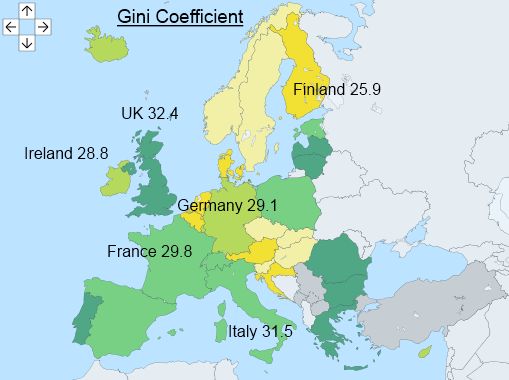
Eurostat puts Ireland’s Gini coefficient well below the 2009 EU average of 30.4. The most unequal EU country in 2009 year was Latvia (37.4) while the least unequal was Slovenia (22.7). An EU map looks like this:

Light yellow countries are the most equal, dark green the most unequal.

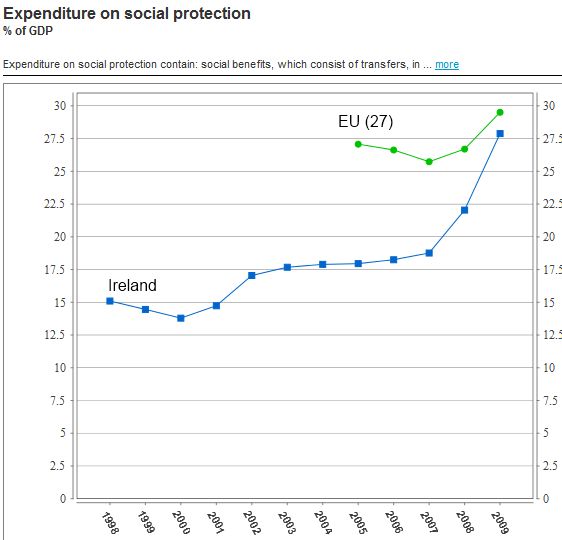
Ireland by this measure is more equal than Germany, France or Italy, despite spending considerably less on social protection as a percentage of GDP (Ireland 27.9 per cent, Germany 31.4 per cent, France 33.1 per cent and Italy 29.8 per cent). This may be related to Ireland’s unusually young population, however, compared with the aging populations of the other countries.

Also, Ireland’s spending on social protection really did rise during this period. I wrote before about Fianna Fáil’s populist spending increases, funded by rising revenue from the housing bubble instead of politically-unpopular tax increases. After the recession hit, GDP decline and mass-unemployment sent social protection costs into a relative spike:

It is interesting, though, to see that Irish inequality was falling even when social protection spending was well below the EU average.

If we look at the other measure of income inequality, the income quintile share ratio, we see similar results. A few highlights:

Latvia: 7.3
UK: 5.2
Italy: 5.2
EU (27): 4.9
Denmark: 4.6
Germany: 4.5
France: 4.4
Ireland: 4.2
Norway: 3.5
Slovenia: 3.2

Ireland’s result here is the lowest score (meaning, most equal) for Ireland since the beginning of these records in 2001.

I think the fact that Ireland, by this measure, is more equal than the well-respected social democracies of Germany, France and Denmark is remarkable! Fianna Fáil were derided for being neo-liberal, even while steadily increasing social welfare and governing during a period of consistently declining income inequality.

There are plenty of things to take from this. First, the point that income inequality did not rise during the late 2000s bubble economy, a point remarked upon by the Economic and Social Research Institute in 2009, reflecting on the earlier boom of the 1990s:

Within the Irish labour market as a whole, the level of wage inequality fell markedly over the period but most particularly between 1997 and 2001.

This has wider significance for other countries pondering economic growth and inequality:  it seems possible to have rising wealth without rising inequality.

The really grating thing for me, however, is that this refutes loud and insistent claims made over the last few years that Ireland’s governments abandoned the poor and that inequality grew worse. Why did I keep hearing this, if the truth was precisely the reverse?

It reminds me of complaints in the US between left and right-wing commentators about mainstream media. Both deride the media, both believe it is biased against their side – never in favour of their side. I wondered sometimes if this was because convincing the public that a group (like a newspaper, a government, a political party) is biased, extreme and unreasonable will make their own extreme alternative appear mainstream and natural.

So maybe we hear these denunciations of modern Irish inequality from the left because they want the present situation to seem like an unacceptable extreme, and want to shift the norm leftwards.

Shane Leavy is a freelance journalist studying for a master’s in applied social research, and blogging at The Harvest, where this post first appeared.

Read Next:

Comments (100 Comments)

  • Mark Malone 08/11/11 #
    Report this comment

    “it seems possible to have rising wealth without rising inequality.” Really so we should ignore all the rest of human experience which shows that wealth creation is actually based on inequality.

    This kinda misses the point. Are we aiming for equality or should that be an afterthought from a few rich and powerful getting rich.

    “denunciations of modern Irish inequality”
    Inequality is inequality so what does this actually mean??

    Reply
  • David Higgins 08/11/11 #
    Report this comment

    Excellent article. I can’t believe we’ve been brainwashed for so long by Vincent Browne and his left wing guests on the Tonight Show. I always had a feeling he was making a big deal out of nothing.

    It’s clear the the far left and the unions are cooking figures for their own political benefit. Thankfully they’ve been exposed here!

    Reply
    • Niall Mulligan 08/11/11 #
      Report this comment

      Can you explain for me what a Gini Coefficient measures, please? And how it’s calculated?

      Seems to me that a rising income quintile share ratio could be equally indicative of a collapse in the upper middle class as any improvement in the circumstances of the least well off.

      Again, would be very interested in the top and bottom 10%, think that would be more revealing.

    • Ugatu Bekiddin 08/11/11 #
      Report this comment

      As much as I agree with the article, the author fails to point out that income distribution and the gini coefficient were bound to drop in the advent of catostrophic economic collapse.

      The incomes of the middleclass plummeted in the periods being measured, so, naturally, the gini coefficient will drop.

      Unfortunately, these statistics are misleading, even though I think that Ireland is actually a pretty equal society.

      As a side note, people complain about the “elite” and “wealth creation creating inequality”.

      Wealth creation does not create inequality. Wealth creation makes everyone wealthier. EVERYONE. The people creating the wealth get more wealthy than others, however. Without this incentive, the entrepeneurs would have no incentive to create wealth, and then the rest of us would not get wealthier.

      If you want to tell me that people haven’t got wealthier, take a walk through any council housing estate – they all have their giant plasma screen TVs in front of their living room windows because their homes are too small to put them anywhere else. If you have a car less than ten years old, you are not poor. If you have ntl, broadband, etc – you are not poor. You just don’t have what other people have. You aren’t entitled to what other people have “just because”. You’re entitled to a living – not to luxuries.

      People need to get this through their skulls.

    • David Conroy 08/11/11 #
      Report this comment

      Tell that to the woman who died for want of private health insurance, or the homeless man who died in a skip. Both in the last year of the bubble.

    • Ugatu Bekiddin 08/11/11 #
      Report this comment

      Are you serious?

      An old woman died because she didn’t have private health care?

      A homeless guy decided to stay in a skip instead of a homeless hostel?

      You have no right or entitlement to private health care. The State provides you with health care, and despite what the uneducated think, we actually have one of the best healthcare systems in the world (backed up by facts and statistics http://hdrstats.undp.org/en/indicators/72206.html).

      With regard to the homeless man that slept in a skip. As a State, we afford our citizens an incredible amount of social protection. We have free health care, the dole, social housing, etc etc etc. We have soup kitchens, the Saint Vincent de Paul, homeless hostels, etc etc etc. How far is the State meant to go? If someone decides to turn their back on society, what can the State do?

      It is sad that these things happened, but they are nothing to do with the boom or bust.

      Old people die. People are homeless for a variety of reasons (heartbreakingly, overwhelmingly due to addiction), and sometimes, despite all best efforts, homeless people die.

    • Niall Mulligan 08/11/11 #
      Report this comment

      Personally, I think this article is nothing more than a transparent polemic. For one thing, where are the figures prior to 2006? Is the author attempting to revise the collapse of the middle classes into a dramatic rise in equality?

      Also, all of this is based on income, what about assets? And what about non-executive directors, say? Or share-related income? Or income that’s funneled offshore? Or other asset-related income?

      Granted, I do think that Ireland remains a pretty good place to live, if you have work. Had considered emigrating to the UK for various reasons in the past 6 months, but ultimately decided against it for because of their evident inequality, class divisions and social problems. But, even having said that, we’re not much better than the European average, so I don’t think there’s cause for complacency.

      Another important point is that a measure of income inequality fails to capture the very real issue of social and political equality, which is an area where Ireland falls down. Fianna Fáil’s golden circle have financially crippled this country.

      “So maybe we hear these denunciations of modern Irish inequality from the left because they want the present situation to seem like an unacceptable extreme, and want to shift the norm leftwards.”

      So you’re basically saying everything’s fine now, is it?

    • David Conroy 08/11/11 #
      Report this comment

      Ugatu Bekiddin alright – I don’t even know where to start with this drivel.

    • Ugatu Bekiddin 08/11/11 #
      Report this comment

      “It is the mark of an educated mind to be able to entertain a thought without accepting it.” – Aristotle

      For a man who is such a fan of Ross O’ Carroll Kelly you’re pretty down on the one percent. It is a good divine that follows his own instructions.

    • David Conroy 09/11/11 #
      Report this comment

      I don’t know how to address an anonymous contributor, but here goes anyway:

      – Ross O’Carroll Kelly is a parody, not a documentary.

      – Aristotle’s quote from my FB page is not relevant here.

      – Given your new-found love of research, you might wish to google Susie Long. You will find that she was not old.

      – Homeless people do not choose to sleep in skips. This was a sick person who was let down by our state while it was awash with unsustainable money.

      – If you return to my page, you will find that I’m not big on “divines”.

      Apart from the above, your initial post in this thread was insightful.

  • Niall Mulligan 08/11/11 #
    Report this comment

    Having a relatively equal society by EU is like being the one of the hottest Eddie Rockets waitress. It’s not bad, but it doesn’t mean you’re good.

    Would be interested in an income decile(?) share ratio, rather than income quintile share ratio – I think that measuring off the top 10% and bottom 10% would tell us much more than the top and bottom 20%, which probably obscures more than it reveals.

    Also, I fear that these statistics may be radically different given a year or two.

    Really, the problem isn’t the top “quintile” but the tiny elite who milked this economy dry.

    Reply
    • P Wurple 08/11/11 #
      Report this comment

      “the tiny elite who milked this economy dry.”
      This may be the perception, but the whole point of the article is that it may not be based on reality.

      Also, hottest waitress sneer…. sexist much?

    • Niall Mulligan 08/11/11 #
      Report this comment

      I thought it was funny. Apologies for any offence – realise it’s borderline …

      The point is that the top “quintile” also contains the absolute elite, those “earning” millions and billions per year, rather than hundreds of thousands.

      What I’m saying is that statistical social science can tend to be dubious – statistics often (intentionally) obscure more than they reveal.

    • Orion 08/11/11 #
      Report this comment

      Agree with @ P Wurple on this one, not so sure that the ‘elite milked the economy dry’ as you put it. It was more a combination of insane government policy and non existen regulation of money lending.

      Also agree that this probably just shows the collapse of the middle class more than anything else.

    • Niall Mulligan 08/11/11 #
      Report this comment

      Well, we paid €700m to unsecured bondholders last week, owing to the activities of maybe 100 people by one estimate. And will be paying for years to come.

      So I think it’s a fair statement.

      Would be very interested in seeing a Gini Coefficient or income quintile share ration within the top 20%, I have a feeling that there may be quite a gulf … and the bottom 20%, for that matter.

    • Donal McCarthy 08/11/11 #
      Report this comment

      Hey comedian,

      The social police of other EU states are constantly held up as ones we should emulate. So if we are better than them it does matter.

      Also – I guess you’ve never had a real job?

    • Phillip Urrea 08/11/11 #
      Report this comment

      I’m really not that surprised by this. I found myself commenting to European friends during the boom times that for such large growth it was remarkably spread out – as these things go anyway. Unemployment was low enough as to be considered 0% (everyone employable was) and rising prices across the board highlighted the increased wage demands of Irish people (further highlighted by the difficulty of finding native-Irish people to cover service industry positions).
      Obviously a minority got super rich but the quality of life for the majority increased significantly as well. Unfortunately, now that we have large parts of the economy in negative equity, high costs of living, falling wages and rising taxes, and unemployment the 2010 / 2011 / 2012 statistics are going to get a lot worse and there will be a widening poverty gap.

    • Niall Mulligan 08/11/11 #
      Report this comment

      Held up by whom? The Scandinavian model is seen as one to aspire to, absolutely, but most of the rest of the European Union, not so much. Wish I hadn’t said it now, it’s admittedly a lame gag, and not really relevant. Was a bit early in the morning.

      Not that it’s relevant to anything but I’ve been working 9-5 solidly since I left college. Play the ball, etc.

    • P Wurple 08/11/11 #
      Report this comment

      So the bondholders are ‘the elite’ now?

      Do you not know that bondholders are usually pension companies? Not private individuals. Go and tell your grandparents you want their pensions wiped out.

    • Niall Mulligan 08/11/11 #
      Report this comment

      “owing to the activities of maybe 100 people by one estimate”

      This is the elite I’m talking about, the developers and bankers, not the bondholders.

      Fair point, Philip, I don’t think it can be denied that life for the majority got much better over the course of the boom – although just as there was a super elite at one end, my perception is that there was a sector of society which was left behind entirely – I don’t think “quintiles” are sufficiently narrow to tell us anything.

      You seem to know more about these things than I do – these measures are all income rather than asset based, right?

    • Donal McCarthy 08/11/11 #
      Report this comment

      Fair enough Niall – I was responding to your ‘joke’ as I found it both sexist and insulting to anyone who had ever worked in ER’s (like me).

      This is a classic case of moving the goal posts. Once we get some positive data you want to change the standard definitions.

      In saying all that if we were to follow your top and bottom 10% I guess it would skew things in favour of equality as the top 10% have lost billions whilst the income of the bottom has been relative stable. The income of 10 to 20 and 30 is where there has been real slippage.

    • Phillip Urrea 08/11/11 #
      Report this comment

      Fair play P Wurple – you’re dead right on the bondholders point. People like to think it’s some rich white guy sitting on a yacht but if you look at the list it’s primarily asset management companies that are tasked with investing the pensions of normal working folk.

    • joseph mcgee 08/11/11 #
      Report this comment

      p wurple
      yes, the majority of the bondholders are the elite.
      go find a list of them online.

      and any bondholders who were gambling recklessly with grannys pension fund should be shot. they should not be paid by taxpayers money tho.

      ur not a bondholder by any chance?

    • P Wurple 08/11/11 #
      Report this comment

      Not only are they not the elite, but bonds investment is considered low risk, rather than the stock market. so it’s pension holders at the end of their working life, and goverments.

      I have a pension, but mine is all in high risk. So no, I’m not a bondholder. But I will be in 20 years or so when I switch to low risk (if there is anything left. Pensions being the next bubble after all)

      Low risk pensions, and government pensions are bondholders.

    • Orion 08/11/11 #
      Report this comment

      See the thing is, most bankers are not ‘elite’ Most developers arent either, the actual amount if them is almost negligible.

    • Donal McCarthy 08/11/11 #
      Report this comment

      joseph mcgee – do you actually understand what a senior bondholder is?

      It is not a gambler by any sense of the imagination. Senior bondholders got the same rate of return as depositors. They are legally the same as depositors.

    • joseph mcgee 08/11/11 #
      Report this comment

      philip, u say the they are “aset management companies that are ‘tasked’ with investing the pensions of normal working folk”
      are you for real?????????????? you are trying to make it sound that these companies are doing the public a service.

      are u another possible bondholder?

    • Niall Mulligan 08/11/11 #
      Report this comment

      Lookit, Dónal, it was a lame gag, and I certainly regret having said it … take it from me, it’s no slur against ERs or anyone who’s ever worked there. I definitely need another cup of coffee.

      Getting back on topic, I don’t think questioning the methodology is certainly necessary – definitely not a case of moving the goalposts. From my own perspective, I can guarantee you that it’s not a case of trying to twist or neutralise these figures, I just want to be sure that they can be trusted.

      I recently finished a Masters in social science, always found that whenever you get pages and pages of “positive data”, the conclusion is normally counterintuitive and in some way right-wing. And normally any cursory reading of the methodology revealed gaping holes.

    • Orion 08/11/11 #
      Report this comment

      Well said P Wurple!!

    • joseph mcgee 08/11/11 #
      Report this comment

      yes donal i do.
      you may have accepted paying private banking debt.
      i have not.

      a question for u donal.
      in ur opinion, are the irish people being scammed?

    • Niall Mulligan 08/11/11 #
      Report this comment

      Didn’t pension funds back up Michael Milken, James Goldsmith, Tiny Rowland, and all the other asset stripping “robber barons” of the 80s?

      Just sayin’.

    • P Wurple 08/11/11 #
      Report this comment

      Oh for goodness sake. James Goldsmith etc were gamblers, not the holder of low risk deposit investments. Anyone who is a recipient of a govt pension is a bondholder. Anyone in a low risk pension fund is a bondholder. Joseph mcgee is more than likely a bondholder who doesn’t even know it.

      How everyone and their cat is now expert in these terms boggles the mind!

      Reminds me of how everyone was a property expert a few years ago…. that went well.

    • Phillip Urrea 08/11/11 #
      Report this comment

      No Joseph, I’m self-employed and I never organised a personal pension – it used to be something that I worried about but as they’ve been decimated over the last few years I probably got off lightly.
      As P Wurple pointed out – banks used to be considered ‘blue chip’, low risk investment so it would mainly be people that have worked hard all their lives and are close to retirement that are the bondholders.

    • joseph mcgee 08/11/11 #
      Report this comment

      philip, you say “it would mainly be people that have worked hard all their lives and are close to retirement that are the bondholders.”

      i think you’ll find that they were mainly shareholders, not bondholders.

      p wurple
      you sound like youre speaking more about yourself.

    • Niall Mulligan 08/11/11 #
      Report this comment

      Actually, the pension funds did invest heavily in the “robber barons” – asset strippers could promise returns that more conventional, ethical, investments couldn’t match, and the fund managers were legally obliged to seek the best possible return, as their only criterion in making an investment.

      While they may not have been gamblers themselves, they enabled the “robber barons” to pretty much gut and fillet the industrial base, particularly in the US and UK. Arguably a factor in the massive growth of the financial services, but that’s neither here nor there.

      Still wondering if anyone can tell me whether these indices cover just income, or assets? I know I could google it, but…

    • P Wurple 08/11/11 #
      Report this comment

      Yes, pension companies invest in all sorts of things, but they don’t do this on their own remit. Their customers approve it in advance. If you are paye you probably have a pension. I know most people ignore it, but we can all take a look at where our pensions are invested, and make more informed choices.

      Either way, asset stripping in the 80′s has nothing whatsoever to do with bank bonds today. Complete red herring.

    • Niall Mulligan 08/11/11 #
      Report this comment

      I’m just saying that this “we are all bondholders now” line is slightly disingenuous, that’s all.

    • P Wurple 08/11/11 #
      Report this comment

      What’s with the quotes, I don’t see anyone who said that here?

      I’m not a bondholder. You’re probably not a bondholder either as you are shiny new out of college. But bondholders are some kind of demonic elite as portrayed by the redtop media. The bogeyman doesn’t exist I’m afraid.

    • Niall Mulligan 08/11/11 #
      Report this comment

      As it happens, again not that it’s relevant, I’m into my second decade out of full-time education, did my masters by night.

      I don’t pay into a pension fund, true, because, with the way things are going, I think that I’ll be working till the day I die.

      Anyway, “we are all bond holders now” is my paraphrasing of an argument I’ve heard from quite a few people.

      I personally don’t buy it – I think it serves to obscure the historical, political and social reality – it takes finance to be neutral.

      This is all way off topic…

    • Donal McCarthy 08/11/11 #
      Report this comment

      Joseph – this isn’t private banking debt. It’s the debt of the State. Once the Guarantee was given the nationalization of Anglo was inevitable. Once Anglo was nationalized, its debts became the State’s debts.

      Do I think the Irish people are being scammed? We will only be able to answer that question in 10/20 years.

      And you clearly don’t know what a senior bondholder is. The grannies and grandads who lost all their dosh because they invested in banks shares were gamblers. Senior bonds are the safe part of any pension or investment portfolio. They are supposed to be the same as lodging the money in the bank.

    • joseph mcgee 08/11/11 #
      Report this comment

      donal if u tell me again that i clearly dont understand the situation re bondholders, im not going to be arsed responding to ur posts.
      i do not care whether its unsubordinated or subordinated debt.

      again, if u have accepted the banking debt as yours, good for u.
      if the government has decided its mine, they will find i will do my best to f@ck them over at every turn.

      regarding the scam.
      think about this,, where is the ecb getting this money to loan us?

    • Donal McCarthy 08/11/11 #
      Report this comment

      That’s real clever. We have no money and have to cut services and raise taxes so as to live within our means (we would have to do this regardless of the acquired bank debt) and your response is to ‘f@ck them over at every turn’; a perfect case of cutting off your nose to spite your face.

      If you have savings in a credit union, you are a bondholder. If you have a pension, you are a bondholder.

      The sooner that people realize that bondholders are not some sort of blood sucking financial creature of the night but are the lowest risk investor of all, the better we will all be.

      Of course, as investors, they can lose money, as many of the junior bondholders have done; however, senior bondholders can not lose money in a institution that hasn’t gone bust. Anglo was nationalized, therefore it didn’t go bust.

    • joseph mcgee 08/11/11 #
      Report this comment

      “That’s real clever. We have no money and have to cut services and raise taxes so as to live within our means (we would have to do this regardless of the acquired bank debt) and your response is to ‘f@ck them over at every turn’; a perfect case of cutting off your nose to spite your face.”
      I take that back. an angry response, i lashed out, i am wrong.

      “If you have savings in a credit union, you are a bondholder. If you have a pension, you are a bondholder.
      The sooner that people realize that bondholders are not some sort of blood sucking financial creature of the night but are the lowest risk investor of all, the better we will all be.”
      The majority of them are blood suckers. they are the large german and french banking houses. they invested in private irish banks, they lost and we have to pick up the tab. if thats not sucking the financial blood of of countries, i dont know what is.

      “Of course, as investors, they can lose money, as many of the junior bondholders have done; however, senior bondholders can not lose money in a institution that hasn’t gone bust. Anglo was nationalized, therefore it didn’t go bust.”
      factually correct. i guess the difference between u and me is that i believe that to give in to this unbelievable injustice means that we accept that democracy is basically a joke, and that we better get uses to years and years of austerity… and you would like us to be grateful to this banktatership??

      yes, we would have cuts to bring our national income into line with national spending.

    • Donal McCarthy 08/11/11 #
      Report this comment

      Joseph – fair enough re the taken back comment; unfortunately I think many people still think that is a rational position.

      I think we will just have to disagree on the makup of the senior bondholders.

      The problem is that according to the rules, they did not lose as the bank never went bust. When we wanted to renege on those bonds, we were asking for the rules to be changed and the people who are keeping our lights on said no.

      And this is the crux of the problem – we have no other source of finance. If we tell the ECB to get stuffed we have to live on circa €20Bn a year. If you think we are seeing austerity now…

      I actually think we will come good in the end. Either capitalism will collapse and all bets are off (and lots of people will finally get what they wished for) or it will all come back with a vengeance and Ireland will be poised to do very well out of it all.

    • David Conroy 08/11/11 #
      Report this comment

      Should have said “hottest waiter”. No negative comments then.

      Actually, for gender equality and trendiness purposes, Eddie Rocket’s use the gender-neutral term “waitron”. Could have saved yourself a heap of pc there Niall!

    • P Wurple 08/11/11 #
      Report this comment

      Awesome idea. We should role it out to all industries. Everyone can be judged on their “hotness” every day at work… I propose the scale should look like this:

      Goosebumps
      Room Temperature
      Tepid
      Mildly Feverish
      Having Fits

    • Niall Mulligan 08/11/11 #
      Report this comment

      Could’ve remembered that what’s funny in my head isn’t always funny to the rest of the world, and kept my fool mouth shut, David ;)

      Let’s just recap here, it’s been reported by those “in the know” and repeated by our President-elect in a Dáil debate that a group of maybe 100 to 150 people are responsible for the Anglo / banking debacle. This is the elite that hobbled the country. What was Fianna Fáil’s Ireland about other than nods and winks and “Golden Circles”.

      And I think we can all agree that turning the private misfeasance of this very small elite into a public debt was a mistake?

      Even accepting this as having been done, I don’t see why unsecured creditors should be paid, whatever their status – I fail to see the theoretical difference between this and any liquidation or bankruptcy. Secured creditors get paid first, if there’s anything left then the unsecured get as much as is available. Going straight to the taxpayer to make up the shortfall really isn’t good enough.

      Some of you also seem to be missing the point that these transactions are conducted through middlemen, who extract phenomenal profits – the faceless “investment vehicles” may not have the flamboyance or the profile of a James Goldsmith, but they do make the same vast amounts of money.

      Then there’s the secondary market in bonds, where the real bottom feeders dwell. Lest we forget that a 70% profit was made by some investors in the secondary market on Ireland’s payout last week. Can anyone honestly defend rewarding these vultures out of the public purse?

      Obviously, then, I don’t believe in some kind of moral right for bondholders to be paid in full. In fact, I think there’s a small element of Stockholm Syndrome going on in that “we are all bondholders now” argument.

      A “haircut” is certainly something that could and should be considered wherever possible – I am confident that there’s scope in the profit margins of the investment houses, and the frankly obscene remuneration they offer senior staff, to absorb the shock without seriously depleting the funds.

      I think it’s interesting that these guys can exist in a world without consequences, where massive, repeated failed investments can go unpunished. It really beggars belief.

      Personally, I think the whole system is rotten to the core. I will admit, though, that I did think the collapse of capitalism was going to be much more fun back when I was an undergraduate.

  • Orion 08/11/11 #
    Report this comment

    Very interesting…

    Reply
  • Joan Ryan 08/11/11 #
    Report this comment

    The phrase, ” lies, damned lies and statistics ” keeps popping into my hand.

    Interesting all the same.

    but doesn’t ring true somehow

    Reply
    • Ugatu Bekiddin 08/11/11 #
      Report this comment

      Fair play to you Joan for not being brainwashed by the “facts” and “statistics” that the right wing capitalist elite always try to force down our throats!

      Next they’ll be trying “logic” and “common sense”!

    • Joan Ryan 08/11/11 #
      Report this comment

      Ugatu Bekiddin

      I don’t know what to believe

      That was my point.

    • David Conroy 08/11/11 #
      Report this comment

      Does this study include the wealth of corporate persons also? Because it seems to my untrained eye that most of the money was disappearing into corporate entities to protect the human “head and brains” of those entities in the event of it all going where it went. If such “persons” are not included, the study is much less relevant.

    • David Conroy 09/11/11 #
      Report this comment

      Cathy’s links below might prove a little more enlightening in this instance.

  • John Cleary 08/11/11 #
    Report this comment

    ‘Loud and insistent claims made..Irelands governments abandoned the poor and..inequality grew worse. Why did I keep hearing this if the truth was precisely the reverse.’
    Well Shane, the ‘truth’ as you call it,is out there, but is infinitely more complex than this simplistic apologia for misgovernment would suggest.
    In fact, when Fianna Fail were removed office, at five to midnight, it could be argued that the country was more levelled than it had ever been, with every class bar the very wealthy brought

    Reply
  • John Cleary 08/11/11 #
    Report this comment

    ..low thanks to a legacy of austerity enforced by the selling out of our sovereignty.
    Thats their real contribution to inequality, Shane.

    Reply
  • John Cleary 08/11/11 #
    Report this comment

    Or equality, whatever way you want to look at it.

    Reply
  • Adam Magari 08/11/11 #
    Report this comment

    Ireland took seats on a time machine courtesy of Cowen-Lenihan’s policies. It is programmed to arrive somewhere back in the mid 50s – a country of small shopkeepers, emigration, widespread poverty, low paid jobs for the few in private employment, secure employment for public servants, high personal taxation, and elites in law, finance and politics skimming cream off the public purse. It was of course a ‘more equal’ society through shared hardship. Recently, I had a casual conversation with someone from the Vincent de Paul Society. I was shocked and humbled by what I heard. I suggest all the proponents of the ‘Ireland is not doing badly, propaganda brigade do likewise.

    Reply
  • John Sheehy 08/11/11 #
    Report this comment

    Fianna Fail has never been given credit for their social policies, ironically many of which have been consistently opposed by the so-called socialists.

    The Labour party and the trade unions are even more morally bankrupt than Fianna Fail, as we have witnessed with the apparatchiks insulating themselves from the economic crisis while preaching the opposite to their brainwashed followers.

    Ireland is still a great place to live if you can put up with the begrudgery and delusional expectations which are pandemic in Irish society.

    We need more Irish people to try living abroad just to see how well they have it in Ireland.
    There are very few countries in the world with better social protection, try living in America for example, the contrast is stark.

    Reply
  • Report this comment

    I live in Denmark. Ireland may have a more equal society but answer me this. Do you get 80% of your wages if unemployed in Ireland? Can you walk the streets of Dublin at 4am unafraid? Do you have state subsidised childcare facilities? Do you have efficient public transport, rent controlled housing? If not stop kidding yourself that somehow Ireland is more equal than Denmark based on statistics. I’ve lived in both countries and the difference is huge’

    Reply
    • Orion 08/11/11 #
      Report this comment

      I dont believe that somebody who is unenemployed should recieve 80% if their wages! How long do you get this for? Indefinitley?

    • Niall Mulligan 08/11/11 #
      Report this comment

      Whoa, didn’t spot that these figures place us as more equal than Denmark … that definitely can’t be right.

    • David Dancey 08/11/11 #
      Report this comment

      In fairness to Ireland we get very generous social welfare compared to our nearest neighbour the United Kingdom. And, based on my hazy recollections of OECD statistics, Ireland’s crime rate is quite low compared to some developed countries (do correct me if I’m wrong). And I have never had any issues walking the streets of Dublin late at night, although, I haven’t experienced much crime in most of the cities that I have visited (being 6 foot 3 has its advantages). Anecdotal evidence of crime can be wildly misleading of overall trends.

      From my (anecdotal evidence alert) experience, I could well believe that overall inequality may be decreasing, but the figures should be counted against the emigration rates. If all of those who felt that they had minimal income and no job prospects emigrated it would show up on the statistics as a decrease in inequality despite the fact that a large swathe of the populace might be stuck in poverty. Emigration fouls the stats.

    • P Wurple 08/11/11 #
      Report this comment

      Denmark is half the physical size of Ireland, but with a 20% larger population. Add another 2 million people paying taxes in Dublin and I’d say you would get better public transportation system alright.

    • David Dancey 08/11/11 #
      Report this comment

      Excellent point P Wurple. A widely dispersed population is harder to provide with services than a tightly clustered one.

    • John Murphy 08/11/11 #
      Report this comment

      P Wurple
      You would just get fatter cats!

    • P Wurple 08/11/11 #
      Report this comment

      Haha, probably right John.

      It still irks me when people are indignant about us not having a tube stop at our doorstep bringing us everywhere our hearts desire, when we simply don’t have the population density to support it.

      We have an excellent standard of living in Ireland, less moaning and more making the best of it would be what I’d like to see.

    • monkey magic 08/11/11 #
      Report this comment

      P Wurple

      Population density has little or nothing to do with providing well-functioning public transportation system. If Denmark doesn’t suit you as a comparison since it has higher population density than Ireland, try, say Finland. The country is four (4) times the size of Ireland with population of 5,5 million. With a well-functioning public transportation system. If Finland doesn’t suit as an example either, try maybe Sweden or Norway? Population density has little to do with their transportation systems functioning. Allocating public funds to them does.

    • P Wurple 08/11/11 #
      Report this comment

      I wouldn’t want to be taxed as they are in Finland either…. Unemployment insurance tax of what 18%? That’s on top of basic income tax, social security, plus pension tax yadda yada. Can’t have the shiny toys unless we pay for them.

  • Lou Brennan 08/11/11 #
    Report this comment

    The boom years just made more deluded people. Most remain deluded as does this survey

    Reply
  • Neill Wade 08/11/11 #
    Report this comment

    On the topic of financial “equality” I’d be very interested to learn about the disparities between wages paid to males and females for the same or similar jobs, both in Ireland and other European countries. I live in Belgium and a woman doing the same job as me gets paid a lot less. I reckon it’s high time this changed.

    Reply
  • Oran Drumgoole 08/11/11 #
    Report this comment

    What good is salarys getting closer if the spending power hasn’t changed?

    What was inflation in Ireland in the 00s?

    If I earned 15k early 20000 and managed to somehow double that to 30k. After inflation, how is my improved spending power in comparison to the poor person on 100k who’s salary only went up a half to 150k?

    Technically that is salary equalling out but somehow I don’t think the person on 30k is that much better off after inflation and I would hazard a decent guess that the person on 150k isn’t having too much trouble maintaining a decent living standard.

    Reply
  • Daire Kennedy 08/11/11 #
    Report this comment

    The 1st statistic in the article was from 2006 through to 2010. Shouldn’t it be “the bust made Ireland a more equal society?”

    Reply
  • Maeve Kelly 08/11/11 #
    Report this comment

    Why is it that I can’t move lately without hearing positive propaganda about ff?

    Reply
  • Aaron McKenna 08/11/11 #
    Report this comment

    From a particularly polarising figure, but the whole wealth vs inequality thing reminds me of Maggie’s famous line about it… “Socialists would prefer the gap be like this, not like this…” (Has to be watched)

    http://www.youtube.com/watch?v=okHGCz6xxiw

    Reply
    • Niall Mulligan 08/11/11 #
      Report this comment

      Wait …. let me understand this.

      You’re saying that you agree with Thatcher?

    • Aaron McKenna 08/11/11 #
      Report this comment

      That’s not what I said… But I thought the point was pertinent to the debate – The idea that statistics can be deceptive in these cases. IE we become “more equal” because middle incomes are decreasing, not because lower incomes are increasing.

    • Niall Mulligan 08/11/11 #
      Report this comment

      I’m a firm believer in the uselessness of quantitative methodology when it comes to social sciences, we can agree on that much.

      But even bringing Thatcher into a debate on equality turns my stomach. I honestly don’t know how the lady sleeps at night.

    • Nivag Yeoh 09/11/11 #
      Report this comment

      Heavy sedatives, I believe, Niall.

    • BJ 13/11/11 #
      Report this comment

      Niall, the IMF nearly took control of British finances prior to the election of Thatcher… She is fondly remembered by most hard working British people because she actually got Britain working!

  • Evert Bopp 08/11/11 #
    Report this comment

    Excellent article which clearly denounces much of the make believe nonsense we are fed most of the time.

    Reply
  • John Murphy 08/11/11 #
    Report this comment

    As far as I understand it ‘bondholders’ are in most cases private individuals putting their money with investment managers for a return to fund pensions etc. The level of risk is relative to how this money is reinvested – high risk/high payback – low risk/low payback. Government and bank bonds are considered at low risk as the fail rate is less likely.
    My problem with all of this is that the money market must have ‘knock-off switch’ where return to investors is negated (default if you like).. Where the very welfare of citizens and the sovereignty of a country is under threat in the interest of honoring these bonds ‘senior’ or ‘junior’ default is the only option – what use are bond dividends in a broken economy? The money markets should not take precedence over the sovereignty of states and at the risk of social collapse.

    Reply
  • John Murphy 08/11/11 #
    Report this comment

    Just to put the above comment into the context of the article. The value of statistics are dependent upon their source and extrapolation, of which in this case we are told nothing. The responses (#occupy etc.) to the current financial crisis is about how the political and financial systems are intertwined (sometimes in very questionable and underhand ways) and the the policies that are being adopted give precedence to the ‘markets’ over and above fairness, transparency and accountability.

    Reply
  • Cathy 08/11/11 #
    Report this comment

    It’s a shame you didn’t dig further. L

    Reply
  • Cathy 08/11/11 #
    Report this comment

    It’s a shame you didn’t dig further. Income inequality dropped faster than anywhere else from 95 to 2000. It then rose from 4.5 to 5 (95 levels) before dropping off again from 2006 on. The rise is documented in these figures from Eurostat http://appsso.eurostat.ec.europa.eu/nui/show.do?dataset=ilc_di11&lang=en

    Sadly FF did not build on the reduction of inequality throughout their term. Their policies on the early 2000s (bad Tiger years) actually increased inequality.

    On the other hand it is good to point this out (and Ronan Lyons also has a post on this). We are much less unequal than say the UK. A lot done more to do?

    Reply
    • David Conroy 08/11/11 #
      Report this comment

      I hope the FF apologists who have lauded this article as a welcome shot of anti-leftie sanity read down this far, Cathy. Well put.

    • Niall Mulligan 08/11/11 #
      Report this comment

      Excellent post, can’t believe I’ve missed it ’till now.

      [/thread]

    • John Murphy 08/11/11 #
      Report this comment

      Right on the money. Oops!

    • Gerard Murphy 09/11/11 #
      Report this comment

      Wondered why he did nt dig deeper myself!, but a trip to his blog answered that question! Seems the dude is fond of the neo cons and the neo libs, and like many of the Friedman followers they usually take the tiny bit of research that suits their agenda and blow it out of all proportions to make a point.! In research terms, for a researcher to make a statement that “The boom made Ireland a more equal society. Surprised?” based on data from a four year period is at the very least poor research and leaves the researcher open to the accusation that the piece of research is actually more ideology and less research

    • David Conroy 10/11/11 #
      Report this comment

      Thanks to Cathy and Gerard. I am surprised to find such an ill-researched piece of revisionist nonsense on the Journal, but I’m sure the intention was to set up a straw man for the purposes of debate.

  • Cathy 08/11/11 #
    Report this comment

    Ps Source for drop of Income Coefficient from 5 in 1995 to 4.5 in 2000 is here http://www.cpa.ie/research/seminars/presentations/2006-03-14_BrianNolan.pdf
    (Combat Poverty Agency)

    Reply
  • David Conroy 08/11/11 #
    Report this comment

    Given that Seanie Fitzpatrick was recently able to prove (to creditors) an income of only 186 euros per month, and that most of the wealthiest used the vehicle of multiple corporations to protect their personal assets, I would say that hefty pinches of salt are to be recommended all round.

    Reply
  • Martin Mc Cormack 08/11/11 #
    Report this comment

    Absolutely, before the tiger none of my neighbours had even loike one range rover

    Reply
  • Johnny Zillion 09/11/11 #
    Report this comment

    Yes, Ireland is a better place today than it was 20 years ago, totally agree

    Reply
  • Pete Gibson 11/11/11 #
    Report this comment

    My GP is paid by annoyed German taxpayers.
    He doesn’t even notice that the Germans regard the Irish public sector workers as spongers off the hard working German taxayers.

    Reply

Add New Comment