TheJournal.ie uses cookies. By continuing to browse this site you are agreeing to our use of cookies. Click here to find out more »
Dublin: 11 °C Monday 20 May, 2013

Column: What the Friday Firesale tells us about Ireland’s property market

Last week’s firesale of distressed properties saw the temporary return of property fever. But when the frenzy passed, economist Ronan Lyons believes the auction left us with some useful new information.

Ronan Lyons

FRIDAY SAW the return of something Ireland hadn’t seen in a long time: a property frenzy. Not only were buyers at the Allsop’s firesale auction spilling on to the street, so many people showed up with cheque books that they set up a live relay in Doheny & Nesbitts for those who turned up to gawk.

Given that there were probably three hundred transactions a day at the height of the boom, the fact that less than a hundred makes such headlines may surprise some observers. However, what people are starved of in the property market right now is information. Sellers and owner-occupiers don’t know what their homes are worth, while would-be buyers only have asking prices to go on.

Therefore, the fact that the details of 65 residential property transactions around the country were public is indeed newsworthy. Not only that, it can also help us shed light where the property market is at the moment. Clearly, we shouldn’t try to be too precise based on just 65 transactions, and it’s worth remembering that the bulk of the deals were probably done without a mortgage.

Nonetheless, Friday’s auction can help us at least get a handle on three important questions. Firstly, it can help us discover how far prices have fallen from the peak. Secondly, we can calculate how the prices achieved at Friday’s auction compare to the current level of asking prices. And lastly, and perhaps most importantly, it shows us what market agents think is a fair “yield” – or relationship between rents and house prices – for residential property in Ireland.

How far have prices fallen from the peak?

As part of my research in Oxford, I have developed a model of property prices in Ireland during the period 2006-2010. While it has been developed for other purposes, it can actually be used to calculate what a particular property was worth in a given quarter, and how that changed over time. Using the information available on each of the lots at the auction, such as location, number of bedrooms and property type, it is possible to calculate the approximate asking price of each property at the top of the market in mid-2007 and at the start of 2011.

While the properties that went under the hammer are not a representative sample from around the country – there are no properties from Munster, for example – the typical asking price at the peak of the market was close to the national average: €375,000. The typical selling price at Friday’s auction was €140,000, which is a fall of 65 per cent from the peak.

This varied, obviously, by property – and there are outliers. One property in Renmore in Galway sold for a price that was barely 25 per cent below the typical asking price for similar properties in 2007 and about 18% above current asking prices. One would hope that there are individual circumstances about the property (or perhaps the buyer) that justify such a high price. At the other end, a three-bed semi-d in Mullingar sold for just €30,000, almost 90% below the peak of €230,000 for such properties. Perhaps it’s in a particularly bad neighbourhood.

What is the gap between asking prices and closing prices?

We can use the same information to work out the gap between the prices that sellers are advertising at the moment, and then compare that with the prices achieved last Friday. The typical asking price in early 2011 for the type of properties sold at Allsop’s auction would be just be €210,000, compared to the €140,000 achieved. This means that the gap between advertised prices and auction prices was a pretty significant 33%.

When discussing the Daft.ie Report, I am often asked what the gap between ask and close is and I have until now said we don’t know but that 10 per cent, or €20,000 on the typical property, was probably a good starting point. This suggests the gap is closer to €50,000.

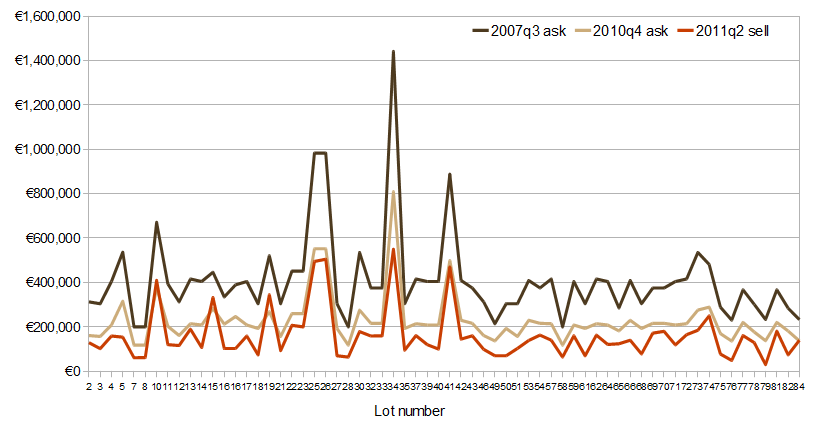
Estimated peak and current asking prices for the firesale properties

Estimated peak and current asking prices for the firesale properties

The estimated peak asking price, estimated current asking price and the price actually achieved for each lot are in the graph above. The quickest way to find out which lot number corresponds to which property is to use NAMAWineLake’s table. (You can see the Raglan Road mews sticking out as Lot 34!) One thing to note is that current asking prices (the light brown line) are closer to the auction prices (red) than peak prices (dark brown): “average” prices may still have further to fall but it looks at though the bulk of the adjustment has been made.

What is the new relationship between rents and house prices?

Ultimately, as an economist, I believe that the relationship between rents and house prices is the true measure of whether a property market is in balance. The annual rental income as a fraction of the property price should look like an attractive savings rate on a deposit account: if the savings rate is 3 per cent or 4 per cent, those putting their money into property will probably want closer to 10 per cent, as a reward for the risk they are taking.

The property market bubble destroyed this fundamental relationship between rents and house prices. The yield went from an average of 8 per cent in 1998 and 1999 to about 3.5 per cent in 2006, as rents were static but house prices rose substantially.

The rich data provided by the auctioneer on rental income from the properties for sale in the auction means we can actually see what sort of yield people investing in property are looking for.  We can also use Daft.ie rental data to fill in the blanks where that is not known and come up with an estimated yield for the entire batch of Allsop properties.

The typical gross yield (12 months’ rental income as a proportion of the price) at Friday’s auction was between 8.5 per cent and 9 per cent. The properties that are definitely investment properties – they have existing tenant contracts – have a median yield of 9 per cent. Those that look like owner occupier purchasers look like they were bought factoring in a noticeably lower yield, typically 6 per cent.

How can I use Friday’s results to find out what a property is worth?

This is very useful information for would-be first-time buyers and indeed anyone who wants to know the value of their property. Looking at a particular property, you can of course just wipe 65 per cent off what you think it was worth at the peak and you will get what it probably would have got at Friday’s auction.

A more scientific way – one I’ve gone through before in my rent-or-buy calculator – is to look at the annual rental cost for the property you’re interested in. If you want to come up with an offer similar to the owner-occupiers last Friday, divide that figure by 0.06. If you want to bargain hard and only offer what an investor would, divide that figure by 0.09.

So if you’re looking at a four-bed family home in the Dublin commuter counties, the monthly rent of €900 translates into annual rental costs of €10,800. Friday’s owner-occupier buyers would tell you to offer €180,000 (10,800 divided by 0.06). Friday’s investor buyers would tell you to offer just €120,000.

Read more like this at Ronan’s blog >

Read next:

Comments (10 Comments)

  • Like poor lambs to the slaughter!

    Reply
  • anybody out there? helloooooooo………(echo)

    Reply
  • Hello Ronan
    Thank you for your comment.
    I hope you don’t mind if I pass on checking out another Toothless position on mortgage arrears (and related topics such as debt forgiveness and negative equity). Its just a shame you are unable to share with us how you really feel about seeing your countrymen and women with 100,000 penal distressed mortgages being exploited . Unfortunately most of our commentators are so removed from this reality that they really think they are telling the unbiased truth.

    Distilled Media You say? By definition the distillation process purifies.How pure is our Media Ronan?
    Conspiracy you say
    100,000 distressed mortgages and counting?
    Number of mortgages on interest only?
    Number of mortgages on trackers?
    The banks we now own putting up the interest rates on our mortgages?
    Amount of non recourse commissions collected by bankers who recklessly dished out these dodgey mortgages?
    Amount of non recourse commissions collected by bankers who recklessly mis sold (sometimes to vulnerable pensioners) dodgey investment products (where advice like your capital is fully protected was replaced by it rarely goes down)?
    Amount of non recourse revenue collected from property industry advertising?
    Properties being sold for a quarter of the mortgage outstanding?
    2 Suicides a day?

    You say:(1) These properties were probably overwhelmingly bought debt-free.
    I say: Lets work on facts Ronan not probabilities,there are peoples lives and futures at stake here.

    You say:(2) These properties were all being sold by HBOS, a UK bank who probably have an ongoing relationship with Allsop’s.
    I say: Why? Is HBOS’s (Bank of Scotland Ireland’s) relationship not good enough with the Irish Auctioneers who valued these properties a few years ago at 4 or 5 times more than the auction result prices/the current true values?
    (Or maybe HBOS’s/BOSI’s relationship is not good enough with their loyal Irish customers who took out mortgages with them a few years ago based at 4 or 5 times the auction result prices/current true values?)

    You say :(3) As per (2).
    I say: The boom time penal jumbo mortgages were given out with the help/services of Irish auctioneers, why aren’t their services good enough now?

    You say: (4) It’s the auctioneer’s job to get the best price.
    I say : Yes but Fairly Transparently and without the commentators inaccurate spin/disparancy/sensationalism,
    They are interfering with our friends and family’s homes, livelihoods and futures here!!

    You say :(5) There were 85 lots in total, 65 (by my count) were residential properties where the price is known, hence my analysis was restricted to those.
    I say: Please correct me if I am wrong here. According to the auction’s results on the Space website http://www.space4u.ie/auctionresults.aspx
    There were 84 lots 8 of which were not residential lots 9,31,38,45,55,56,67,8.
    Leaving 76 residential properties.
    Lot 24 a flat in Rathfarnam sold after, result not published on auction website.
    Lot 36 a flat in Galway sold after,result not published on website.
    Lot 75 a house in Tinryland Carlow remains unsold.
    Leaving 73 residential properties with result prices published on the Space website.
    So would you not agree that there are 73 residential properties where the price is known?
    Anyway regardless of the above.
    Why I am asking question number 5 is because when I was at the front of the Q outside the auction on Friday when lot 7 and 8 in Portlaoise were ”sold”.
    I can confirm these lots didn’t sell to anyone on the steps outside the Shelbourne.
    On the RTE1 Mary Wilson Show Podcast from the Day of the auction there is live auction audio at 5 minutes 54 seconds of the auctioneer in the Shelbourne selling lot number 7 an apartment in Portlaoise to a bidder outside on the steps of the Shelbourne for €61,000.
    Ronan tell me (using factual evidence) Is there any way of verifying this mysterious buyers identity?

    Not to even mention the disparities in the media coverage about the amount of people there.
    Was there 850? 1000?or even 2000 people at the auction?
    Irelands next property boom as arrived!!!!
    To buy advertising space please phone 1800-d.i.s.t.r.e.s.s.e.d.i.e!!! NOT!!!

    You say : (6) I’m an economist, not a lawyer, but I imagine law of contract would kick in if anyone tried to pull out. As I understand it, people had to prove they had the cash to become a bidder so the bank knows they have the cash.
    I say : I was inside the auction and bids were accepted from anyone who waved their hand in the air.
    They did ask some of the people who entered the auction for a look at their checkbook and photo ID but not everyone, so in fact you could place a bid without this.
    Even so Ronan producing a checkbook does not prove to the Auctioneer that the bidder has the cash let alone prove it to the bank .

    You say :(7) This one really made me smile!
    I say :Smile you may but Its always a good barometer if people in the property industry are actually buying property themselves (taking their own advice or eating their own cooking as such)
    Its not long since that a repossessed property in our town was sold (off market) for pittance to the wife of one of the officials working in our local bank.
    (One of the fine pillar banks of our country I might add)

    Ronan
    The auctioneers claim that most of these properties are sold fully tenanted.

    According to the industry ”Gurus” the properties were sold with rental yield mostly between 7% an 10%.

    So as compensation to the people who have been ”encouraged” (by the banks,regulators,industry commentators and all the other vested interests) into taking out these ”Dangerous Penal Mortgages” these banks should.

    1.Leave the properties in the possession of the people who put their hard work, money and time into these properties over the years (home owners and buy to let investors alike) .

    2.Leave the properties in the possession of these people and write down these penal unrealistic loans to the true level based on a (sustainable long term) rental income yield of between 7% and 10%.(which the Irish property industry and the offending banks now maintain is the actual true value of these properties, however we would have to truthfully take the 10% figure because most the properties auctioned at the Shelbourne were purchased well over their actual true current value )
    Eg If the annual rental income on your property is €12,000 per year (€1000 per month) then your property is worth €120,000 (based on a 10% yield) thus the bank should write down your loan using the original loan to value of say 80% of €120,000, so your loan would now be €96,000 (which is realistic and sustainable taking into account that you would be making capital and interest repayments and allowing for interest rises)
    These banks (including) our banks should also be forced by law into offering long term realistic fixed rates of 10,20 and 30 years and capped rates (the same as those offered to our European counterparts)
    so as to avoid a debacle like this to ever happen again in Ireland.

    3.Then these banks should make a public apology to these people,their families and try to compensate in some way the families of those who took their lives at the hands of these ignorant bankers who used our prehistoric bankruptcy laws to vilify and criminalize people to the point of premature death and suicide.
    Leaving Irish children without their parents!
    Leaving Irish parents without their children
    Leaving Irish wives without their husbands!
    Leaving Irish husbands without their wives!
    Leaving Irish people without their loved ones!
    And as for our great political leaders who are getting highly paid to ignore the obvious!
    All that I can say is!
    At least there is one brave Irish politician who was not afraid to speak up about these grave Irish tragedies!
    Yes our very own Bill Clinton!!!

    By following these 3 simple steps above?
    I believe these banks can
    Immediately reduce the loss of human life!
    Immediately increase the life expectancy of their customers!
    Immediately increase the level of trust and respect people have for them!
    Immediately reduce the level of embarrassment to themselves!
    Immediately clean up their balance sheet by converting bad loans to good loans ( having mortgages to 10% yield properties on their books instead of distressed mortgages)!
    Immediately clean up their balance sheet by converting customers they call bad into customers they call good!
    Immediately decrease the level of abuse their front line workers take from distressed frustrated betrayed customers on a daily basis.
    Immediately reduce the money they waste on auctions,advertising,retraining staff not to mention the reputational damage of having to do their dirty laundry in public.
    Thus allowing us all to move on from here!

    Reply
  • To the People of Ireland…stop taking investment advice from Irish sources such as realestate gurus,
    Irish newspapers and the government. instead…spend 4 or 5 euros for a copy of the Wall street journal,Barron’s,The Econonomist magazine, ect…
    Buy now and it’ll be worth 30% less a year or two from now….sorry.

    Reply
  • Great analysis, thanks. There really is a massive thirst for accurate information about sale prices; it’s one of a number of things making the mystery of purchasing a house even harder.

    Any news about that information being made public?

    Reply
  • Excellent piece. A real insight into how house prices stand in the current climate. Thank you.

    Reply
  • Hi guys,
    Thanks for the comments, I’m glad the piece was of use.
    @Eoin
    The last government had put a start to a public database online of purchase prices (similar to the UK’s). It’s stalled a little bit with the change in government but I would still think that it should be in place by the New Year. Fingers crossed.

    @Michael
    The important thing to remember is the difference between money and wealth. Money didn’t disappear with the credit crunch, wealth did. If a share in a particular company goes from €20 to €1, and that company goes from €20bn in valuation to €1bn, that’s €19bn in wealth that has been destroyed. The same principle applies for property. The residential Irish property market was worth about €560bn at the peak of the market and is now worth probably €300bn. Unfortunately, while wealth can disappear over night, because it depends on someone else valuing what you have, debt cannot, because it’s a contract you’ve signed.

    As the saying goes, “wealth is imaginary, debt is real”.

    Reply
    • Hi Ronan

      You say above.
      ”FRIDAY SAW the return of something Ireland hadn’t seen in a long time: a property frenzy. Not only were buyers at the Allsop’s firesale auction spilling on to the street, so many people showed up with cheque books that they set up a live relay in Doheny & Nesbitts for those who turned up to gawk”.

      You must daft(.ie) Ronan!!

      My brother and I were at the auction all day both inside and outside and very few people we spoke to brought checkbooks.

      You might please back up your check book statement with some facts!

      You might also ask your (We’ve Xrayed everyone and they are all carrying checkbooks) source at the auction, who is the person Allsops claimed (on national radio on Friday evening) bought the apartment in Portlaoise on the steps outside the Shelbourne because I was outside at the front of the Q when both of the Portlaoise apartments went through and there was no buyers outside.
      (Maybe we can sift through the Shelbournes CCTV footage for some proof, at least it would be more neutral than the skewed perspective of the media’s TV cameras) (although the Shelbournes is now owned by the biggest bidders in town your buddies at NAMA so its hard to know who to trust these days)

      Ronan, from your years of experience at daft.ie you might answer some important questions like.

      (1) Why are our Banks selling the homes from over people’s heads for a quarter of the amount of mortgage that is owed on it labeling them bad debtors and at the same time funding their ”Vulture Fat Cat Chums” to buy these homes thus making their vulture chums good debtors?
      Please note here:
      These ”evictees” have been loyal customers of our banks for decades and paid them tens of thousands of Euros.
      They have made them more profits than the Spindoctor who boasted on the Marian Finucane Show on Saturday about ”Flipping properties for a profit”

      Would it not be more intelligent for these banks to come to an arrangement leaving the good paying home owners in situ?
      ( the banks never recoup the shortfall between the mortgage outstanding and the selling price anyway)

      Would it not pay these banks better to facilitate the honest loyal hardworking homeowners whose only fault was to want to put a roof over their families heads (in their own country) than instead trying to criminalize them whilst these banks (our banks) fund their ”Chocolate Mouthed Chums” property speculation habits.

      (2) Why was a UK company (Allsops) hired in to dispose of these properties (with all the out of work Irish auctioneers in the country)?
      were they drafted in like mercenaries to do the dirty work?

      (3) Why there didn’t seem to be anyone from Space auctioneers (Allsops Irish Partners) at the Auction?

      (4) Why were these (Lock Stock And Barrel Lookalike) auctioneers using ”Nightclub Style Rent A Cue Spin” tactics at the auction and why did they think they needed to?

      (5) Why were there so many conflicting stories in the media about the auction about (1) the amount of people there some said 1000 some said 2000 (2) the amount of properties sold some said 65 some said 80 (3) some like yourself even made references to ”Frenzied Checkbook Wielding Buyers Spilling Into The Street” etc etc etc etc etc.

      (6) How many of these so called sales do you think will actually complete?

      (7) Are any of your chums at daft.ie snapping up these distressed sales?

      You say some people turned up to Gawk at the auction Ronan!

      And I have to say I was there to Gawk aswell as you call it!

      We all have the freedom to Gawk Ronan!

      And the hundred thousand other people in Ireland with distressed mortgages should have been there to Gawk!

      To Gawk and see what these Banks, Media, Property Industry and Bought Out Washed Up Economists
      Spin Doctor Vested Interests types think are homes and land are worth now Ronan!

      Reply
    • @Hello Spruiker
      It’s probably worth checking out my position on mortgage arrears (and related topics such as debt forgiveness and negative equity) before accusing me – and seemingly the others who work for Distilled Media including thejournal.ie team – of being part of some grand conspiracy of “vulture fat cats” and “bought out washed-up economists”!
      However, I’ll do my best to answer – briefly – your questions:
      (1) These properties were probably overwhelmingly bought debt-free.
      (2) These properties were all being sold by HBOS, a UK bank who probably have an ongoing relationship with Allsop’s.
      (3) As per (2).
      (4) It’s the auctioneer’s job to get the best price.
      (5) There were 85 lots in total, 65 (by my count) were residential properties where the price is known, hence my analysis was restricted to those.
      (6) I’m an economist, not a lawyer, but I imagine law of contract would kick in if anyone tried to pull out. As I understand it, people had to prove they had the cash to become a bidder so the bank knows they have the cash.
      (7) This one really made me smile!

      Reply
  • Good piece Ronan.
    There’s been a lot of talk about how money has disappeared since the so called credit crunch (remember that). You know, someone buys a house for €300k and now it’s valued at €175k, or whatever. I have no idea who the buyers were at Friday’s Allsop “firesale”, but can’t help wondering if many of them are where the money went. The people who sold sites down the country for huge sums. And now it’s time to realise that money in a deflated market. The only way is up…

    Reply

Add New Comment