We need your help now

Support from readers like you keeps The Journal open.

You are visiting us because we have something you value. Independent, unbiased news that tells the truth. Advertising revenue goes some way to support our mission, but this year it has not been enough.

If you've seen value in our reporting, please contribute what you can, so we can continue to produce accurate and meaningful journalism. For everyone who needs it.

Alamy Stock Photo

Parenting When I became a mother, I didn't know it would turn me into a total softie

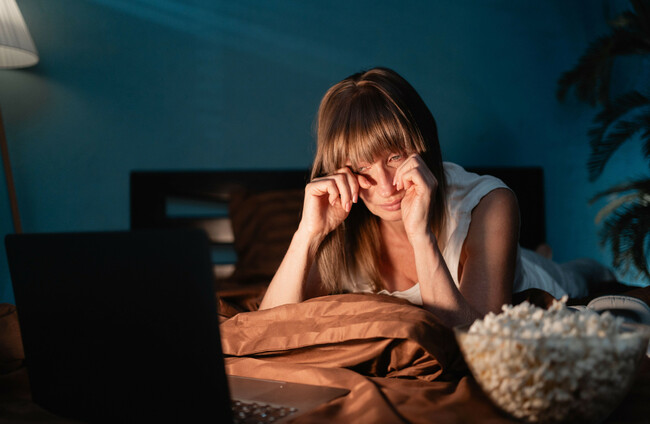
The minute Margaret Lynch had her first child, her heart blew wide open and every moving scene around her set her off, and that’s okay.

LAST UPDATE | 8 Mar

IT’S NOT THAT I ever found joy in the suffering of children or animals, I just didn’t really give much thought to things that didn’t directly impact me.

I was 24 when I had my first daughter and life up until that point had really just been about me, my needs and what I wanted or needed to do. Before having kids, I was a normal person, who had normal responses to situations. I could watch horror movies (from behind a cushion), slashers, thrillers, murder mysteries, end-of-the-world catastrophe movies, anything I wanted!

I could easily grasp the concept of TV, and actors, and it not being real. I absolutely never, not even once, ever cried at TV, and I wasn’t even proud of that fact, instead, I thought that anyone crying over a movie was weird.

A rush of empathy

Since having kids, I have the emotional bandwidth of a cheese single, and anything can, and will, tip me over the edge. The John Lewis Christmas Adverts with all the feelings, or The Toy Show with the sick children living their lives with more courage and bravery than we can imagine.

Andy giving his toys away in Toy Story, any Disney movie where the parents die (so, all of them), wildlife documentaries, most news articles, an advert selling puppies, even Finding Nemo! I actually watched that one before having kids and barely even registered it, and then put it on for my two when they were little and was absolutely inconsolable after the poor mammy fish died. I am even getting choked up now thinking about it. She died trying to save her babies!

It’s not just that having kids made me more emotional, it’s that it changed me on a molecular level. I think about everything differently. The first time it happened was the day we brought my eldest daughter home from the hospital. Obviously, this is a hugely emotional day, fraught with stress and nerves. Neither of us were really sure what to do. Once we got her settled into her basket, her dad put on Saving Private Ryan, which, although it was a strange choice given the occasion, I wouldn’t have thought it capable of unravelling my mental health.

Now, to be fair, I was only home from the hospital. My world had just been up-ended, I hadn’t slept in three days, and I was a little woozy from strong painkillers. I was already terrified. At some point during the movie, he glanced over and asked if I was OK. ‘I’m fine’ I shrieked at a pitch that was far too high for normal conversation, from the edge of my seat with fingernails digging into the couch.

But I wasn’t fine, I was losing my marbles. I couldn’t stop looking at all the bodies on the beach (I think there was a beach, but I can’t watch it again to check, you’ll have to take my word for it) and thinking that someone had grown each one of them for nine whole months. Someone has a (likely horrendous) birthing story for every single one of them, and shared it for the rest of their life.

Someone taught them to roll over. Someone made their favourite food when they had a bad day. Someone wondered when their hair would grow and which side of the family they looked like.

Obviously, at some level, I knew that this was a movie, with actors, but that level was entirely inaccessible to me. Emotion had taken the wheel. I was heartbroken for their poor mothers. For the person who cut their sandwiches just right, tucked them in at night, and reminded them to brush their teeth. It takes such a staggering amount of work to get a baby to adulthood, and to think that it can all be wiped out in a second? It was such a waste. 

Anyway, I’d like to say that I have since returned to my senses and that things are back to normal. But that would be a lie. In fact, it has only gotten worse. The well of empathy that had been cracked open inside me was not just limited to movies. I literally cannot hurt a fly without wondering if the fly has a mammy somewhere waiting for him to come home.

Or maybe the fly has babies, and they are all at home somewhere, hungry and frightened, waiting for her to return. If I see a line of ducklings following their mammy duck home to safety, I am sniffling. That awful video where the baby ducks fall into the drain because their little feet were too small to cross the grate? Devastated.

The recent story of the 98-year-old woman who moved into a nursing home to care for her 80-year-old son because he is still her baby? Don’t speak to me.

Now initially, as I’m sure you can imagine, this was all very inconvenient. I had a small baby to look after, shattered fragments of life to piece back together, and here I was crying over dinner because there was a small bean left in the tin after I poured it into the saucepan and I was wondering if it was a baby bean who has now lost his mammy. It felt like my heart was an open wound, and I suppose in some ways it was, because our kids are our hearts. And my heart now has to live outside of my body, independently of me, and I just need everyone to not be mean to it! It felt like a weakness. It was exhausting.

Strength in empathy

In recent years, though, I have come to see it as a strength. I have spoken to friends who feel the exact same way, and there is research confirming that your brain does change after having kids, neural pathways are re-wired and a ‘parental caregiving network’ is activated, engaging areas for empathy, social processing and emotional understanding.

Realising that we are all someone’s baby means that we look out for all other children the way we would our own. It keeps everyone safe, or it tries to anyway. It’s the driving force behind parents banding together to confront societal issues, the reason why we have speed bumps in residential areas, safe public playgrounds, or nuts banned in schools.

It’s the same instinct that makes every mother turn around in public when she hears a small lost voice call ‘Mammy?’

That deep well of empathy is a connection to all other mothers, and that link means I now protect, care, mind and grieve all others– even if those others are a random fly in my kitchen or a cartoon fish in a movie.

It guides me as a mother, and a human, in this very turbulent world, and it shows me time and time again that emotional strength, compassion and empathy are the very tools that we need more of, along with a very large box of tissues.

The world really should be run by mammies.

Margaret Lynch is a mother of two and is parenting columnist with The Journal.

Readers like you are keeping these stories free for everyone...
A mix of advertising and supporting contributions helps keep paywalls away from valuable information like this article. Over 5,000 readers like you have already stepped up and support us with a monthly payment or a once-off donation.

Close
JournalTv
News in 60 seconds