We need your help now

Support from readers like you keeps The Journal open.

You are visiting us because we have something you value. Independent, unbiased news that tells the truth. Advertising revenue goes some way to support our mission, but this year it has not been enough.

If you've seen value in our reporting, please contribute what you can, so we can continue to produce accurate and meaningful journalism. For everyone who needs it.

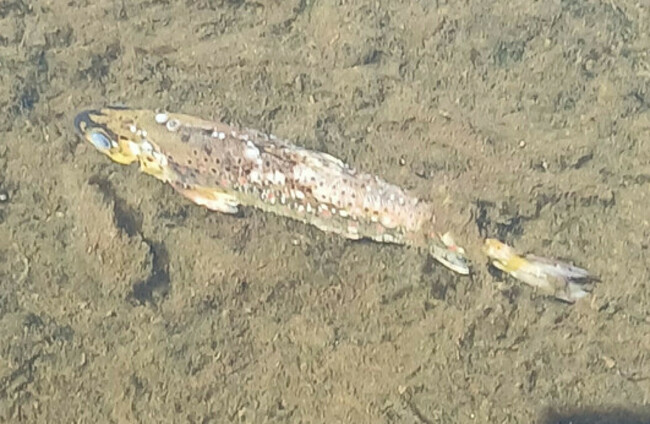
A dead fish following a fish kill in the River Blackwater in north Cork in August IFI

Committee warned fish kill from recent Cork incident could run into the ‘hundreds of thousands’

An inter-agency report estimated that up to 32,000 salmon and brown trout died when an unknown environmental irritant entered the water.

AN OIREACHTAS COMMITTEE has been warned that the fish kill from a recent incident in the River Blackwater in Co Cork could “run into the hundreds of thousands”.

The incident happened on a 30km section of the River Blackwater between Lombardstown and Killavullen in North Cork.

The fish kill was first discovered by anglers on the morning of Monday, 11 August but no sampling took place by Inland Fisheries Ireland (IFI) until a full 24 hours later.

Early testing is seen as important in establishing the likely causes of the fish kill.

According to the IFI, the first testing took place at 1.30pm on August 12 in the area of Blackwater Bridge, with further samples taken at 2pm and again after 4pm that evening at other locations.

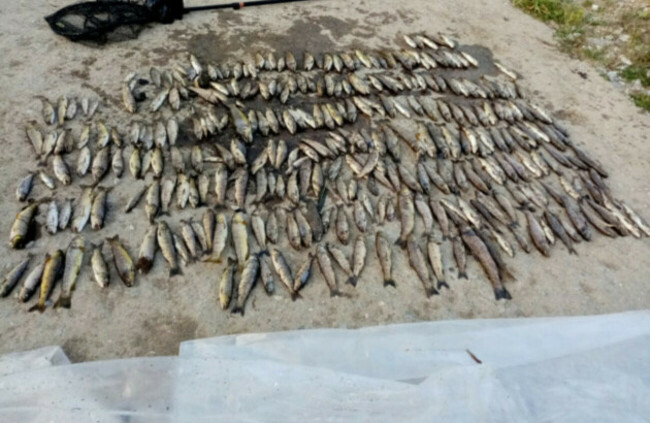
river (32) Image from the fish kill at the River Blackwater in August

Last week, an inter-agency report estimated that up to 32,000 salmon and brown trout died when an unknown environmental irritant entered the water.

But despite the significant investigation, the report stated that the pollutant or source that caused the large fish kill could not be identified.

Analyses of deceased brown trout from the river found no evidence of disease, chemicals, pesticides or heavy metals.

The main conclusion from the report is that a waterborne irritant likely entered the River Blackwater at an upstream point some 72 hours before the first mortalities were observed.

The report estimated that the irritant dissipated quickly, explaining why it was not detectable in water samples and fish tissue samples.

The recent fish kill in the River Blackwater was discussed at an Oireachtas Committee yesterday.

Conor Arnold was among the witnesses to address the committee.

He’s the Chairperson of Killavullen Angling Club and also owns an angling centre on the River Blackwater.

He told the committee that the figures of the fish killed released by the inter-agency report did not include “juvenile fish or fry, which are up to one or two inches in length”.

He said that when juvenile fish and fry are taken into consideration, the number of fish killed “could actually run into the hundreds of thousands”.

He went on to claim that the investigation was “fundamentally flawed and uncoordinated”.

Arnold questioned why it took around two weeks for an inter-agency group to be established to investigate the fish kill.

He added: “Ultimately, the time lost plus the state bodies complete inability to observe international best practices during their investigations has resulted in a lack of evidence which has made an appropriate prosecution very difficult.”

Arnold called for “extensive” habitat restoration programmes, constant water quality monitors to be “strategically placed into the river” and for these monitors to be under the remit of a “rapid response team to give one single focal point in any investigations”.

He also called for the removal of all commercial netting and increased fines on facilities that discharge into the River Blackwater.

“The distressing scenes of thousands of dead and dying fish in the River Blackwater has outraged the community and we demand answers and solutions,” said Arnold.

“We cannot simply allow this to happen again anywhere in this country.”

Meanwhile, IFI used its opening statement to express alarm at the “catastrophic environmental incident”

“Such events must not, under any circumstances, be tolerated on our rivers or lakes,” said IFI.

IFI said the fish kill prompted one of the “most extensive investigations in Inland Fisheries Ireland’s history”.

“Despite comprehensive efforts, the precise cause of the event remains undetermined,” added IFI.

Readers like you are keeping these stories free for everyone...
A mix of advertising and supporting contributions helps keep paywalls away from valuable information like this article. Over 5,000 readers like you have already stepped up and support us with a monthly payment or a once-off donation.

Close
12 Comments
This is YOUR comments community. Stay civil, stay constructive, stay on topic. Please familiarise yourself with our comments policy here before taking part.
Leave a Comment
    Submit a report
    Please help us understand how this comment violates our community guidelines.
    Thank you for the feedback
    Your feedback has been sent to our team for review.

    Leave a commentcancel

     
    JournalTv
    News in 60 seconds