We need your help now

Support from readers like you keeps The Journal open.

You are visiting us because we have something you value. Independent, unbiased news that tells the truth. Advertising revenue goes some way to support our mission, but this year it has not been enough.

If you've seen value in our reporting, please contribute what you can, so we can continue to produce accurate and meaningful journalism. For everyone who needs it.

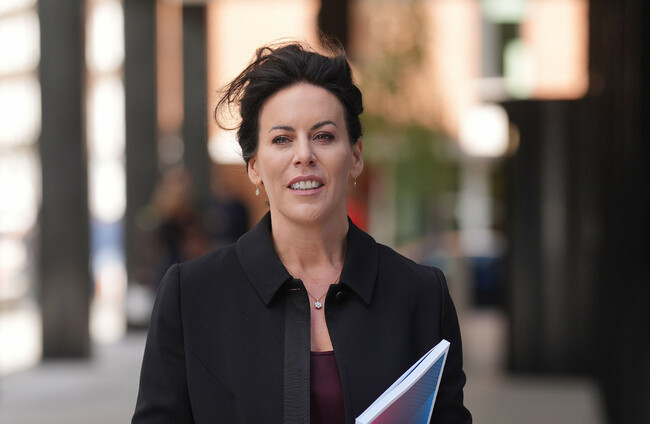
Jennifer Carroll MacNeill told the Oireachtas Committee that she was 'careful' around her use of words Alamy Stock Photo

Health minister 'not happy' with spinal surgery waiting lists but won't call it 'an emergency'

Minister Jennifer Carroll MacNeill and HSE CEO Bernard Gloster were both before a Joint Oireachtas Committee this morning on hospital waiting lists.

HEALTH MINISTER JENNIFER Carroll MacNeill has said she is not happy with waiting lists for spinal surgeries and urology services but refused to describe it as an “emergency”.

MacNeill and HSE CEO Bernard Gloster this morning appeared before an Oireachtas Committee on the management of waiting lists for hospital treatment.

Senator Tom Clonan said that “young teenage boys and girls and disabled children are becoming infertile due to the lack of routine therapeutic intervention that they would get in other jurisdictions”.

He added that “they’re becoming incontinent with increased risk of cervical, bowel, and renal cancers”.

Clonan described this as a “situation or a crisis of international proportions”.

He asked for waiting lists for urological services to be treated in the “same way that you might deal with the spinal surgery, scoliosis waiting list”.

He then asked both Carroll MacNeill and Gloster if they would “characterise the situation with regard to wait lists in Children’s Health Ireland as an emergency”.

MacNeill said she is looking at “every possible option” to support children who need surgery.

She expressed concern that treatment abroad schemes had been facilitated but not used by CHI.

“I’m looking at all of my different options, both domestically and internationally, to find different ways to meet the surgical needs for the particularly complex group of children, perhaps about 140 children, of particular complexity,” said MacNeill.

She also pointed to the HSE audit in relation to the management of waiting lists and that this audit should be ready by December.

Clonan again asked if MacNeill would describe waiting lists as an “emergency”.

She replied that she is “not happy” and noted that there is a “gap”, particularly in Temple Street, in relation to urological wait lists.

When again pressed if she would describe waiting lists as an “emergency”, MacNeill said she is “careful” around her use of words.

“I am not happy about the services provided to those groups of children with spina bifida, hydrocephalus and complex spinal services, in every way I am not happy about it,” said MacNeill.

Clonan once more asked if MacNeill would use the term “emergency”.

“I don’t use [that word], I have an audit into spinal services and urology that’s literally proceeding at the moment, precisely because of my concerns about how those lists have been managed and continue to be managed,” said MacNeill.

She said she is expecting that audit by December.

Clonan replied: “I can tell you, Minister, with the catastrophic outcomes that are applying to disabled children and adolescents, it is an emergency.”

Waiting lists

Elsewhere, MacNeill told the Committee that she “fully acknowledges waiting lists for primary care therapies have increased significantly”.

She put this down to an increase in referrals, a “greater complexity of presentations”, as well as recruitment and retention challenges.

She called on the HSE to reduce waiting times for physiotherapy, occupational therapy and speech and language therapy to less than 10 months.

“That would be a massive improvement on where we are now, as approximately one third of our patients are currently waiting over a year for a service,” said MacNeill.

She described this as a “challenging target” but added that it is important to be “ambitious”.

She said if this was successful, it would remove 60,000 people from waiting lists across these three therapies.

Meanwhile, Gloster said his focus is on “waiting times, rather than overall list volume”.

He said this is the “real measure of patient experience and our performance on waiting lists”.

He said that as of August, 83% or 517,000 patients on outpatient lists are now waiting less than 12 months.

The number of people waiting over 12 months as of the end of August dropped by 13.7% compared to the end of August in 2024, a reduction of 4,200.

He added that “despite increased activity due to increased demand, the total waiting list volume at the end of August is 754,849”.

This compares to 712,821 at the end of August in 2024.

However, Gloster said that if there is a “focus on time waiting, the number on the list becomes less relevant in health impact terms”.

“Ireland’s progress in reducing long waiters in the past few years has significantly and positively altered the landscape of scheduled care in our system,” said Gloster.

He added that the main “challenge” is the pace of reforms.

“We accept that the pace of scaling reforms is slower than we would wish,” said Gloster.

Readers like you are keeping these stories free for everyone...
A mix of advertising and supporting contributions helps keep paywalls away from valuable information like this article. Over 5,000 readers like you have already stepped up and support us with a monthly payment or a once-off donation.

Close
55 Comments
This is YOUR comments community. Stay civil, stay constructive, stay on topic. Please familiarise yourself with our comments policy here before taking part.
Leave a Comment
    Submit a report
    Please help us understand how this comment violates our community guidelines.
    Thank you for the feedback
    Your feedback has been sent to our team for review.

    Leave a commentcancel

     
    JournalTv
    News in 60 seconds