We need your help now

Support from readers like you keeps The Journal open.

You are visiting us because we have something you value. Independent, unbiased news that tells the truth. Advertising revenue goes some way to support our mission, but this year it has not been enough.

If you've seen value in our reporting, please contribute what you can, so we can continue to produce accurate and meaningful journalism. For everyone who needs it.

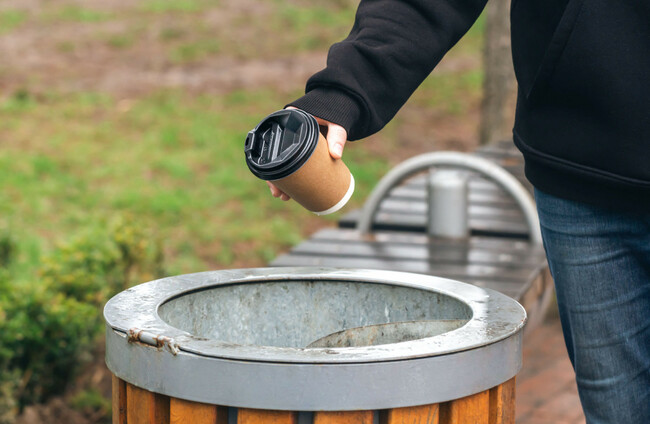
The 'latte levy' on disposable cups is one of a number of government commitments that have not been met. Alamy

The government is dragging its feet on tackling takeaway cups and wet wipes

Brussels has initiated infringement proceedings.

THE GOVERNMENT SHOULD be requiring companies placing single-use plastics on the market to cover the cost of cleaning up the resulting litter, the European Commission has said.

Irish local authorities spend tens of millions of euro each year on street cleaning, while large numbers of volunteers from community organisations such as Tidy Towns perform regular clean-ups in communities nationwide.

The overwhelming majority of Irish people are concerned about the amount of plastic we are consuming as a society, research has shown.

However, the government has failed to implement a number of EU rules aimed at preventing and reducing the impact of single-use plastics on the environment. Single-use plastics include fast-food containers, sandwich packaging, packaging on fruit, and wet wipes.

According to the commission, Irish law does not include sufficient measures aimed at achieving a “quantifiable reduction in single-use plastics” this year.

The commission sent the government a letter of formal notice on 29 April over its failure to transpose a number of elements of the Single-Use Plastics Directive. 

“It’s a lack of political will,” said Abi O’Callaghan-Platt, director of policy at environmental NGO Voice Ireland.

“The [2020] circular economy action plan had great ambition. We were going to reach a complete elimination of disposable coffee cups, for example. We were going to work on cold drink cups, we were going to work on containers – and none of this has come to pass.

“It’s been all backtracking ever since.”

The government has until the end of June to explain how it will address the shortcomings raised by the commission.

The government insisted this weekend that it is “progressing a range of initiatives” to cut consumption of all single-use plastic products targeted by the directive.

“Ireland has and will continue to engage constructively with the European Commission on all infringement matters,” the environment department said.

Coffee cups are among the most prevalent forms of litter in Ireland but a ‘latte levy’ on disposable cups promised four years ago has never been enacted.

The department confirmed there are “at present…no firm proposals” for additional levies under the 2022 Circular Economy Act, which allows the minister to impose these on single-use cups, containers and packaging.

The department said it is considering the option of an upstream levy on producers and importers of disposable cups, rather than at the point of sale to consumers. It is working with the Revenue Commissioners on this proposal and has recently commissioned an impact assessment on the matter.

Polluter pays principle

The Single-Use Plastics Directive places obligations on ‘producers’ of single-use plastics, which include manufacturers, sellers and importers placing these products and types of packaging on the market. 

These companies should cover the cost of cleaning up litter resulting from single-use plastics, and the cost of the transport and treatment of this litter. These companies should also be on the hook for the cost of “awareness raising” to inform consumers about reusable alternatives and the impact of litter.

O’Callaghan-Platt, of Voice, noted that authorities in Catalonia, in Spain, have run public awareness campaigns about reusable period products and distributed free cups, period pants and reusable pads.

She said that the “polluter pays principle” means it’s important that companies selling single-use plastics fund public information campaigns of this type.

The European Commission is set to table new legislative proposals on the circular economy and resource use during Ireland’s upcoming EU presidency, which makes the government’s failure to enact the Single Use Plastics Directive particularly embarrassing, O’Callaghan-Platt said.

“Using plastic, an entirely durable material, for items that are used once and then discarded is an example of terrible resource use,” she said.

Voice has written to Darragh O’Brien, the environment minister, to raise concern about the delay in implementing required measures against single-use plastics.

The NGO highlighted in its letter to O’Brien a range of commitments in the 2020 national circular economy action plan that were never met. These include the ‘latte levy’, a ban on disposable cups in sit-in cafés and measures to oblige retailers to give a price reduction to consumers who use disposable cups.

An ‘on request’ policy for single-use plastics for food and drink was also promised, as were bans on non-medical wet wipes, single-use plastic items for hotel toiletries and single-use packaging for condiments.

The 2020 programme for government of the then coalition of Fianna Fáil, Fine Gael and the Green Party included a pledge to phase out the use of single-use plastics, and a commitment to use taxes to tackle plastics. These commitments were dropped in the 2025 programme for government for the current coalition of Fianna Fáil, Fine Gael and independents.

The current programme pledges that the government will “work with EU member states to encourage the further reduction and prevention of plastic packaging and consider ways to increase the use of compostable materials”.

Compostable coffee cups and cutlery are only biodegradable in industrial composters at high heat, so they need to be disposed of correctly to be truly environmentally friendly. In practice, they often end up in general waste bins – destined for incineration – or as litter.

Latte litter

Although a levy on single-use cups is not currently in place, “many consumers and businesses have already made the switch to reusable cups, thereby saving the purchase cost of throw-away cups and reducing the cost to the public purse of litter clean-ups”, the department said.

However, Irish Businesses Against Litter (Ibal), which carries out regular litter surveys in towns and cities nationwide, warned in its most recent report in January that “without government intervention coffee cups will remain an unsightly and entirely unnecessary blot on the landscape across our towns”.

Ibal said the government’s “prevarication” on the issue was “worrying” and argued that “weaning ourselves off single-use coffee cups should not be such a big deal”.

The environment department said it is working on ‘extended producer responsibility’ (EPR) schemes for two products: balloons and wet wipes. EPR schemes shift the cost of waste management from taxpayers to producers. The longstanding Repak EPR scheme for packaging requires companies placing packaging on the Irish market to pay fees towards the recycling system here.

The department said separate legislation from Europe, the Packaging and Packaging Waste Regulation, will introduce reuse and refill obligations for the takeaway sector, including a requirement to offer reusable packaging by early 2028. Very small businesses will be exempt.

This regulation will also ban certain types of single-use plastic packaging from 2030.

Readers like you are keeping these stories free for everyone...
A mix of advertising and supporting contributions helps keep paywalls away from valuable information like this article. Over 5,000 readers like you have already stepped up and support us with a monthly payment or a once-off donation.

Close
7 Comments
This is YOUR comments community. Stay civil, stay constructive, stay on topic. Please familiarise yourself with our comments policy here before taking part.
Leave a Comment
    Submit a report
    Please help us understand how this comment violates our community guidelines.
    Thank you for the feedback
    Your feedback has been sent to our team for review.

    Leave a commentcancel

     
    JournalTv
    News in 60 seconds