We need your help now

Support from readers like you keeps The Journal open.

You are visiting us because we have something you value. Independent, unbiased news that tells the truth. Advertising revenue goes some way to support our mission, but this year it has not been enough.

If you've seen value in our reporting, please contribute what you can, so we can continue to produce accurate and meaningful journalism. For everyone who needs it.


Doctor uses stethoscope for patient cardiology checkup. In the clinic, a physician conducts an examination of patient with obesity, heart and lungs. Theme: preventive healthcare and wellness.

Irish public more likely to blame people's lifestyles for obesity epidemic

The public in Ireland were the least likely to identify environmental causes for the epidemic out of Ireland, the UK, and the US.

PEOPLE IN IRELAND were least likely to blame environmental difficulties in living healthily as the cause of the obesity epidemic, a study has found.

The country’s Economic and Social Research Institute (ESRI) examined the views of people in Ireland, the UK and US and how they compared to experts’ beliefs about the causes of obesity.

Members of the public believed that individual decisions about diet and exercise had caused the obesity epidemic, while experts instead highlighted how modern life made it difficult for people to eat healthily and get enough exercise.

The public in Ireland were the least likely of the three countries to identify environmental causes.

The ESRI’s behavioural research unit compared perceptions of 2,400 adults across Ireland, the UK and the US with those of 51 experts working in obesity healthcare, research and policy.

It revealed a substantial gap, not only about what had caused the obesity epidemic, but also who was responsible for addressing it and what policies may be most effective.

While most members of the public did recognise at least one environmental cause, such as greater availability of unhealthy food, they rated individual choices as just as important or more so.

By contrast, experts pointed the finger at changes to food production and availability, marketing, portion sizes and car-dependent neighbourhoods.

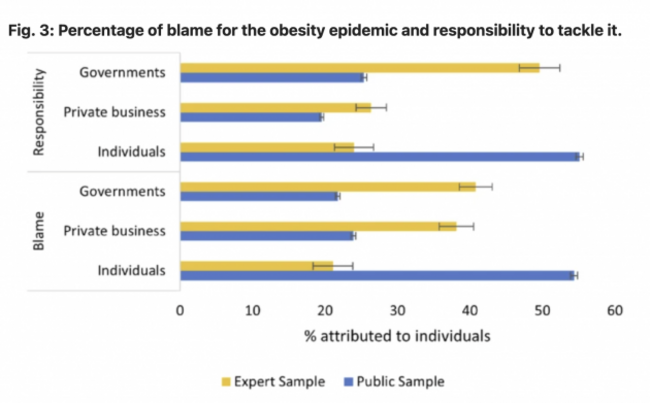
Both the public and experts perceived obesity to be a serious public health issue, but the public believed individuals were much more responsible for the obesity epidemic than businesses or governments.

Experts instead attributed significantly more responsibility to governments and businesses, aligning with scientific evidence that the epidemic is largely driven by environmental causes.

Screenshot 2026-06-08 at 18.47.21 The first panel shows the percentage of responsibilty assigned to governments, private business and individuals by the expert sample and by the public sample. The second panel shows the percentage of blame assigned to each by the expert sample and the public sample. International Journal of Obesity International Journal of Obesity

The public tended to support policies such as information campaigns and subsidies for healthier foods, while experts viewed more interventionist policies, such as taxes and regulations on the fat, salt and sugar content of certain foods as both fairer and more likely to be effective.

Those members of the public who did recognise responsibility of businesses and governments also had views on policies that were closer to expert views.

“These findings show that while people believe obesity is a serious public health issue, many are not aware of the strength of environmental influences,” Dr Deirdre Robertson, lead author of the report, said.

“The individual choice narrative contributes to stigma and can undermine public health efforts to reduce rates of obesity.”

Chief medical officer for Ireland Professor Mary Horgan: “This research shows the need for a shift in the public dialogue around obesity – this disease is not a personal failing.

“Obesity is a complex, multi-faceted problem and needs a multipronged solution, with every sector of society playing its part.

“The [Irish] department of health is currently working on the next obesity policy action plan which will seek to transform the food environment, look for ways to modify the built environment to encourage physical activity as the default position, and to address the social and commercial determinants of obesity.”

Close
40 Comments
This is YOUR comments community. Stay civil, stay constructive, stay on topic. Please familiarise yourself with our comments policy here before taking part.
Leave a Comment
    Submit a report
    Please help us understand how this comment violates our community guidelines.
    Thank you for the feedback
    Your feedback has been sent to our team for review.

    Leave a commentcancel

     
    JournalTv
    News in 60 seconds