We need your help now

Support from readers like you keeps The Journal open.

You are visiting us because we have something you value. Independent, unbiased news that tells the truth. Advertising revenue goes some way to support our mission, but this year it has not been enough.

If you've seen value in our reporting, please contribute what you can, so we can continue to produce accurate and meaningful journalism. For everyone who needs it.

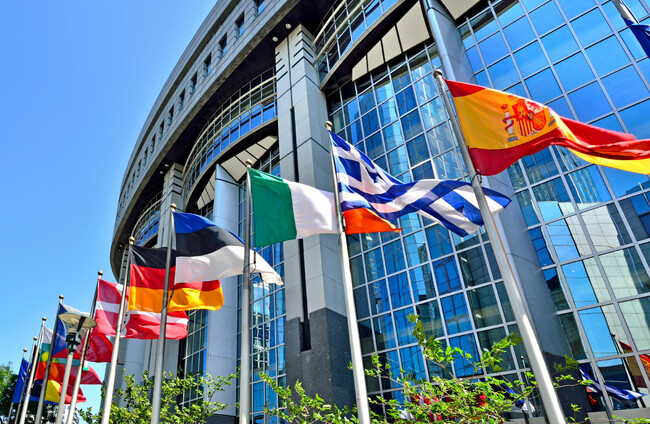
Ireland's flag sitting among other EU member states' outside the European Parliament. Alamy Stock Photo

Opinion The position of the president matters for Ireland’s European interests

Former Irish Ambassador Bobby McDonagh argues that statements made by Catherine Connolly would be picked up by important Irish allies as being anti-EU.

THE QUESTION OF support for the European Union has been frequently referred to during the campaign for the presidential election but has not been adequately teased out and tested.

The role of the president and their remarks on the EU and European countries matter in regard to the future influence and interests of the Irish people in Europe.

One of the two candidates, Catherine Connolly, contrary to what she says or may even believe, has made statements and taken stances that, in my strong view and the view of many, are essentially anti-EU.

Her argument has been that she is not anti-Europe but that she questions the “direction the compass is going”. However, there is no doubt that many of her comments would be construed as opposition to the EU by our European neighbours.

Needless to say, the great majority of Irish people, irrespective of the outcome of the presidential election, will remain supporters of the European Union because they recognise that that’s where Ireland’s fundamental interests lie.

The elected Government would not be deterred by any president from conducting Ireland’s foreign policy, as provided for in the Constitution, including representing Ireland’s interests skilfully and forcefully in Brussels.

However, a president who is sceptical about the European Union to the extent that Connolly is would have the platform and potential to alienate Ireland’s closest partners and to undermine our standing.

If Ireland’s interests in Europe matter to them at all, voters might reflect on five points.

The EU and Ireland

First, there is only one European Union, the real one that we have painstakingly evolved together.

As all human constructs, it is imperfect and therefore needs to be constantly improved, but it has contributed enormously to stability, prosperity and decent values across the continent, including in Ireland.

Sometimes people pay lip service to a pie-in-the-sky “European Union” – one that doesn’t exist and never will – while badmouthing and undermining the one we actually have. This is dangerous nonsense at a time of immense, real and growing challenges for Europe.

Second, every Irish Government has sought, over more than half a century, with significant success, to contribute to shaping the European Union and its policies to reflect Ireland’s values and interests.

To present euro-scepticism as some sort of counterpoint to meekly accepting the status quo is hogwash. Irish politicians and officials sit around every EU table every day, where they exercise influence in the real European world of complexity, compromise and mutual respect.

Third, Connolly has accepted that she voted against the Nice Treaty and the Lisbon Treaty.

These were not Treaties foisted on us by “Brussels” but compromise agreements negotiated by all EU Governments, including Ireland, to advance Europe’s interests in our complex world.

If Ireland had ended up blocking any of those treaties, which we had ourselves negotiated, it would have sidelined Ireland – doing at least as much damage to Ireland and to our interests as Brexit did to the UK.

On Brexit itself, Connolly spoke with a degree of admiration for the vote of the British people to leave the European Union at the time, saying in 2016 that it was a “first step in exposing the EU”. That sort of language is not compatible with her claim to be a committed European. Addressing the comments last week, Connolly said that she “wasn’t pro-Brexit” but “was having respect for the democratic process”. 

Fourth, our partners in the European Union increasingly recognise the importance of helping Ukraine to resist Putin’s brutal war and that, beyond Ukraine, Russia represents a real and existential security threat to the European Union itself.

This is a matter of most immediate concern to the member states closest to Russia, including our friends in the Baltic and Nordic countries and in Poland.

However, even if geography provides us with some degree of comfort, the Irish people cannot but be aware of the real threats to our own country, including cyber-attacks, disinformation and suspicious activity in relation to our underwater cables.

Yet when Germany reluctantly increased its military expenditure, inspired solely by the defensive need to assist Ukraine and strengthen the security of the European Union, Connolly criticised this, fatuously blaming what she called the “military-industrial complex”.

The specific point here is not that she’s wrong about the Russian threat, although she is, but that she appears to show no understanding of, or sympathy for, the deepest concerns of our EU partners.

They all stood by us in avoiding a hard border on this island after Brexit. It would obviously undermine our standing and influence in Europe if we were to be dismissive of their very real, understandable and immediate concerns about their own borders.

This has nothing to do with the issue of Irish neutrality, for which we expect their understanding. It’s about whether we have any understanding for their concerns.

Finally, Catherine Connolly, absurdly, likened Germany’s increase in defence expenditure to Hitler’s military build-up in the 1930s.

This showed no apparent acknowledgement that Russia started the war in Ukraine, that it is on a war footing, or that it has military ambitions beyond Ukraine. However, above all, it showed no empathy for a valued EU partner and no grasp of Ireland’s important interests in Europe.

If Catherine Connolly makes it to the Áras and continues expressing similar sentiments, the pro-European majority in this country and the government can simply ignore her.

However, a president’s voice can register internationally and would have the capacity to damage significantly Ireland’s reputation and interests.

Bobby McDonagh is a former Irish Ambassador to the EU, UK and Italy. He is an executive coach and commentator on subjects around the EU and Brexit.

Readers like you are keeping these stories free for everyone...
A mix of advertising and supporting contributions helps keep paywalls away from valuable information like this article. Over 5,000 readers like you have already stepped up and support us with a monthly payment or a once-off donation.

Close
30 Comments
This is YOUR comments community. Stay civil, stay constructive, stay on topic. Please familiarise yourself with our comments policy here before taking part.
Leave a Comment
    Submit a report
    Please help us understand how this comment violates our community guidelines.
    Thank you for the feedback
    Your feedback has been sent to our team for review.

    Leave a commentcancel

     
    JournalTv
    News in 60 seconds