We need your help now

Support from readers like you keeps The Journal open.

You are visiting us because we have something you value. Independent, unbiased news that tells the truth. Advertising revenue goes some way to support our mission, but this year it has not been enough.

If you've seen value in our reporting, please contribute what you can, so we can continue to produce accurate and meaningful journalism. For everyone who needs it.

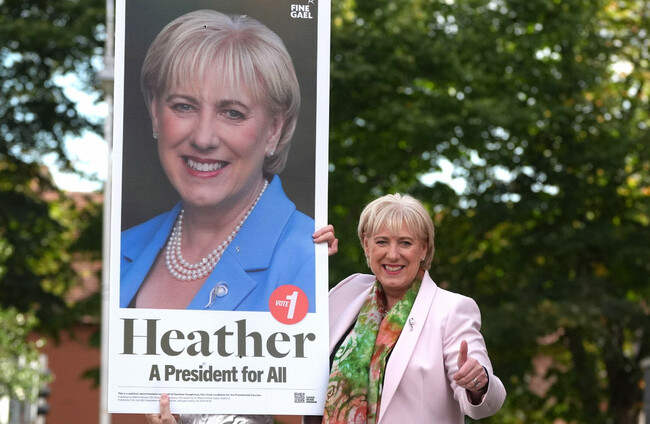
The campaign period has offered an interesting case study in political brand management. Alamy

Opinion Fine Gael's confused campaign branding has done nothing to help Humphreys

Fine Gael’s campaign hasn’t been clear in painting a picture of the person they are asking the electorate to vote for, writes Gerard O’Shea.

“FOR DIEGO, I would go to the end of the world… But with Maradona, I wouldn’t take a step.”

This quote from Fernando Signorini, who was personal trainer to the great Argentinian footballer, highlights the difference between the private and public personas, between the person and their job. Diego was the man, Maradona was the footballer.

In politics, the use of a first name in campaigning – formally or informally – is perhaps rarer, but there are some notable examples.

In Ireland, we have Bertie (Ahern, former Taoiseach). In Britain, there’s Boris (former Prime Minister Johnson). Other examples include Jacinda, Kamala and Hillary (Ardern, Harris and Clinton respectively).

Of course, the relative rarity of these names is a factor, but by ‘firstnaming’ a politician, the tactic is clear: portray them as relatable, immediate, one of the people.

Strategically, the implication is even more stark – the campaign wants you to identify with and vote for the person, not the politics. It’s an attempt to shift the dial away from the head and towards the heart, away from policy and towards what Sean Moncrieff in the Irish Times called “vibes.” Boris is the person, Johnson is the politician. We’re asking you to vote for the person.

Fine Gael’s material for the 2025 Presidential Election campaign seems to make clear their approach to promoting their candidate: “Heather for President” – not Humphreys. Heather is the person, Humphreys is the politician.

The issue is that the rest of their campaign doesn’t seem aligned with this strategy.

The shifting sands of the Irish presidency

Prior to 1990, every single Irish President was either nominated by or represented Fianna Fáil.

Of the nine elections, only four were contested, all by Fine Gael providing the opponent.

Only once, in 1945, did a third candidate stand, and predictably finished third. In essence, the Presidential race was always one Fianna Fáil candidate versus one non-Fianna Fáil candidate.

Party politics mattered, and to an extent, so did policy.

Not necessarily what policies the President could enact, which they have no power to do, but whose career had most entitled them to a comfortable political retirement in Áras an Uachtarán.

The 1990 election changed all that.

Mary Robinson was elected – the first time Fianna Fáil’s pick had not won, the first time a woman had even stood, and the first time a woman had been elected.

Fianna Fáil’s candidate restored normal order in 1997, but it was different by then.

Robinson, and subsequently Mary McAleese and Michael D. Higgins, were elected as much because of who they were as because of what they had done.

Heather Humphreys’s campaign

Heather Humphreys is evidently a very capable politician. She served as a TD for fourteen years, eleven of those as a minister across five different departments. She is clearly very well qualified to run for the role of president.

The problem is Fine Gael are asking people to vote for Heather, not Humphreys. Heather is the person, Humphreys is the politician. If you ask voters to vote for a person, they need to know who they’re voting for. We know very little about Heather.

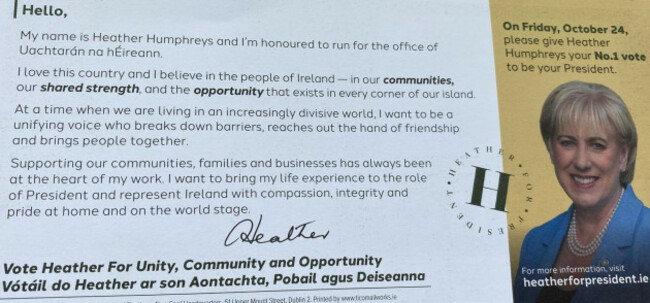
From the outset, her campaign literature set the tone. Her flyer, sent to every household in the country, says very little about who she is. It tells us she loves the country, believes in communities and that she wants to be a unifying voice, but almost nothing about her as a person.

In fact, even if this was a flyer for Humphreys the politician, it still says very little about her political career – it mentions her “life experience” but provides no insight for the uninitiated as to what that experience is.

561367040_4334617886862260_5074444899667999366_n An election campaign leaflet for Heather Humphreys

By contrast, her election opponent, Catherine Connolly (incidentally, her literature is largely surname-led) tells us in her flyer that she is a mother, public representative, barrister and psychologist. Yes, this isn’t the sum of who she is, but it’s a start.

Perhaps she had lower name recognition than Humphreys and needed this kickstart, but from this platform, throughout her campaign, Connolly has been the more relatable and more knowable person. Whether one agrees or disagrees with her policies, we’re getting a much clearer sense of who she is as a person. In a vibes election, these things matter.

A party piece

Connolly’s sporting prowess went viral when her keepie-uppies and basketball skills at a campaign event popped up on social media feeds across the country.

It seemed so good that some viewers thought it must be AI-generated content. But it wasn’t – it was us finding out something we didn’t know about somebody, an opportunity to get to know her that little bit more.

Interviewed by RTÉ Drivetime a few days later, Connolly went into more detail on her sporting and family background. Humphreys, when asked if she too had any talents the public might not have known about, replied that her special skill was “listening”.

This was a fairly soft question in the scheme of a political interview. It was an easy opportunity to let us in a little bit on who Heather the person is. The answer, instead, was political – the kind of soundbite job interview answers people give when they don’t want to give anything away.

It was an answer from Humphreys when we were crying out to hear from Heather.

Strategic rigidity vs electoral agility

Of course, one might say the Fine Gael campaign was conceived at a time when there was going to be at least a third, and perhaps even a fourth, candidate in the race.

In that scenario, there was a logic to Humphreys remaining politically formal. The campaign could allow the two others who had perhaps more evident political weaknesses to target each other.

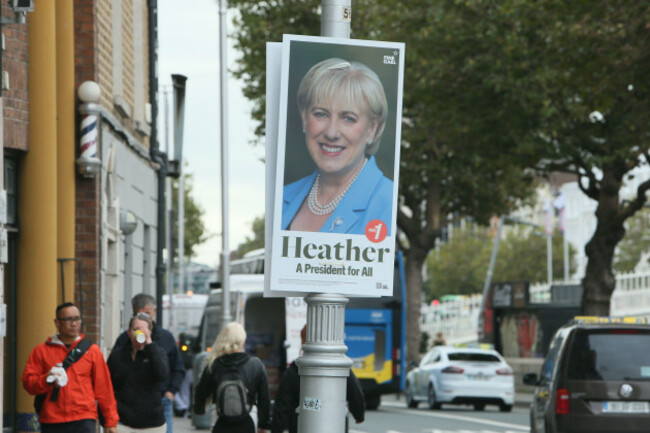
dublin-ireland-07th-october-2025-people-walk-past-fine-gael-candidate-heather-humphreys-election-poster-for-the-2025-irish-presidential-election-on-a-dublin-city-street-pole A Heather Humphreys poster in Dublin Alamy Stock Photo Alamy Stock Photo

This was certainly the approach in the first three-way televised debate (although almost immediately, popular opinion suggested it hadn’t worked as well as hoped). If the campaign could be pitched as one involving Jim Gavin, a political rookie, and Connolly, whose views could easily be portrayed by opponents as extreme, competing hard with each other, Humphreys could remain above the fray and be seen as the one truly “Presidential” candidate.

Gavin’s withdrawal, less than three weeks before polling day, removed that possibility. It became a straight fight between Humphreys and Connolly. And after three weeks of campaigning, it started more and more to resemble a personality and popularity contest.

The political lessons

Every campaign is unique. Clearly, there were some bizarre occurrences in this election, not least Gavin’s dramatic withdrawal.

Presidential elections are different to general elections. In general elections, we demand policy platforms, diplomacy and experience. Increasingly, in presidential elections, we look for the person who we like most, who we most identify with, who we think most closely reflects who we are and where we’re heading.

Drawing specific lessons from one campaign can be difficult, but for Fine Gael and Team Humphreys, there are three key lessons to learn from this experience.

Know the ‘rules’.

You have to understand the terms of the election you’re in. If the contest is going to be about the popularity of the candidate, then the electorate need to get to know them. If it is going to be about policies and political experience, then those are the things you need to talk about. Fine Gael have never been clear about the type of election they want this to be, and the grounds they want to fight it on.

Be consistent in your messaging.

Everything about how Fine Gael have run this campaign suggests their candidate is Humphreys the politician, not Heather the person. That is an absolutely valid approach, but choosing to focus campaign posters and flyers, which are the main places most people will encounter the candidate, on “Heather” brought inconsistency and confusion to what they were asking people to vote for.

Be agile.

Play the game you find yourself in, not the one you want to be in. When UK Prime Minister Harold Macmillan was asked what was the greatest challenge for a statesman, he replied: ‘Events, dear boy, events’. The same is true of election campaigns.

Gavin’s withdrawal moved the goalposts in this campaign. The Humphreys strategy of remaining above the fray while the others slugged it out no longer works in a two-horse race. Campaigns need to stay true to their message, but be agile to reflect the new reality. Since it became a head-to-head between Connolly and Humphreys, the election has needed to be fought on those terms. Fine Gael need to convince people why they should vote for Heather.

The latest opinion poll from the Irish Times/Ipsos B&A on 16 October gave Catherine Connolly a commanding lead (60% to 32% excluding undecideds).

Of course, large electoral leads have been turned around before. Humphreys has the backing of one of the Government coalition parties, the tacit support of most members of the others, and increasing public backing from high-profile politicians from across the political spectrum.

However, it appears it would take a shift of seismic proportions at this stage to reverse the groundswell of support behind Connolly.

If Fine Gael are to create that shift, perhaps they need to show us who Heather is.

Gerard O’Shea is a vice president at communications firm FINN Partners

Readers like you are keeping these stories free for everyone...
A mix of advertising and supporting contributions helps keep paywalls away from valuable information like this article. Over 5,000 readers like you have already stepped up and support us with a monthly payment or a once-off donation.

Close
33 Comments
This is YOUR comments community. Stay civil, stay constructive, stay on topic. Please familiarise yourself with our comments policy here before taking part.
Leave a Comment
    Submit a report
    Please help us understand how this comment violates our community guidelines.
    Thank you for the feedback
    Your feedback has been sent to our team for review.

    Leave a commentcancel

     
    JournalTv
    News in 60 seconds