We need your help now

Support from readers like you keeps The Journal open.

You are visiting us because we have something you value. Independent, unbiased news that tells the truth. Advertising revenue goes some way to support our mission, but this year it has not been enough.

If you've seen value in our reporting, please contribute what you can, so we can continue to produce accurate and meaningful journalism. For everyone who needs it.

Rezoning plan for west Dublin could intensify area's 'parking wars'

South Dublin council chief executive is pushing ahead with the plan.

A MAJOR REZONING plan for more than 7,000 potential new homes in south and west Dublin has moved a step closer despite strong objections from a number of local politicians.

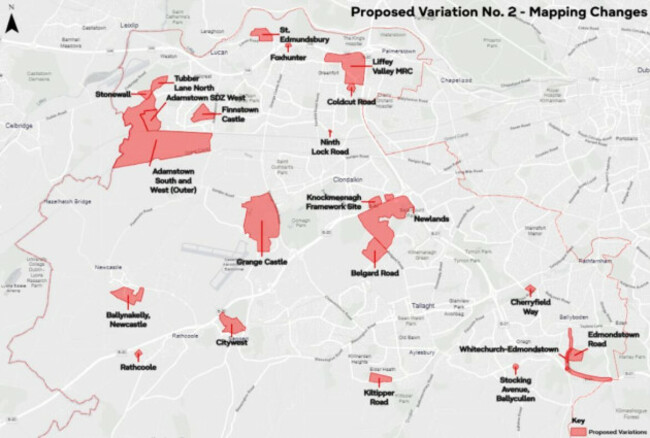
In a report released this week, the chief executive of South Dublin County Council, Colm Ward, gave his seal of approval to the local authority to rezone 15 sites across the suburban outskirts of Dublin.

The decision will come before local councillors in the coming weeks for a final vote on whether the sites are rezoned for residential use.

Six of the sites are in the Lucan and Adamstown areas, three are in Clondalkin, including one in the area of Liffey Valley shopping centre. The remaining three sites are near the N7, in Newcastle, Rathcoole and Citywest.

If approved, they would have a total potential of 157.5 hectares of newly zoned residential lands and could provide up to 7,453 new units of housing. Submissions were received from 2,678 people for the rezoning plan.

IMG_9786 The rezoning map under South Dublin County Council's plan.

South Dublin County Council says it must rezone these lands as residential to meet housing needs in the county.

Dublin Mid-West TD Paul Gogarty said the plans will risk “gridlock” and “chaos” in the area.

The Independent deputy pointed to heightened tensions in a number of new estates across the constituency, in what has been dubbed the ‘parking wars’.

As previously reported by The Journal, these disputes among residents have been fuelled by a lack of parking spaces at newly built housing estates and apartment complexes.

Under South Dublin County Council’s parking standards policy, new housing developments must promote “reduced car dependency” and shift towards other forms of travel.

However, Gogarty said the parking ratios for new-build housing estates may well cause further strain on current residents and any new residents by “squashing” them together in each area.

“The whole hypothesis is you should be able to walk and cycle to access amenities in a short distance, but that hasn’t materialised,” Gogarty said of previous plans for new estates.

He added that it could result in “wholly unsustainable communities” if the plans proceed without either greater public transport services or a revision of parking ratios.

Similarly, Gogarty said plans need to take into account including retail spaces in new developments to try and ensure they don’t “add to the gridlock” by needing to travel greater distances.

In the chief executive’s report, Ward said the council was listening to the concerns raised over parking and transport infrastructure in submissions made by local residents.

He added that “any future development will be required to comply with the council’s parking standards”, which are influenced by government policy aimed at securing reduced dependency on the car, as a way of helping Ireland to meet its broader climate objectives.

The council chief added amendments outlining that development of future housing on two sites – lands at Tubber Lane, Adamstown and in Finnstown, Lucan – may not commence until the proposed Dart+ Southwest line has commenced construction.

In response to queries from The Journal, Eoin Burke, the council’s director of planning and transport said that South Dublin County Council “does not prescribe a single numerical parking ratio per dwelling” when deciding on parking spaces.

Burke added that national policy aims for housing developments must be applied by planning authorities in the assessment of planning applications.

“Accordingly, parking provision is tailored to the location and context of each development, with lower levels of car parking appropriate in urban areas that have access to public transport and services,” Burke said.

“Any parking proposal must meet the needs of the development and be justified to the satisfaction of the planning authority.”

The government has previously strongly criticised councils for not moving fast enough to zone land for housing, with the Taoiseach calling the rezoning of land for housing the real “test” for local authorities.

However, a number of councillors across Dublin’s local authorities have hit out at the plans as they have argued that public transport infrastructure is not where it needs to be to support the new housing developments.

Readers like you are keeping these stories free for everyone...
A mix of advertising and supporting contributions helps keep paywalls away from valuable information like this article. Over 5,000 readers like you have already stepped up and support us with a monthly payment or a once-off donation.

Close
7 Comments
This is YOUR comments community. Stay civil, stay constructive, stay on topic. Please familiarise yourself with our comments policy here before taking part.
Leave a Comment
    Submit a report
    Please help us understand how this comment violates our community guidelines.
    Thank you for the feedback
    Your feedback has been sent to our team for review.

    Leave a commentcancel