We need your help now

Support from readers like you keeps The Journal open.

You are visiting us because we have something you value. Independent, unbiased news that tells the truth. Advertising revenue goes some way to support our mission, but this year it has not been enough.

If you've seen value in our reporting, please contribute what you can, so we can continue to produce accurate and meaningful journalism. For everyone who needs it.

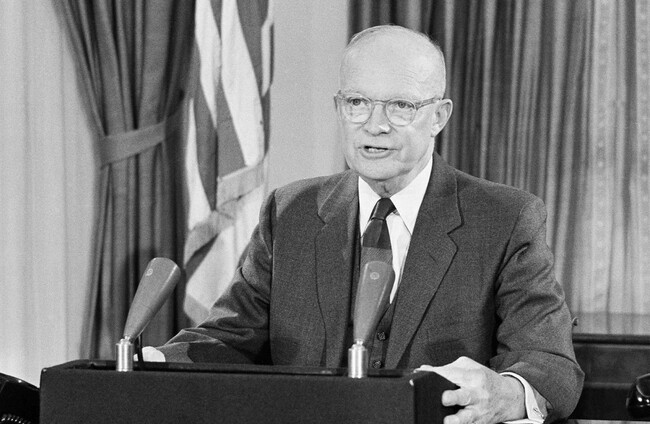
Former US president Dwight D. Eisenhower giving his famous farewell address in 1961. Alamy Stock Photo

Catherine Connolly mentioned it a lot last night - what exactly is a military industrial complex?

All told, Catherine Connolly used the term military-industrial complex five times in last night’s Virgin Media debate.

DURING THE FIRST presidential debate last night, independent candidate Catherine Connolly was asked about her recent comments drawing parallels between the current German military build-up and that of the 1930s.

“I’m extremely worried about the military industrial complex that’s building up, particularly in Europe,” Connolly said.  

“Germany is just one of the examples, because they’ve actually said it very openly that that’s what their economy needs and it’s a boost to their economy,” Connolly said. 

Her concerns came up again in relation to last weekend’s American football game in Dublin and the NFL’s close ties with the US military. 

“We have to begin to question the military-industrial complex and its connections with everything,” Connolly said.

All told, Connolly used the term military-industrial complex five times in last night’s Virgin Media debate with fellow candidates Jim Gavin and Heather Humphreys. 

But what is a military-industrial complex? 

It’s actually a description of the relationship between a state’s military and the businesses that supply it with weaponry that’s been around since the 1940s, but was popularised in a prescient speech given by departing US president Dwight D. Eisenhower in 1961.

In his farewell speech, Eisenhower reflected on the position the United States found itself in after World War II and the massive productive capacity the country had built up as a result. 

“We have been compelled to create a permanent armaments industry of vast proportions,” he said in a televised address.

He said “this conjunction of an immense military establishment and a large arms industry” was new for the US at the time. 

Ewafa / YouTube

While recognising what he called the “imperative need” for such a development, he also warned the US public that “we must not fail to comprehend its grave implications”. 

Those implications were and are that the arms industry and its growing importance to a nation’s economic power can lead to undue influence that steers government priorities and policies. 

In the decades since his warning, Eisenhower has been proven correct. 

The US economy relies heavily on the arms industry and spends more on its military than any other country by a massive margin. For example, the US spent $997 billion (€848.9 billion) on its military last year while the second-highest spending nation was China, which spent $314 billion(€267.3 billion). 

US arms companies contribute to the election campaigns of both Republican and Democrat politicians, and their weaponry is manufactured across the country, making it a significant employer. 

Another result of the growing influence of the arms industry on US policy is what’s referred to as the “revolving door”, whereby government officials frequently move from the public sector to roles in private military corporations. 

Critics of the US military industrial complex often point out that people in government roles have to negotiate with their potential future employers over arms contracts, arguing that this creates a cosy environment in which those companies get more lucrative contracts than they otherwise would.

The US military is also a prominent feature in everyday American society, as can be seen in its close relationship with the NFL. 

Politicians on the left in Europe have warned against the EU’s increasing push for heavier defence spending and integrated military cooperation, citing similar concerns to those raised by Eisenhower more than 60 years ago. 

The governments of Germany, France and other European powers have argued that they need to move away from dependence on US military support and weapons sales, especially given the current geopolitical situation brought about by Russia’s invasion of Ukraine and recent changes in American foreign policy. 

This line of thinking is what led the European Union to unveil plans for €800 billion worth of investment in military spending earlier this year. 

Readers like you are keeping these stories free for everyone...
It is vital that we surface facts from noise. Articles like this one brings you clarity, transparency and balance so you can make well-informed decisions. We set up FactCheck in 2016 to proactively expose false or misleading information, but to continue to deliver on this mission we need your support. Over 5,000 readers like you support us. If you can, please consider setting up a monthly payment or making a once-off donation to keep news free to everyone.

Close
93 Comments
This is YOUR comments community. Stay civil, stay constructive, stay on topic. Please familiarise yourself with our comments policy here before taking part.
Leave a Comment
    Submit a report
    Please help us understand how this comment violates our community guidelines.
    Thank you for the feedback
    Your feedback has been sent to our team for review.

    Leave a commentcancel

     
    JournalTv
    News in 60 seconds