We need your help now

Support from readers like you keeps The Journal open.

You are visiting us because we have something you value. Independent, unbiased news that tells the truth. Advertising revenue goes some way to support our mission, but this year it has not been enough.

If you've seen value in our reporting, please contribute what you can, so we can continue to produce accurate and meaningful journalism. For everyone who needs it.

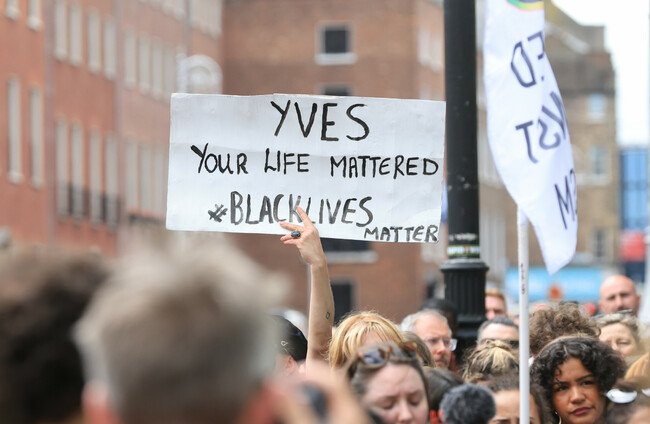
Supporters attend a “Justice for Yves Sakila” rally on Merrion Street this week RollingNews.ie

George Floyd comparisons around Yves Sakila’s death went viral and came from unexpected places

Our FactCheck editor details the internet trends seen by a thirtysomething-year-old man.

YVES SAKILA’S DEATH may not have been as widely reported this week were it not for social media.

Initial reports about the death of a man outside a shop on Dublin’s Henry Street first appeared last Saturday, but it wasn’t until three days later – when a clip showing the Congolese national’s final moments was posted online – that the story really rose to the top of the news agenda.

Multiple investigations are now underway into the circumstances that led to Mr Sakila’s death, while the African-Irish community and anti-racism groups have called for justice at vigils and demonstrations in the capital.

Yet in my feed, it was surprising to see which types of accounts have most loudly sought to portray Mr Sakila as Ireland’s answer to George Floyd, whose death in Minneapolis in 2020 sparked weeks of protests across the United States and around the world.

In an unusual inversion, the comparison was mostly being pushed by far-right and anti-immigrant users and not anti-racist groups or others pointing to questions around systemic discrimination.

The version of the story I was being shown was primarily one of mockery, rather than grief or anger about what had happened.

Fergus Power, who has been named in the Dáil as a far-right agitator, referred to Mr Sakila as “Saint George O’Floyd” in a post on X in the hours after the clip showing him prone on the ground before his death went viral.

The same day, a video posted by far-right personality The Irish Git, captioned “Congolese Floyd” clocked up hundreds of thousands of views online.

Keith Woods, another prominent figure in Ireland’s far-right movement with a large following on X, claimed that “Africans in Ireland are desperate for their own George Floyd figure”.

There are, of course, some straightforward analogies between the two cases.

Both men were black; both died after being restrained on the ground by multiple people; and the lead up to both of their deaths was recorded on a smartphone and uploaded to social media, where footage went viral and became a much bigger story.

It should also be noted that, unlike George Floyd’s case, the exact circumstances that led to Mr Sakila’s death are still unclear and nobody has been deemed responsible.

I saw these types of posts as my feed is exposed to Ireland’s far-right because of accounts I monitor, but that alone doesn’t explain why I saw so many parallels drawn between both men.

Part of the explanation is down to algorithmic nudging, because online platforms are designed to feed users the most contemptuous takes once public anger around an event like Mr Sakila’s death occurs.

I also saw plenty of posts supporting calls for justice and asking questions about the circumstances surrounding Mr Sakila’s death, but comparisons to George Floyd came almost exclusively via the types of users I’ve mentioned.

But those posts didn’t travel through my feed with the same force.

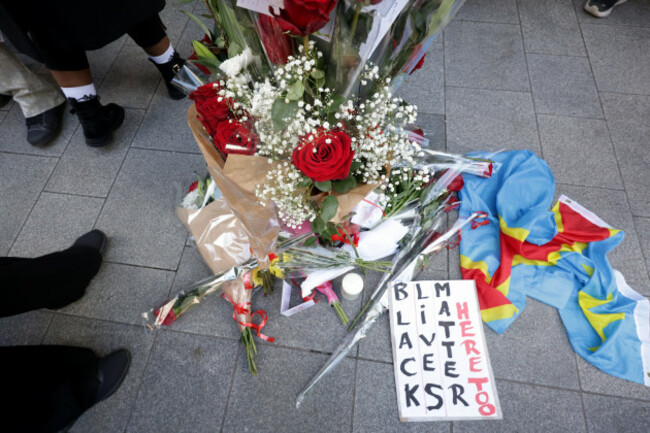
501Yves Sakila Vigil_90748876 Flowers left on Henry Street in Dublin near where Yves Sakila died Leah Farrell Leah Farrell

The obvious question is why anti-immigrant and far-right groups would be so eager to embrace a comparison that would normally be associated with anti-racist politics.

It’s a form of ironic posturing that treats Mr Sakila as both a punchline and an anti-cause célèbre to signal that claims about racism should be viewed with scepticism.

The scornful mood was captured by AI-generated memes mocking Mr Sakila that emerged later in the week and which played on the alleged shoplifting incident that preceded his death. 

One such image depicted him in religious garb with a plastic bag and called him “the patron saint of shoplifters”, while another featured the caption “I can’t steal” (a reference to George Floyd’s telling police officers “I can’t breathe” as he suffocated to death).

Emotionally charged interpretations of events like this - whether from a place of attempted humour or outrage – are rewarded by algorithms, especially when they reinforce existing worldviews.

For Irish far-right and anti-immigrant figures, the story touched upon many of the major themes around which their politics revolve: crime, immigration, race and social cohesion.

Notably, seven of the 10 most-viewed posts this week on Facebook accounts that The Journal monitors for fact-checking purposes concerned Mr Sakila’s death, drawing millions of views between them.

Similar material also spread widely on X and TikTok, where clips, commentary and reactions accumulated millions more views.

The ultimate effect is to invert the direction of grievance, transposing anger from marginalised communities onto far-right and anti-immigrant groups instead.

In those corners of the online world, Mr Sakila became a metonym for wider arguments about immigration, crime and race.

There were attempts made to smear him and immigrants more generally, while also downplaying grievances among immigrant and black communities about racism.

It’s a tactic that’s been tried and tested by similar groups elsewhere – including in the United States at the time of George Floyd’s death.

When Black Lives Matter protests broke out in the US in 2020, a far-right group called the Boogaloo network (which is planning for a second US civil war) sought to exploit unrest by pushing narratives about civil conflict and racial confrontation.

The suggestion was that expressions of anger and calls for justice from minority groups were evidence of social tension.

Far-right and racist figures presented a Manichean reading of events, in which minority grief becomes aggression and their anti-immigrant stance was a defence against the perceived threat against white people.

In Ireland, demonstrations and vigils linked to Mr Sakila’s death have been peaceful, but there are sections of social media that have used a similar framework to present these events as a threat.

Commenting on a Henry Street vigil earlier this week, one X user baldly stated the logic that’s at play.

“This could lead to race riots,” they said. “Remember if the riots do happen that illegal unvetted immigration from Africa is our strength.”

There are still plenty of questions to be resolved about Mr Sakila’s death, which is precisely why it has become such an online story.

But in the lacuna of information, extreme groups have filled the gap with radicalised speculation, making the uncertainty around the case politically useful.

Now, the online narrative is a contest to decide what Mr Sakila’s death should mean, while the rest of us wait for the facts to emerge.

Readers like you are keeping these stories free for everyone...
A mix of advertising and supporting contributions helps keep paywalls away from valuable information like this article. Over 5,000 readers like you have already stepped up and support us with a monthly payment or a once-off donation.

Close
JournalTv
News in 60 seconds