TheJournal.ie uses cookies. By continuing to browse this site you are agreeing to our use of cookies. Click here to find out more »
Dublin: 18 °C Wednesday 19 June, 2013

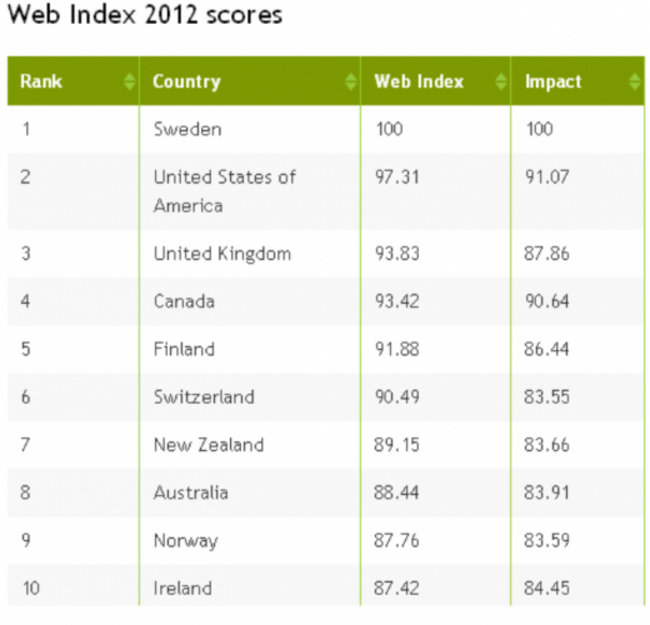
Ireland is 10th in world web index

Ireland outpaces all other countries in the Index in terms of the Web’s effects on the economy, new index finds.

THE FIRST ATTEMPT to rank countries by how much benefit they get from the world wide web has placed Ireland 10th.

Looking at how the web works for 61 different countries and their citizens, the web index found that Ireland outpaces all other countries in the Index in terms of the Web’s effects on its economy: Between 2007and 2010, Information Computer Technology service exports accounted for 14.8 per cent of GDP —”exponentially ahead of any other nation”. Switzerland, Sweden, the UK and Canada  followed.

However, it found that the political impact of the Web  in Ireland is substantially lower than any of the countries in the top 10, ranking below nations including Chile, Colombia and Egypt. According to the index, there was significant scope for the government to “increase the extent to which it uses the Web to engage and interact with citizens.”

One in three people use the internet globally,  and fewer than one in six in Africa, is also found.


Source: Web Index via www.webfoundation.org

The index, which has been publicly backed by web inventor Tim Berners-Lee, found that the web works best for people in Sweden. Six of the top ten countries were European, although not all western economies dominated it. Berners-Lee singled out Italy for the lack of impact the web has made there.

“In Italy the attitude is that people don’t automatically turn to the Web, so relative to where it would be on GDP ranking, it is quite low on the Web Index.”

Italy ranks 23rd, below Qatar and Mexico.

Almost 80 per cent of lone pensioners have no internet access>

  • Share on Facebook
  • Email this article
  •  

Read next:

Comments (15 Comments)

  • We still have one of the worst broadband infrastructures around

    Reply
  • The web works best in the country that tried to shut down Pirate Bay?

    Reply
  • The use of the Internet by government or lack of dhows a lot about there age and unwillingness to move with current trends economics and technology. When you think it cost 800€ each to train them how to use twitter and face book it might be better to let this shower die off in a dark corner while the likes of Simon Donnelly come through. Any interaction they do have with tech is done with an army of over paid advisors.

    Reply
  • I bet the Italians are kicking themselves.

    Reply
  • I don’t if I’d subscribe to this. I’ve lived in Canada for over a year now and their online service pale in comparison to our own. At least for private websites. Government websites and services are on a par with Ireland.

    Reply
  • There’s been some confusion here. The guy in the picture wants to stop INTENET censorship. Thats a different thing all together

    Reply
  • Shane can you explain why we had to pay for a course to teach them how to use twitter and face book if we are do good. Europe must be in a shocking state if we are at the top of the table.

    Reply
    • I really don’t get the question, Chuck. Are you suggesting that a training need in one part of the Government is some kind of proof that the entire public sector has no competence on technology? It makes no sense.

      As it happens, I have grave concerns about payments made by local authorities on training for Councillors. If you search for my posts on politics dot ie, you’ll see that I’ve actually done something about this issue. The fact that some people opted for training on use of social media tells you nothing. Many organisations will pay to train people in use of social media – it’s not that unusual.

      Check out the ninth Benchmark Measurement of European eGovernment Services, released in March 2011 by the European Commission. In the full online availability ranking, Ireland was number one among the 32 measured countries, on 100%, compared to the EU average of 82%.

      Reply
  • Comments are closed for this article.

    Reply
  • Well, for example, BC is years ahead re Open Data and Open Gov http://www.activecitizen.cc/open/open-data-signals-new-direction-for-bc/

    Reply
  • WARNING: According to TBL, the next generation Web, known as ‘semantic web’ has been built on the top of the ‘web of data’. In turn, the ‘web of data’ is mainly driven by ‘Open Government Data’ http://newsstream.blogs.cnn.com/2012/08/02/openness-and-the-opening-ceremony/

    In some countries civil societies push their respected governments to liberate the meaningful information collected by the governments on behalf and at expense of it’s citizens; and make it available for reuse in useful non-propitiatory machine-readable formats, known as ‘Open Data’.

    In other countries, governments, seeing undeniable benefits of the ‘open data’, champion the data liberation and encourage development of civic apps, which help both the government and its citizens to make more better informed decisions based on facts.

    Taking into account that in Ireland:
    (i) there is not even a notion of ‘Open Government’;
    (ii) on the national scale, there is no ‘Open Data’ (even in comparison to Italy, never-mind the UK),
    we will be lucky to be in the top 20 next year and in the top 50 a year after.

    (Just see one example of what’s hosting Google, Microsoft, Twitter et al. Ireland is missing completely already http://www.activecitizen.cc/open/open-data/open-data-in-transit/)

    Unless the situation with availability of the ‘Open Government Data’ in Ireland is changed radically and without any further delay, the Irish hopes to have a knowledge economy will never materialise and a hard earned reputation of a global technological centre-of-excellence will disappear rapidly.

    Reply

Add New Comment