TheJournal.ie uses cookies. By continuing to browse this site you are agreeing to our use of cookies. Click here to find out more »
Dublin: 10 °C Wednesday 22 May, 2013

People who grew up during the troubles more prone to suicide, study finds

Professor Mike Tomlinson tells thejournal.ie that people have found the transition to peace difficult.

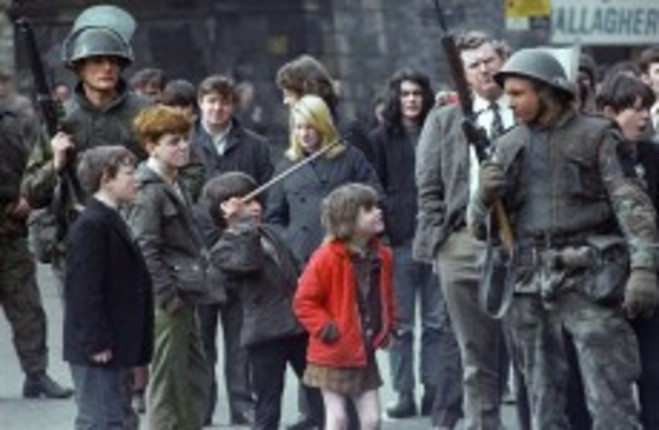
Local children taunt a British soldier as he stands guard in Derry, Northern Ireland on April 13, 1972, after an explosion in the city centre.
Image: Michel Lipchitz/AP/Press Association Images

CHILDREN WHO GREW up in Northern Ireland during the troubles are more prone to suicide, according to a new study carried out by Queens University Belfast.

Researchers found that young people who grew up in the worst years of the violence in the 1970s have the highest and most rapidly increasing suicide rates.

Contradicting previous research, which found that war reduced suicide through greater social interaction between people, Professor Mike Tomlinson found that the increase in suicide arose from a complex set of factors. These included a growth in social isolation, poor mental health and even the greater political stability of the past decade.

“People  born during that period have had everything framed for them in terms of antagonism, violence, conflict and division” Tomlinson told thejournal.ie.

“Whereas before it was normal to externalise those anxieties on others, people have now changed the way they deal with agression because it is no longer socially acceptable or approved to engage in external forms of hatred. So they internalise it instead.”

According to Tomlinson, the highest suicide rates are among those who grew up in the worst years of violence between 1969 and 1978.

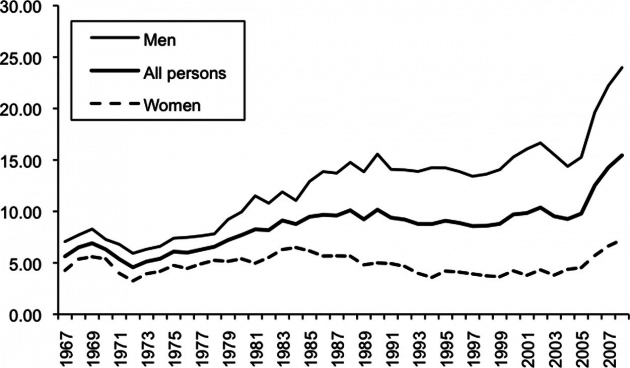
His study found that the overall rate of suicide for both men and women in Northern Ireland doubled in the decade following the signing of the Good Friday Agreement in 1998.

Suicide rates, as the graph below shows, rose from 8.6 per 100,000 of the population in 1998 to 16 per 100,000 by 2010. The rate was higher for men.

[caption id="attachment_532835" align="alignnone" width="630" caption="Northern Ireland suicide rates by gender, 1967–2008."]Suicide rates Northern Ireland[/caption]

Between 1965 and 2008, the number of suicides registered in Northern Ireland was 6131 of which 1751 were female. Over the period of the conflict, there were about a thousand more suicides than conflict-related killings.

“There has been a general change in the social and political culture” in Northern Ireland, says Tomlinson. “Along came peace, and how people deal with fears and agression changes.”

Isolation has increased dramatically, he found, with the annual number of divorces increasing three-fold during the troubles. By the end of the 1990s they were up five-fold. Men of working age are now twice as likely to be living alone than women, according to the study, while the proportion of families
headed by a lone mother increased from 10 to 23 percent between 1983 and 1998.

Read next:

Comments (14 Comments)

  • I’m sorry but was this not fairly well known? From my work with Irish people in London, they have higher rates of suicide and depression than any other migrant group in England. Maybe those who fled the Troubles have even higher rates than Southern Irish. This could come from the anxiety caused by the violence, but also the unplanned nature of their migration…many I’ve talked to needed to get out of Northern Ireland as soon as they could for various reasons. Glad its being recognised officially though.

    Reply
    • Broin 25/07/12 #

      Southern Irish? You mean like County Cork, cause that’s in Southern Ireland. Ah wait there, you mean south of the border. Of course, you could mean that segregated Ulster, is actually Ireland, and everything beneath, below, under is Southern Ireland. But that would just be silly. It’s an island – we’re one and whole with slight nuances – Religion and ethnicity! But I’m Irish – not southern, or northern – I’m just literally Irish – it’s the island I grew up on. And for all you segregationists please jump off a cliff like a pack of lemurs!!

      Reply
    • Broin, I feel more a stranger in Northern Ireland than any where else. Rep of Ireland is culturally different to Northern Ireland no matter how you label it. Folks in NI have been thru a war essentially and the topic of the article is its impact on theirs lives. So go jump ur self!

      Reply
    • What a way to pick a bone there, Broin! Just to clarify, the system I work under (NHS) recognise the social and cultural differences between Northern and Southern Irish, that was my logic for using the terms. Don’t have a go at me, contact them and complain. Unless you’re a troll…! All I’m saying is that this study makes sense in relation to my work. Also, its lemmings that jump off cliffs….not lemurs!

      Reply
    • Top notch Anne Marie, a very intelligent lady indeed!

      Reply
  • Institutiona and programmes must be set up to help these people!

    Reply
  • Does this not just mean people of a certain age are more prone?

    Reply
  • JTHM 25/07/12 #

    Makes sense.

    Reply
  • Some of these Studies produce nothing but rubbish . you will find that Suicide rates have risen dramatically all over Ireland and Europe in areas of conflict or not .

    Reply
  • Broin 25/07/12 #

    @Pablo Oreillio – eh you missed the point of what I was saying. Pablo – it really depends which lens you are looking through in respect to culture.

    Anyone I know from the Six Counties, Northern Ireland, the North of Ireland etc however “you” wish to label it, regardless of religion, identified themselves as being Irish.

    In terms of “identity” Pablo, an affect and effect of the conflict has resulted in heightened suicide. This can be looked at in two ways – one it’s a statistical matter (a confined geographic area with a limited population – thus elevates anything statistically) two it could be viewed as a matter of identity erosion, a lack of belonging, economic depression etc.

    The “point” that you missed in terms of my retort to Ann-Marie Wallis was the destructive nature of segregationism in Ireland, and it’s effect on a “cultural psych.”

    I’m well aware, as you say “folks in NI have been thru (through) a war essentially.” By this do you mean that their trauma is not validated because it didn’t involve fighter jets? Let’s put it down to semantics.

    I’m also aware of the basis of the article, and have followed this issue for a number of years. But merely what I was highlighting was the divisive nature of labeling people – and it’s negative impact!

    Reply
    • Citizenship and identity
      Further information: British nationality law and Irish nationality law
      Several studies and surveys performed between 1971 and 2006 have indicated that, in general, Protestants in Northern Ireland see themselves primarily as British, whereas Roman Catholics regard themselves primarily as Irish.[37][38][39][40][41][42][43][44] This does not however account for the complex identities within Northern Ireland, given that many of the population regard themselves as “Ulster” or “Northern Irish”, either as a primary or secondary identity.
      A 2008 survey found that 57% of Protestants described themselves as British, while 32% identified as Northern Irish, 6% as Ulster and 4% as Irish. Compared to a similar survey carried out in 1998, this shows a fall in the percentage of Protestants identifying as British and Ulster, and a rise in those identifying as Northern Irish. The 2008 survey found that 61% of Catholics described themselves as Irish, with 25% identifying as Northern Irish, 8% as British and 1% as Ulster. These figures were largely unchanged from the 1998 results.[45][46]

      Reply
  • no sh*t Sherlock

    Reply

Add New Comment