TheJournal.ie uses cookies. By continuing to browse this site you are agreeing to our use of cookies. Click here to find out more »
Dublin: 12 °C Monday 20 May, 2013

What do YOU want to know about the referendum?

Tired of the political squabbles between the campaigners? TheJournal.ie is going to help you find out the answers to the questions you have about what voting ‘Yes’ or ‘No’ will ACTUALLY mean. Read on to participate…

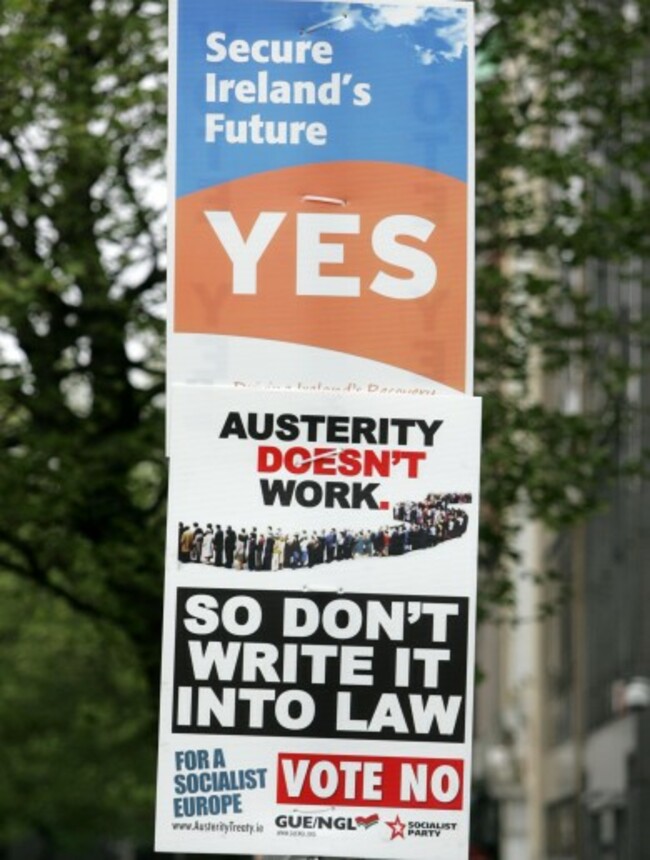
Image: Sam Boal/Photocall Ireland

WE ARE JUST eight days from going to the polls to decide whether Ireland should ratify the Treaty on Stability, Coordination and Governance in the Economic and Monetary Union (official title).

Monday night’s debate on RTÉ 1′s Frontline was the latest head-to-head for the ‘Yes’ and ‘No’ sides – but many complained that the war of words didn’t help further our understanding of exactly what WILL happen if you vote either way.

We want to help you (and ourselves) to understand the nitty gritty of the treaty that we are being asked to ratify – but we need to know what YOU need to know. For example…

Do you want to know whether voting ‘No’ DOES actually mean we won’t have access to ESM funds?

Do you want to know if voting ‘Yes’ DOES mean we won’t have control over our next national budget?

  • Please email us (tips[at]thejournal.ie) OR tweet us (@thejournal_ie) OR leave your question in the comments section below.
  • This is not about point-scoring and it’s not about opinions – send us clear, concise questions that you want answers to, or points you want clarified.
  • We plan to get independent advice on a representative selection of your questions and publish those answers early next week.

So let’s get started! Feel free to share this callout on your social media networks so we can take in as many questions as possible – and get answers to as many as we can.

Looking forward to hearing from you…

Read next:

Comments (81 Comments)

  • I’d like clarification on the following please;
    1. Who are the people who will be caretakers of the 700 billion, how many people will be in charge, and who is the Irish person ( woman) that will be part of this Bord, and what qualifies them to do so?
    2. Is it true that these fiscal custodians will not be answerable to any legal system, and if they are, which law governs them?
    3. Why is it that we are not being given to option to wait until France and Germany ratify the treaty first, as they both are clearly waiting for some clarification, and if the wording of the treaty is changed after , and if we ratify it, will the same amendments apply to us?

    Fair play to the Journal for addressing people’s questions when we clearly can’t find answers else where!!

    Reply
    • On point 2, you’re quite right – the ESM is being set up so as to be beyond any laws, anywhere.

      The treaty says (here: http://www.european-council.europa.eu/media/582311/05-tesm2.en12.pdf):

      The ESM, its property, funding and assets, wherever located and by whomsoever held, shall enjoy immunity from every form of judicial process except to the extent that the ESM expressly waives its immunity…..”

      It goes on to say that the property, funding, assets, archives and premises “shall be inviolable”.

      And then says that directors etc “and other staff members shall be immune from legal proceedings with respect to acts performed by them in their official capacity and shall enjoy inviolability in respect of their official papers and documents.”

      Reply
    • Why is it that those who work for the ESM will not have to pay income tax?

      Reply
    • Income taxes are enacted under the laws of the land. But since the ESM is to be set up outside of any laws, income tax can’t arise! Nice work if you can get it, eh?

      Reply
  • Aldo 23/05/12 #

    1) Define “structural deficit”

    2) Provide a definitive explanation as to how exactly it is measured.

    Reply
  • I don’t know what a tracker mortgage is.

    Reply
  • Pushing politician opinion aside vigorously, what are the main academic based Irish economists suggesting would be the best possible outcome from this vote?

    Reply
    • Good Question, to further elaborate, what’s the best and worst case scenario for both a yes and a no vote.

      Reply
    • That’s presuming academic economists are apolitical (pretty much none of them are that – most have very strong alliances to certain political ideologies. What all economists seem to agree (from what i’ve read – even the ones that do support the treaty) that it will essentially mean that Ireland cannot spend into deficits, which essentailly means that if there were little money in the economy that there would have to been increased austerity), but likewise some would argue that if we vote no it would mean we can’t get more bailout money (although i’ve heard a few who say that that’s BS and we still could)

      Reply
  • Leaveing all scaremongering aside, What is the goverments contingincie plans in the case of a no vote?

    Reply
  • In a country which is currently under a lot of pressure to reduce national debt, how will signing a treaty to reduce deficit impact or limit our economic growth / ability to recover?

    Reply
  • By the way, great idea by The Journal staff.

    Reply
    • Aldo 23/05/12 #

      How can anybody give that comment a thumbs down?
      Fair play to the Journal team for cutting through the BS and allowing people to pose salient questions to which they will do their best to answer without bias attached.

      It’ll be interesting to see if any regular FG heads on this site pose any worthwhile questions!

      Reply
  • Hi all,
    Just wanted to say a quick thanks to everyone who has contributed their questions so far – we’re gathering them all and will try and choose a representative number of them to get answers.
    And thanks for understanding what we’re trying to do here – sift the real concerns from the political point-scoring!
    Keep them coming,
    Susan, Editor, TheJournal.ie

    Reply
  • Would the fiscal compact, with its notion of structural deficit, had it been in place when the Euro came into being, have prevented the government excesses of the Celtic Tiger and its aftermath?

    Reply
    • Good question that I’ve been thinking about as well. I actually don’t think it would as we had huge current budget surpluses during the Celtic Tiger. I think Spain had as well??

      Reply
    • Probably not given that while we stayed within the defecit rules between 2000 – 2004, France and Germany decided to break existing EU treaty laws by chosing to ignore them. Had smaller countries stood up and insisted on penalties being handed out to the Franco German governments for the flagrant disregard they showed to fiscal defecit rules, then maybe things wouldnt have gotten so out of hand and half of Europe wouldnt be in the mess it now finds itself in.

      Reply
    • @Chris I dont think so because it was in fact the ECB that flooded Irish banks with cheap money that they in turn doled out everywhere and anywhere to anyone!!! The ECB have gotten away with murder the past 10 years!!

      Reply
  • One thing I’d love to know is about the structure of the treaty. Is the preamble legally binding, or is it just wishy-washy aspirational stuff. (It’s the preamble that mentions access to ESM funds would only be available to those countries who pass the treaty…)

    Reply
  • Since Ireland (and other countries) joined the EU how many years would we (and other countries) of had a structural deficit of below 0.5 and what would the fines to us (and other countries) of been?

    Reply
  • Roughly how much money will the State have to repay annually and roughly how much of this will come from increased tax if we vote Yes

    Reply
  • What adjustment does François Hollande want to make to this treaty. We have all heard that he wishes to add an article for growth. What is it and what would it involve?

    Reply
  • Is it true the esm (bail out fund) has not come into law, and is inly a probosal, so saying if we vote yes will have automatic access to the esm is untrue, as the esm may never happen?

    Reply
  • What is the government’s contingency plan to raise funds should the country vote No to the treaty?

    Reply
  • Where exactly will our government get the money to contribute to the ESM- not just the first tranche but all of our required contribution and over how long a time period?

    Reply
    • They will get it from you and me Ailís, and everyone else in the state..whether its from tax or from cutbacks to services.There is no other way we can reach the deficit targets set out each year from 2015 (by the ESM) other than selling off all (or a substantial amount) of our state assets and we cant affors to sell off our assets because in private hands we will pay through the nose for water, electricity etc etc (Some would say we already are!)

      Reply
  • Question: What amount in additional cuts will have to be made, given the Department of Finance figures published last month which have now being revised downwards, to bring Ireland in line with the 0.5% structural deficit rule from our expected 3.5%+ structural deficit for 2015? Where is it envisaged those cuts will be made?

    Reply
  • How is the government going to reduce GDP to 3% by 2015?

    Why have we been threatened with hard budgets in 2013 when nothing is supposed to change until 2015?

    Why has our so call leader of the country refused to debate the topic himself on ANY show?

    Why are we rushing into this treaty while other countries in the EU look like they may be pullling out altogether?

    Reply
  • From what I understand, fiscal rules are already in place within the EU and passing this treaty means these same rules will be strengthened by requiring countries to change their local laws giving the rules legal force. That’s fine, nothing new as such. But what I want to know is – what is NEW in this treaty ? What new rules, regulations, strengths or weaknesses will passing this treaty mean for Ireland ?

    And note that I ask for IRELAND. Not necessarily the EU.

    Thanks.

    Reply
    • What I want to know is how exactly do you ‘strengthen’ a rule?

      Reply
    • You insert a clause into our constitution which says that

      “No provision of this Constitution … prevents laws enacted, acts done or measures adopted by bodies competent under that Treaty from having the force of law in the State.”

      Scary stuff. Full text of the amendment below for your reference

      “The State may ratify the Treaty on Stability, Co-ordination and Governance in the Economic and Monetary Union done at Brussels on the 2nd day of March 2012. No provision of this Constitution invalidates laws enacted, acts done or measures adopted by the State that are necessitated by the obligations of the State under that Treaty or prevents laws enacted, acts done or measures adopted by bodies competent under that Treaty from having the force of law in the State.”

      Reply
    • Ryan, you strengthen a rule by providing for a sanction for its breach. So at present if a State breaches the rules that were introduced in the Maastricht Treaty there’s no consequences for this, so no incentives to keep to the rule.

      Reply
  • Will Ireland be contributing 11bn to the ESM and will we be borrowing that money from the EFSF to do so?

    Reply
  • 1. What interest rate will the ESM charge?
    2. For a country to gain access to the ESM funds do all countries who have provided funds to the ESM have to agree?
    3. What are the Constitutional implications of allowing a third party (ESM) direct access to Irish budgetary considerations for ever rather then temporarily as in the current bail out?
    4. A figure of €11 billion has been suggested would be Ireland’s maximum input into the ESM. I’ve read or heard else where that the ESM has the power to increase this figure if required. Is this correct?

    Reply
  • In the evernt of a Yes vote, could we be forced to give up our 12.5% corporation tax rate in efforts to harmonise the tax rates accross Europe?

    Reply
  • There are two types of GDP figures given out regularly, one including and one excluding Multinational Companies where the profits are taken out of the State. There is quite a gap between the two. Which figure does this treaty refer to?

    What alternative sources of funding are available to Ireland? And what are the pros and cons of these?

    How democratic is the European Parliament? In the event we were to vote yes, how much say would we have over decisions made by EU over what constituted a good reason not to keep to the agreed target of fiscal discipline? Are we even sitting at the ‘Decision Making Table’?

    Why do politicians and economists persist in talking about growth as a indicator of success? Surely it was growth which created the bubble that burst? I know there are alternatives to this economic model but what are they. Haven’t politicians and economists a duty to look at and debate these given our present crisis/opportunity? Why are they not looking creatively at this situation rather than doling out the same old, same old?

    Thanks for this opportunity!

    Reply
    • Denise

      as we will be providing 1.592% of the capital sock of the ESM we will hold 1.592% voting rights but only if we have kept up with our ESM lodgements. So feck all basically.

      Reply
    • There is only one type of GDP it is everything produced in a country in a given year including foreign multinationals, the second figure you are referring to is GNP and it is all the revenue produced by Irish countries at home and abroad, the treaty relates to the first one GDP.

      Reply
  • Hello again,
    Thanks to everyone who is continuing to submit questions about the substance of the treaty and about the consequences of voting ‘Yes’ and ‘No’.
    As mentioned in the article, we want to keep the comments section on this piece free of debate from either side of the Yes/No campaign, so please help us out with that.
    Thanks, Susan, Editor

    Reply
  • I’d just like confirmation of one thing. From my, frankly limited knowledge of things. Whether we vote yes or know we are still going to have to balance our budget. Surely we cannot keep spending however many billion it is (€15bn) rings a bell more than we take in. Simple household budget maths that. If we vote yes we get a ‘cheap’ interest loan until we balance the books. If we vote no we have to rely on market rates?

    Is that broadly correct?

    Reply
    • That is more or less correct Steve, however the ESM will not be wound down when the books are eventually balanced. The first problem is that should Italy, Spain, Portugal or France need a bailout (and its looking like Spain are going to be needing one pretty soon) we will have to lodge 11 billion euros into the ESM fund. However, we will have to borrow the 11 billion from Europe, which means that we will borrow money and pay interest on it for us to put it into the bailout pot. The first trench (1.3billion) of the 11 billion euros is due to be paid by us in July.
      Secondly, the ESM can decide that our capital stock input of 11billion is not enough and can increase this sum if it so choses and to whatever amount it choses and we in turn will have to pay it and do so within 7 days. If we fail to meet this obligation we can be brought before the european court and fined up to 200 million euros if we dont.
      Thirdly, should we sign up to this we will be handing over our fiscal sovereignty to a group of unelected technocrats who’s interest in keeping the German economy afloat, is greater than meeting the needs of 4 million people who live on an island somewhere off the coast Europe.

      Reply
    • Nearly right Steve. If we vote Yes Europe will continue to provide us with funding. If we vote No they probably won’t so we may have to seek finance from private lenders. The problem with seeking private funding is that we will most probably have to pay a higher interest rate than that available from Europe. The problem with voting Yes is that while the interest demanded from Europe will be lower, we will have to ensure that our national deficit is below a certain level or face as yet unknown financial penalties imposed by Europe. Further to this Europe may attach conditions to any further funding such as those demanded by the Troika, effectively allowing Europe to dictate our fiscal policy further.

      In short if we vote No we will probably have to pay higher interest rates to borrow money, but at least we will know exactly what the total cost will be. If we vote Yes we will pay a lower interest rate but will have to implement as yet unknown European demands on our fiscal policy and pay unknown costs if we exceed European budget deficit limits.

      Take your pick.

      Reply
  • 1) Someone on the @LateDebateRTE said the EU used a law that was intended for disasters to create the ESM. what article was that and what treaty?
    2) Can we veto Article 136 of the TFEU?
    3) If we pass the Fiscal Compact, does that mean we are allowing Article 136 by proxy?
    4) Will the ESM have enough money in a worst case scenario i.e Greece -> Spain -> Italy
    5) Is it true to say that the ESM institution will not be legally responsible?
    6) If a YES vote, how long after it do you expect the €uro to fail

    Reply
  • Exactly how many independent economists/experts are on yes/ no side ???

    Reply
  • What are the reasons for the world economy that Greece were not allowed to default,?? Had 70% of their bank debt wrote off?? Can you also please explain how much of the Irish debt is private, how much the state has to pay gambling German bondholders etc ??

    Reply
    • The reason is quite simple. European debt default has been insured against using credit default swaps and these are mainly issued by Wall Street institutions. These institutions do not have sufficient liquidity to cover the likely payments should anyone actually call on them. Greece is being kept afloat to avoid sending Wall Street down the toilet, which is where it belongs, by the way.

      Reply
  • i want to know what parts of the treaty were suggested by our negotiators and what they rejected?, id like to know what their (irish government) specific input was?, also i would like to know who suggested and supported esm access based on ratification of the stability treaty?

    Reply
  • If we vote No, will the Government resign and, if not, why not?

    Reply
    • No, because despite your hang ups with the government they were elected and have a mandate from the people to lead the country.

      Reply
    • Derry the mandate they were given was VERY VERY different to what they have done in office!They promised us all sorts in the run up to the election….that hospitals in certain places wouldn’t be closed, that they would renegotiate the troika deal, Leo V said Anglo wouldn’t get another “red cent” etc etc etc etc etc……all lies to get into power…..They now have NO mandate from the people!

      Reply
    • Derry, any mandate this government had disappeared the moment they broke their first pre-election promise. The same goes for any previous or forthcoming government that breaks what is in effect a verbal contract.

      Reply
  • If we vote yes and are outside the prescribed structural deficit of 0.5%, by law, an automatic process kicks in to address this. What is this process? Is it the same old austerity approach of increased taxes and lower spending, or will it have a growth dimension to improve our economy and thus address the deficit?

    This i feel is central to knowing what actually happens if we vote yes or no. Access to future funding is a follow on to if we fail to address our legal obligations to reduce our deficit.

    Reply
  • Damocles 23/05/12 #

    In the event of a No, is there any way in which Ireland could decouple itself from the EMS and recouple with Sterling?

    Reply
  • Two questions. One for the yes campaign and one for no. For the YES are we committed to funding the ESM whether we vote yes or no. For the NO campaign exactly where are we going to get funding if we vote NO. The treaty expressly forbids any country not accepting it to have ESM access

    Reply
  • Phil 24/05/12 #

    Can the yes side (Government) provide us with their actual plan if a No vote is passed.

    Surely they MUST have something in place and I think this would be good info for the voting public to have.

    Reply
  • Why did the Irish Gov. allow the addition of the blackmail clause to the Treaty?
    What advantage if any does it add to Irelands position?

    Reply
  • 1. Is it correct that if Ireland does vote yes to the fiscal treaty this does not guarantee access to the ESM in the event we fail to fund ourselves on the bond market?
    2. If we do require funding the ESM can set additional austerity measures as part of the agreement to provide funding to Ireland?

    Reply
  • I think we should kNOw if any economists have done a debt cost viability study to see if we can actually afford the weight of the bank debt, promisery notes, bailout 1, & estimated bailout 2 and include projected economy over the next 5 years? Just to give a rough idea to see if it is sustainable. This could clear up if we really do need to look for write down or if its worth slogging away?
    please put this to professional opinion. theJOURNALrules.

    Reply
  • How much is money from the ESM?
    Micheal Martin has said it would be at cost, i beleive thats not true.

    Reply
  • I’d love if you guys could help clarify the many myths and misconceptions about this treaty.

    1. people think the fiscal compact and the ESM are immune from any legal proceedings. Can it be clarified that this immunity is only within their frame of reference. So that if they do something illegal they are still liable for it.
    2. The treaty is not being added to our constitution, it’s only the permission for the government to ratify it.
    3. Can you confirm that all the fiscal limits in the treaty already exist in other agreements so by default anyone claiming that it’s the ‘austerity treaty’ is wrong. Some of the limits are from 20 years ago.
    4. That it doesn’t overrule our constitution and all the other scary stuff people are claiming.
    5. That we can meet the targets in this treaty with just inflation and nominal growth. economic-incentives.blogspot.co.uk/2012/05/whats-on-table.html (Even using the real figures from the 1980’s this works)
    6. That the majority of the money we’re borrowed went to fund the day to day running of the country and not to the banks. economic-incentives.blogspot.com/2011/11/deficit-and-banks.html
    7. That people claiming we can just get a deal on the ‘bank debt’ really don’t understand the complexity of the situation. There’s an excellent thread explaining that here. http://www.boards.ie/vbulletin/showthread.php?t=2056647891 (Of course Ganley is a smart guy who already knows this, he’s just not adverse to telling porkies).
    8. That the ESM requires unanimity so they cannot force us to increase or change our payments to it. We appoint one of the board.
    9. That growth or stimulus doesn’t necessary work either. The US and Japan have had huge stimulus packages with little actual benefits for the massive money spent.
    10. That ‘having control of your currency’ is not the panacea that some make out. That UK has gone from the third most indebted country in the EU vs GDP to the forth most indebted for all their control and quantitative easing.
    11. That we are not a heavily taxed country in Ireland. http://www.irishtimes.com/newspaper/world/2012/0522/1224316503183.html
    12. That the household charge and water charge are not mentioned in the treaty whatsoever.
    13. That the correction mechanism involves an independent Irish body to oversee our budgets, not some EU one.
    14. That we are already massively over what the IMF should loan us. A figure normally based on a country’s contributions to the IMF.

    Food for thought hopefully :)

    Reply
    • Please show where it says that the ESM is only liable to legal action when it is outside of its frame of reference? I see no mention of this in the treaty whatsoever. What I see is a pretty much blanket immunity with the sole exception that they can be liable if they choose to be so.

      Reply
  • as far as i can tell pretty much every country are in some sort of dept purely for practicality, would the automatic actions taken when the country goes into a deficiet of just .5% of the GDP not give us little or no leeway?

    Reply
  • Phillipa 23/05/12 #

    I would like to know
    1. Who added/why was the clause add to the treaty?
    2. Is there provision for any circumstance that any individual or group of countries to opt out of this treaty in the future?
    Thank you

    Reply
  • Just saw that you can get 7/2 on Paddy Power for a “No” bet!!

    Reply
  • Sandra 29/05/12 #

    I would appreciate any guidance on the referendum as am truly conflicted. I am leaning toward spoiling my vote. I take my right to vote seriously and am offended by the black and white approach to such a complex issue. For the most part I agree with the Treaty. However it should have been in place long ago before the crisis developed. Requiring deficits to be below 3% of GDP is fiscally responsible as are requirements to reduce such excesses by 5% per year. Maintaining debt at 60% of GDP is also sensible. However, in the middle of a seemingly insurmountable debt crisis it seems unworkable. Countries often operate in excess of these figures it seems (Canada I believe has a debt of around 80% of GDP and yet people are flocking there for work). In short I agree with the treaty in principle. I agree that greater fiscal integration and budgetary oversight is good (it would have been great had this been in place during the Celtic Tiger madness) but feel that enshrining such measures within a legal agreement at this point in the crisis will only set Ireland and other EU states up to fail and guarantee deeper recession and undermine growth. Can EU leaders not park the treaty while they instead put their energy into devising a growth strategy in tandem with fiscal corrective measures and once the crisis ebbs (which I hope it will) then lock countries in to agreements on fiscal responsibility so that this can never happen again? I would really appreciate any insights as am really confused by all this.

    Reply
  • We have a 119% deficit and the treaty would oblige us to get this down to 60%. what is the plan to achieve this and how many years would we have to do it?
    Seems we will be like the Greeks if we have to do this – the quicker we have to do it the greater the austerity- how will it benefit Ireland?

    Reply
  • If a financial penalty was to be imposed on Ireland for non compliance of the treaty, and assuming this would need to be passed on to the taxpayer, how much would this cost us individually and has the Government made plans for how this will be applied?

    Reply
  • My question is simple. The no side are very vocal that austerity doesn’t work. Can they show why and for whom it doesn’t work?

    Reply
  • What I would like to know is, if the treaty is passed can the goverment ratify the ESM treaty prior to the IIRC’s hearing on the 19th of June, or will they have to delay signing off on the ESM? If they dont have to wait and go ahead and ratify the ESM and Pringle wins his case, what happens then?

    Reply
  • Whats the point not voting NO, if we vote NO, they going to have another referendum until we eventually vote yes, just reminder of Lisbon Treaty, so try to save money and conflict between Irish government and EU and vote YES

    Reply

Add New Comment