TheJournal.ie uses cookies. By continuing to browse this site you are agreeing to our use of cookies. Click here to find out more »
Dublin: 10 °C Wednesday 22 May, 2013

MRSA superbug found on 23 newborn babies in Mayo General Hospital

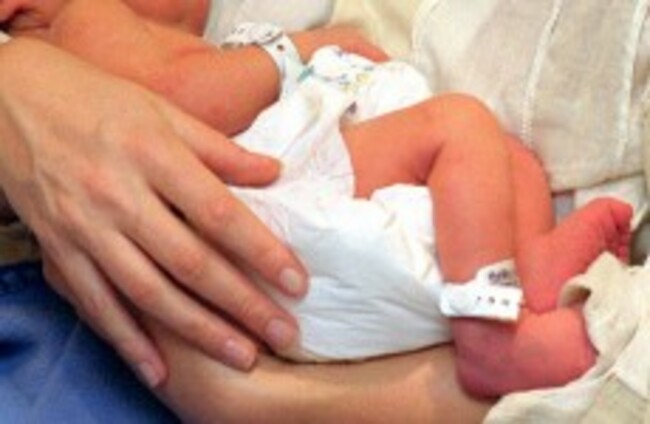
Around 23 newborn babies have been found with the MRSA superbug in Mayo in the past seven months.

Image: Fiona Hanson/PA Wire/Press Association Images

HEALTH OFFICIALS AT Mayo General Hospital in Castlebar are trying to stop the spread of MRSA that has been present in the maternity unit since March this year.

The superbug has been found on the skin of the infants known as ‘colonisation’, which means they are carrying the bacteria, only making it a life-threatening bug if it enters the bloodstream. This could easily happen through a cut or an open wound.

In the past seven months, the hospital has started screening all babies in the maternity unit, not just in the Special Care Baby Unit and they found that on average around three babies tested positive for MRSA colonisation per month.

A spokesperson for the hospital said:

Mayo General Hospital screens all babies for MRSA on admission to the Special Care Baby Unit and weekly after that; this is standard clinical practice. Sometimes we find a very small number of babies per month positive for colonisation following this screening. When a baby is found to be positive, they are cared for in a separate room, if possible, from the other babies and increased precautions are taken to reduce the risk of spread to other babies. Sometimes eradication therapy may be considered, like cream for the nose or special washes.

No infant has become ill due to a MRSA infection in Mayo and there are no babies carrying the MRSA bacteria in the unit at present.

The Maternity staff supported by the infection control team, consultant medical staff and hospital management are reviewing possible causes and implementing control measures, such as increased screening, a strict visiting policy, environmental cleaning and enhanced vigilance.

The most important and effective infection control measure to reduce the spread of the infection is hand washing.

Read: Rates of MRSA drop to the lowest recorded in Ireland >

Read next:

Comments (25 Comments)

  • Unacceptable

    Reply
    • It’s not the hospitals fault. The reason it is called a superbug is because it is almost impossible to kill with antibiotics and sterilisers. They try to get rid of it.

      I had MRSA while I was in hospital earlier this year. I don’t blame the hospital though. I can assure you that even though I was in isolation (2 weeks in intensive care and 5 weeks in burns unit) the staff were constantly cleaning everything. People had to wear aprons and gloves when coming into my room. It’s just a fact of hospitals that MRSA exists and is difficult to eradicate.

      Reply
    • Never said it was, Barry.

      Can you outline for me what would constitute an acceptable level of MRSA presence in a maternity unit in your eyes?

      Reply
    • It’s estimated that up to 1/3 of people are carriers of MRSA, in their nose and throat, these people may carry the bacteria and be “colonised” with it and never know. That is the normal level of MRSA in everyone.
      It becomes a problem when either a carrier’s immune system becomes compromised, usually due to another illness, and they become symptomatic. They begin to show signs of having an MRSA infection. It can also manifest if a carrier accidentally passes it on to someone else, usually the other person will have to be immunosuppressed, their immune system will be already weaked either because of illness or because they may be very old or, as in this case, very young. The bacteria may also enter to an open cut or wound.
      If someone knows they are a carrier it can be easily treated with nasal creams and normal hand hygiene, if it gets into a wound or they become symptomatic then there ARE atibiotics, or combinations of antibiotics that can treat it.

      Reply
  • Terrifying for their families! Hopefully there will be a good outcome for all of those poor little babies.

    Reply
    • They’re not sick

      Reply
    • I’m aware that they are not sick YET. how would you feel if it was your newborn? Terrified?

      Reply
    • Not if my baby was otherwise healthy, no. MRSA lives happily on the skin of many people who are completely oblivious because it’s not a risk to people with heathy immune systems. That’s why, as the article says, the majority of those babies were sent home with no follow up treatment. But i’m sure lots of people would get a fright initially. The only reason it’s presence in newborns was recently detected us because it only became standard practice to swab newborns i’m recent months. No doubt many many were born and discharged carrying the bacteria prior to this.

      Reply
    • M Barron 12/10/12 #

      I take your point, people would be blissfully unaware without these new infection controls and the article is meant to scare people unneccessarily. However, newborns can be fragile little creatures and I would be frightened if my newborn had a superbug such as this living on her skin with the potential for a deadly infection.

      Reply
  • MRSA is an absolute nightmare ! It is not good enough that any hospital has it , as it is prevented by basic hygiene practises , such as hand washing and disposing of nappies tissues etc appropriately. I really hope that these little babies do not develope any further symptoms of the infection . Its a blasted curse to overcome.

    Reply
    • The hospital doesn’t “have it”. It’s present on the skin of some new born babies. MRSA naturally lives on the skin of some people, nothing can be don’t about that. This article is completely sensationalist.

      Reply
    • +1 on it being a sensationalist article. I’ve been there, done that, suffered through it, and don’t like seeing the doctors and nurses who saved my life, porters, cleaners, etc, who also helped look after me, being blamed for what is essentially evolution. Natural selection let the antibiotic resistant bacteria multiply while the weaker bacteria was wiped out.

      As I said above, I was in isolation so the only people allowed in were hospital staff and immediate family (except my son because no kids were allowed), everyone who came into my room had to wear disposable gloves and aprons, even when my mother called in and had a sore throat they made her wear a surgical mask before leaving her in. Before and after putting on the gloves everyone entering/exiting the room had to wash hands with antibiotic soap. I’ve seen first-hand the efforts that hospital staff go through to contain MRSA and they can’t be faulted.

      Reply
    • Barry

      It is definitely the hospitals fault if they cannot prove that the patient brought the infection into the hospital with them.
      In Denmark there were only approx one hundred total cases last year described as hospital acquired and they rigidly adhere to infection control procedures. In Ireland the vast majority of doctors and nurses do not was their hands per and post touching patients .
      However the real issue seems to be the prevalence of this resistant superbug in national pig herds where the likely cause is the overuse of antibiotics both to prevent infection and speed up growth. These practices need to be stopped now.

      Reply
    • And as I personally witnessed MRSA with a member of my family. I Totally Agree Eileen it is a devastating infection and very very lengthy recovery

      Reply
    • Paddy, I can personally vouch for the staff in CUH washing their hands before and after coming into my isolation room when I had MRSA.

      Reply
    • Hey Barry , I have been there too . And I thank goodness for the staff ( ALL of them) who looked after my Mam, and yes it is on the skin,in the nose,around the groin area ,hands, and as the article says if it gets into the blood stream that is where the problems start. In my opinion the article is not sensational as you suggest . Why is it that the medical profession do not want to talk about it publically ? They treated my mam’s and dealt with it but in my experience they would not say straight out that MRSA was the problem, til we asked them directly.My mam recovered and is very well and medically fit thanks to the hospital staff’s efforts.
      Like I said basic hygiene hand washing etc is the best defense.

      Reply
    • My mam , was in isolation too , where we all had to wear gloves and aprons, until her eyes were bleeding(terrifying sight) and we had to wear masks too for a time , the medical staff still rejected that it was anything more than an unfortunate infection. Then a friend told me to ask them was it MRSA and it was only then they admitted it . Basic hygiene hand washing is the key to prevention .
      http://www.domestos.ie/health-hygiene/infections-viruses/skin-wound-infections.php?WT.srch=1

      Reply
    • Sorry to hear about what your mother went through Eileen. I guess we’ve had different experiences. I don’t remember a whole lot when I came out of ICU because of the morphine but as far back as I can remember through my time in hospital the doctors and nurses were honest about it to me and my family. They said that infections (I had many more besides MRSA) were to be expected because rather than just having nose/mouth as avenues of infection, I had been burned on 60% of my body so that was all open to infection.

      Bacteria is everywhere. It’s because hospitals use so much sterilisation and antibiotics is the reason why the strains of bacteria commonly found there, e.g. MRSA, are so deadly. I was being pumped full of antibiotics to no effect. It’s the inability to fully treat MRSA because of that trait is what makes it so deadly compared to “regular” infections.

      Reply
    • Barry
      I am so sorry to hear how you suffered . It must have been awful for you ,I hope you continue to keep well. You are correct , bacteria and infection is every where and that is why hand washing is critical. My mam got ill after an ordinary straight forward hip replacement ,the wound became infected.
      You know what Barry even the fact that we are discussing it is good ,and puts it out there.
      I am sure the babies will be fine and will be looked after with great care.
      You take care too Barry ,it sounds like you are a fighter / survivor. :)

      Reply
    • I totally agree Eileen from Personnel experience of many years with a member of my Family A horrendous and devastating infection

      Reply
  • Albania under these gangsters in power.

    Reply
  • This is a disgrace

    Reply
  • hand washing and cleaning down surfaces is answer. yes we do know mrsa is a superbug, not really the point..hand washing and cleaning doesnt kill bacteria it clears away , i.e down sink or in bin. irish hospitals are no different to other hospitals in world but mrsa is higher why……………………………….

    Reply
  • Cylon 13/10/12 #

    The levels of MRSA in Ireland are unacceptable. Im Irish but live abroad. I had a baby recently and during my pregnancy I did not travel home for fear I’d end up in an Irish hospital.

    My father had renal failure and was in hospital regularly. I often had to remind staff to wash their hands before they touched him. He had a line into his body and MRSA would have destroyed him. In all the years I was in and out of hospital with him, I was constantly shocked by the lack of hand washing.

    Reply

Add New Comment