TheJournal.ie uses cookies. By continuing to browse this site you are agreeing to our use of cookies. Click here to find out more »
Dublin: 10 °C Saturday 18 May, 2013

Cameron to face Commons grilling after Clegg attacks EU veto

David Cameron will defend using his veto to the House of Commons – which his deputy prime minister said was “bad for Britain”.

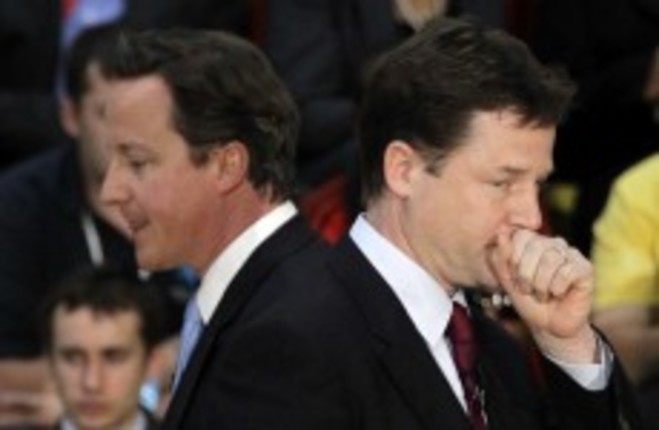
David Cameron (left) and Nick Clegg are deeply divided over the PM's veto at last week's Brussels talks.
Image: Matt Dunham/PA Wire

DAVID CAMERON is likely to face one of his toughest-ever outings in the House of Commons today, when he explains to MPs why he backed out of a deal agreed by the 26 other members of the EU last week.

Cameron was the only one of the 27 EU heads of government not to sign up to a new “fiscal compact” agreed by leaders in the early hours of Friday morning – a move which has divided opinion in the United Kingdom.

Though Cameron has face attacks from all sides over his effective veto, the harshest criticism has come from his own deputy – Liberal Democrat leader and deputy prime minister Nick Clegg.

Speaking on BBC One’s Andrew Marr show yesterday morning, Clegg described Cameron’s block – an effective veto over the negotiation of a new EU treaty – as being “bad for Britain”.

The Guardian quotes Clegg as saying he was “bitterly disappointed” by the outcome, speaking of a “danger that the UK will be isolated and marginalised within the European Union”.

Clegg added:

There’s nothing bulldog about Britain hovering somewhere in the mid Atlantic, not standing tall in Europe, not being taken seriously in Washington.

The Lib Dem leader was keen to insist, however, that there was no risk of his party leaving the coalition – saying a collapsed government would be “even more damaging to us as a country”, and describing such an event as an “economic disaster”.

Senior members of Cameron’s own Conservative Party – including the justice secretary and former chancellor, Kenneth Clarke – and the heads of the devolved parliaments in Scotland and Wales have also bemoaned Friday’s events.

Sky News notes, however, that Cameron’s actions seem to have met with general public approval – with a poll published in The Times showing 57 per cent of people believing it was “right to exercise Britain’s veto”.

The BBC cited Downing Street sources in saying that Cameron would begin his address to the Commons today with a factual timeline of the decisions he took in Brussels.

Cameron will address the House of Commons at 3:30pm today.

Gilmore suggests referendum may not be needed for EU deal

Germany insists EU deal will crack crisis – as Britain fears isolation

Read next:

Comments (16 Comments)

  • He wanted to show his H o C colleagues and the English people that he wasn’t going to be bullied by Europe, but in doing so shot himself in the foot

    Reply
  • I suppose those that red thumbed my first comment ,prefer the government to make all the choices on the publics behave without ever consulting the public.No wonder this country is so F***ked up.

    Reply
  • He may have shot himself in the foot but his actions last week will make a vote on what the government is intending on doing nearly a certainty.So i wish to extend my thanks to Mr Cameron for that.

    Reply
  • The self amending clause inserted in the consitution by the Lisbon treaty has been negated by Mr Camerons actions.Even though a court challenge may have to be taken to force a referendum considering the Government knows they SFA of a chance getting a vote through considering the lies and broken promises.

    Reply
  • Don’t you think he is getting a little too arrogant, with an inflation approaching 5%?

    Reply
  • Pity the Irish don’t have a leader like him. Someone has to say no to the fourth Reich!!

    Reply
    • Now if Britain says no and Europe says ‘whatever’, I’m guessing his approach has completely backfired. An exercise in national stupidity, not something we should do, although we’d probably be very good at it..

      Reply
    • Ok, so what is the alternative? allow France and Germany to micro manage our country?? effectively turning our elected leaders in EU managers! increase corporate tax, impose more austerity causing a further contraction in our domestic economy??? this is WW2 without the violence!!

      Reply
    • So sick if this WWII analogy – don’t believe it’s accurate, or helpful.

      Yet again, Cameron acted in the interest of the City, not the British people. No more democratic than your Fourth Reich.

      Reply
    • Cameron acted in the interest of the British people and fair play to him (not like our puppet Enda Kenny), WW2 analogy is used because of the EU’s (France and Germany) desire to control our finances, the Irish people did not cause this financial crisis yet we are expected to pay for it! and to be fined if our deficit is not inline! As if the country is not experiencing enough pain!! Also the idea of a treaty being passed without giving us a referendum is completely undemocratic! (and god forbid we say no! we will be told to vote again and again until we get it right!! come on where is the democracy??)

      We will be giving to option to a reduced interest rate on the Bailout for exchange for our Sovereignty!! this completely undemocratic . Niall I respect your opinion but I don’t agree with it!

      Reply
    • And Cameron’s happy to cut government to the bone, and hand over power, as well as responsibility for service provision, to unaccountable, unelected, faceless private sector actors. The reason he vetoed came down, primarily, to shielding his mates in the City from possible regulation or a Tobin Tax.

      I’m not sure that France and Germany have any particular interest in controlling our finances, I think that they just want to deal with this crisis without completely ruining the economies of the entire Eurozone. Don’t get me wrong, I’m pretty … forthright … in my opinions on the bailout, but at this point I see the solution being within the EU rather than outside. Also, I don’t think there’s anything wrong with balancing the books, so long as the political decision of how to achieve this remains a domestic one.

      Obviously we’re going to disagree here, but I personally think that we have a better chance of retaining meaningful democracy and sovereignty by working within the EU than pulling out and leaving ourselves to the mercy of The Markets.

      Reply
  • The British EU Civil Servants have failed dismally in keeping Cameron in the loop and have put the Prime Minister in a seriously awkward position both at home and in the EU !

    Reply

Add New Comment