TheJournal.ie uses cookies. By continuing to browse this site you are agreeing to our use of cookies. Click here to find out more »
Dublin: 18 °C Wednesday 19 June, 2013

Dispute erupts over USI’s student fees poll

The union’s members have voted in favour of maintaining the USI’s current position in campaigning for fully Exchequer-funded fees.

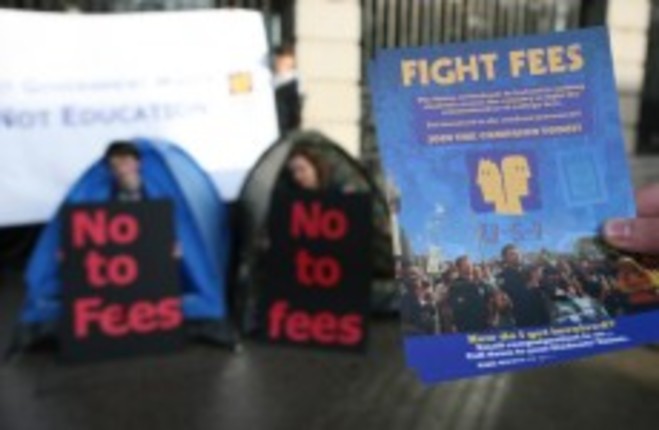
File photo of a USI 'no fees' protest.
Image: Niall Carson/PA Wire

Updated, 08:46

MEMBERS OF THE Union of Students of Ireland have voted by a slim majority to maintain the union’s policy of seeking free fees for third-level students.

The results of a week-long online poll on the issue were revealed at a special congress of the USI in UCD today, with the 100 per cent Exchequer-funded option emerging as the top preference.

Support for the  Exchequer-funded model narrowly beat student contributions as the most popular option.

Disputes have emerged over the poll, however, with NUIG’s delegation walking out of the congress over the passing of a procedural motion to end the debate prematurely and proceed directly to a vote.

A number of delegates to the congress had been planning to base their votes on the outcome of the debate, and had not travelled with mandates on how to vote.

Speaking to TheJournal.ie this evening, NUIG’s SU president Emmet Connolly described the online poll as a “sham”. He said that a decision had been made among the national executive earlier to hold the vote at a time of year when most students would still be in college.

“At this point of the year,” he said, “people are away and you don’t get a representative sample of students [for a poll]“.

Though pleased with the outcome of the vote, Connolly said that the NUIG SU feels that it should not have gone ahead in mid-May.

The NUIG SU is now considering disaffiliation from the USI and “it will be on the agenda for the incoming SU when they take over in July,” according to Connolly.

USI President Gary Redmond disagreed with NUIG SU’s stance on the poll’s timing, saying that the date for the poll was set by the union’s national executive and that it “didn’t seem to cause a problem in a lot of the colleges”.

“We’re absolutely delighted with the turnout and with the effort put in by the student unions,” he told TheJournal.ie.

Redmond also confirmed that attempts were made to hack into the website carrying the online poll, but that the USI is “100 per cent satisfied that security wasn’t breached”. “We’re very happy with the way the website performed.”

The USI president also said that he believes the union now has a stronger position when campaigning over fees because of the result of the poll: ”For the first time ever we were able to ask all of our members across teh country to vote in an online poll and to give their views. The fact that they voted in support of the policy we had in place means we can go to the government” and show this support.

Earlier: Students meet to decide fees stance after online referendum >

  • Share on Facebook
  • Email this article
  •  

Read next:

Comments (37 Comments)

  • It wasn’t the students who ruined this country , and young graduates are probably the only thing this country has going for it. University should be 100% funded… Or else we would all be sitting at home watching tv and surviving off the dole, with nothing to live for.. Which people would also be complaining about!. Young people cannot be punished because of how people made a balls of the country.

    Reply
  • The cost of putting a student in university costs the exchequer somewhere between €6,000 fees to €13,000 full maintenance and fees. The cost of someone on the dole is €10,000 weekly payment to €14,000 weekly payment and rent allowance this increases with other benefits.

    While there is a lack of jobs would it not be more beneficial to pay for education? These figures are just rough, it would be a lower fee for plc, diploma etc

    Reply
  • Hugh 23/05/12 #

    Wait, the website is completely secure despite there being documented XSS vulnerabilities AND a screenshot of someone logged in as the admin, with the password in tow? What a joke.

    Reply
    • In addition, several confirmed reports of graduates, transfers, dropouts being able to vote in the preferendum. USI has not adequately addressed how their votes could be separated from students’ votes while maintaining a secret ballot.

      Reply
  • @Vocal Outrage. You couldn’t vote as your college is not affiliated to USI.

    Reply
  • They do contribute something at the
    moment- over €2000 worth of something in fact. It’s for every union and every representative body to fight for the most they possibly can. I see no reason for USI to be different, even if this vote was less than perfect.

    Reply
  • we didn’t cause this mess, nd you need an educated work force, people can afford the fees!!

    Reply
  • Thats a brilliant result. There are really only two camps in this debate, those that think third level education should be completely free or that students should be liable to pay full fees. Fee’s having been moving towards the latter for some time now. It could end up being 20 or 50 years, but the way things are going, students could very well end up with the full bill like in the US. By making this their policy, the USI have to fight for free fee’s. Its completely unrealistic that it will happen, and they’re fully aware of that, but it will help to keep fees as low as possible. If they had taken a new position of a student contribution for example, their position would have moved closer to those that would see them paying as much as possible.

    Reply
  • I can vouch for how secure the site is, it would not even let registered students use it. Despite being a student in CIT the site would not accept my vote. Which by the way was for some form of student contribution post graduation.

    Reply
  • How can you have fees fully funded by the exchequer in the current climate? Nuts.

    Reply
  • Hang on! A bunch of students still in college voted to keep the exchequer I.e taxpayer paying the full bill as opposed to contributing anything themselves? Shocking.

    Reply
    • Students, in many cases ARE tax payers, many are mature students who have paid tax most of their lives and the rest will graduate to go on and generally pay more tax than those who decide not to go to college.
      Everyone in society benefits from education, it gives us better teachers, doctors, judges, politicians, nurses. Those who benefit directly from education unarguably pay more tax during their lives.
      Why are you claiming that the educated don’t “contribute anything themselves”? The people you are talking about over all contribute more than any other sector of society.

      Reply
  • The universities should be cutting their own costs just as well as expecting the gov to keep pumping money in, vastly overpaid lecturers and job sharing secretaries in abundance

    Reply
    • Wouldn’t necessarily agree with lecturers being overpaid given their work load. A lot of them put in well over 40 hours a week. But the Presidents are a joke. The President of UCC is on 230,000 a year as of 2010. Thats down from the 280,000 he was on in 2008. Thats an absolute disgrace! Even cutting that 30,000 would put two students through a year in college nearly.

      Reply
    • Come on Val, over 40 hrs is nothing, how many of them are actual teaching hours, probably 10 at most. Most people on salary in private sector do far more that that and don’t get 3 months off at summer to think about stuff and write Micky mouse papers. still overpaid compared to our european neighbours.

      Reply
    • @ap freely While about 10 hours a week are teaching hours, the other 30 are class prep, lecture notes, test corrections and making tests. I wouldn’t say they waste their time off either. Majority of my lecturers are going for their Doctorates as well as (trying) to teach us

      Reply
    • Lecturers are far from overpaid, nor is their timetable solely centred around teaching. Bear in mind that their job is 40% teaching, 60% research. Not to mention all the admin they have to do, and don’t forget that there are PhD students to be supervised and guided along as well. If they really were that overpaid, they wouldn’t be constantly competing for grants and fellowships from research councils such as the IRCHSS now, would they?

      Reply
    • Most university staff do not get 3 months off in the summer. Lectures are not the only thing that go on in universities.

      Reply
  • The simple issue is that 3rd level has to be funded somehow, Govt cannot afford it so funding had to come from commercial research or students. Commercial risks undermining academic freedom and research, yet direct student funding is a barrier to entry. Hence deferred student contribution once students are earning enough seems to me to be a better funding model

    Reply
    • Government very much can afford it. Progressive taxation and restructuring of how some colleges are run will be necessary.

      The government has found the money to bail out Anglo and the bondholders, to whom we owe nothing; that was private debt that the people of Ireland should not have to repay because private business people took a gamble.

      Being able to access education should never be contingent on financial means. To suggest such a system is discrimination of a gross nature. 100% Exchequer Funded is fair to families and to society.

      (This vote was still a complete catastrophe, and USI needs a major overhall but that’s another kettle of fish.)

      Reply
  • One factor effecting high university costs is the large proportion of students who use exchequer funding only to drop out. Students who drop out should be forced to pay for the education they received. This would not only relieve the strain on the exchequer but would deter people who have little interest in college applying anyway ( as many do now ). The extra capital could be used to provide free fees to students who remain in college. This would incentivise people to do so too.

    Reply
    • As of 2010 the HEA but the first year drop out rate at 9%. Sounds like a lot but when you consider that the University does not claim fees if the student drops out before October 31st and only claims half fees for those who drop out before January 31st I don’t think the problem is as big as you claim, financially speaking.

      As pointed out above the cost in JSA to those not enrolled would be higher than the cost of educating them for the year.

      Reply
  • It’s just as well they don’t make policy so. Students have to contribute in the current climate. University’s are falling down the rankings fast for lack of funding. Though the massive salaries of the senior academics don’t help…

    Reply
    • A fairly prominent lecture explained this too our class towards the end of this year. Our colleges are falling down the rankings because they are refusing to throw out their outdated marking schemes. Our college will rarely give someone over 70/80% because there thinking is anything higher than that is professor standard, and clearly a student can’t be of that standard! On the other hand, the US and UK colleges along with many others, have thrown out that system and started marking on actual worth. Its keeping our grades way lower than they actually are as a result and stopping us from competing for the top prizes. Its actually some joke.

      Reply
    • Wow, O’Reilly, you have regurgitated what it repeated on RTE perfectly. “current climate” “falling down the rankings” etc, you would make a good government spin doctor!

      Do you think it may be possible that Ireland, and much of the rest of Europe’s higher educatin institutes are falling in world ranking because so many recently developed and developing countries have started to establish western-standard institutes?

      We are falling because Asia are rising, it has nothing to do with dropping standards, just the standards are rising elsewhere and the demographic is massively increasing.

      Reply
  • As long as they learn Chinese they get a job when they graduate :)

    Reply
  • Majority of comments in this points are just illustrative of the keyboard warriors that will never change anything in this country but will talk the best reform ever. The fact is, USI conducted a Nationwide consultation, unprecedented and historic. Yes there may have been teething issues but that’s inevitable. For NUIG to argue about timing is petty-the college calendar is hectic all year around so there is never and ideal time. This article also sensationalises NUIG’s walk out which should not be commended under any standards. It also fails to note that one of their delegates walked back in to recontribute to the debate so it hardly had the hallmarks of a revolution.
    I’m sure USI has many flaws but this is a positive and progressive step towards better student representation and the only way we’ll actually make progress in the fees battle is as through being innovative in ideas and united in practice, not through walk outs when you don’t get your way.

    Reply
    • Hi Ben, Cian from NUIG SU here.

      The timing of the preferendum was especially bad for various reasons. Mainly that now is a time when students are unconnected with their campuses due to either being mired in exams or having already finished. This is while USI are criticising the government for holding the referendum during the week as it will disenfranchise students. It would have been far better to hold this in October when colleges will be pulsing with students and SUs can ensure they have an actual mandate.
      Plus, timing this now means that the media is even less likely to care, given the importance of the Fiscal Treaty.

      As for NUIG’s walk out, it’s important to note that not every delegation had a mandate to vote: delegations such as QUB, UU and NUIG were free voting meaning it was important to give their delegates a chance to hear each side debated. This was one of the most monumental decisions USI can vote on given it would mean a radical policy shift by USI. We felt it was vital to ensure that each option was debated as much as possible. When this was guillotined and the debate was cut off after only 4 speakers we walked out to show our dissatisfaction with how this was being run (we still voted as we checked with the USI Steering Committee that voting was still possible)

      In addition, the USI online poll was utterly flawed with many students being unable to vote and other non students being able to. We tried e-voting before in Ireland and it was a dismal failure. This was no exception.

      Reply
    • Hugh 24/05/12 #

      In my mind “teething issues” means “the site went down a few times” or something like that. The reality is the equivalent of the ballot boxes being unsupervised for the entire duration of voting. On a basic levee, e-voting has myriad problems as is – this system had even more.

      Reply
    • Ben, you can’t possibly believe the things your saying above; do you?

      Having a vote when the majority of students are in exams or finished for the Summer is pathetic. It leaves no time or opportunity for students to be informed. If, as Gary Redmond, keeps cheeping, the USI really does care about what its grassroots members think about the structure of our higher education and funding models, they would not rush through this vote at a time that is completely inconvenient to students. The appalling turnout (5% of USI members voted) reflects this.

      That doesn’t even address the fact that the website has XSS vulnerabilities AND alumni and students who had dropped out and were no longer registered students were able to cast votes. The USI has not adequately addressed how these votes were identified and nullified while maintaining a secret ballot.

      NUIG’s delegation and some of the QUB delegation left the room after 9A was passed (to end further debate on the issue). This again returns to the fact that USI’s supposed concern for their members’ opinion is remarkably fake. If this issue is so important that it had to be rushed and put to students now, why couldn’t there be proper debate and discussion at Special Congress?

      If you can’t see anything wrong with this catastrophe, we are living in parallel realities.

      Reply
  • pointless drivvel

    Reply

Add New Comment