Welcome to our Public Beta Site - What does this mean?
Dublin: 13 °C Wednesday 23 May, 2012

Eta calls definitive end to armed conflict

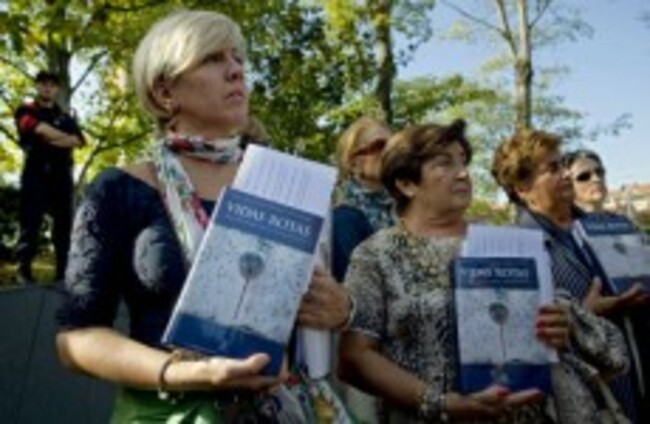
Relatives of people killed by the Basque armed group ETA protest with several books with the history of more than eight hundred people killed by ETA, during the International Conference in San Sebastian, northern Spain on Monday.
Image: Alvaro Barrientos/AP/Press Association Images

BASQUE TERRORIST GROUP Eta has said it has brought its campaign of violence to an end.

In a statement to the BBC, the separatist group called a “definitive cessation” to its bombings and shootings.

The 40-year-old conflict has seen more than 800 people killed.

Eta has also called on the Spanish and French governments to respond to their permanent ceasefire with a “process of direct dialogue”.

Previous attempts at peace talks between the governments and the Basque separatist movement have come to abrupt endings after the group broke “permanent” ceasefires.

The group had called a permanent ceasefire in January 2010 but has not since engaged in any peace talks.

The Spanish government is particularly cautious following the breaking of a ceasefire with an airport bombing in 2006. Two people were killed in the incident.

The statement comes after a conference held in the Basque Country earlier this week. Irish politicians, including Gerry Adams and Bertie Ahern, attended talks in which the Northern Irish model was used as an example of a successful peace process.

The decision has been welcomed by Adams, who reiterated calls for the governments of Spain and France to agree to talks with Eta.

Here is Eta’s statement in full:

Eta, socialist revolutionary Basque organisation of national liberation, desires through this declaration to announce its decision:

Eta considers that the international conference held recently in the Euskal Herria [Basque Country] is an initiative of great political transcendence. The agreed resolution brings together the ingredients for an integrated solution to the conflict and has the support of large sectors of Basque society and of the international community.

In Euskal Herria, a new political age is opening. We face a historic opportunity to obtain a just and democratic solution to the age-old political conflict.

Faced with violence and repression, dialogue and agreement must characterise the new age. The recognition of Euskal Herria and respect for popular will must prevail over any imposition. This is the will of the majority of Basque citizens.

The struggle of many years has created this opportunity. It has not been an easy road. The rawness of the struggle has claimed many companions forever. Others are suffering jail or exile. To these our recognition and heartfelt homage. From here on, the road will not be easy either. Facing the imposition which still remains, every step, every achievement, will be fruit of the effort and struggle of Basque citizens. Throughout the years Euskal Herria has accumulated the experience and strength necessary to tackle this road and it also has the determination to do it.

It is time to look to the future with hope, it is also time to act with responsibility and valour.

Because of all this, Eta has decided on the definitive cessation of its armed activity. Eta makes a call to the governments of Spain and France to open a process of direct dialogue which has as its aim the resolution of the consequences of the conflict and thus the conclusion of the armed conflict. With this historic declaration, Eta demonstrates its clear, firm and definitive purpose.

Eta finally calls on Basque society to get involved in this process until peace and liberty are achieved.

Long live the free Euskal Herria, Long live Basque socialism, no rest until independence and socialism.

In Euskal Herria, 20 October 2011

Euskadi Ta Askatasuna

Eta

Read: Adams and Ahern in Spain for talks on Basque separatism>

Read Next:

Comments (13 Comments)

  • Ryan Murphy 20/10/11 #
    Report this comment

    No doubt Bertie will try and claim the credit for this good news as well. He hardly flew over there for the good of his health!

    Reply
  • Alan Breslin 20/10/11 #
    Report this comment

    Bravo!!

    Reply
  • Frank2521 20/10/11 #
    Report this comment

    As soon as Bertie arrived they called a cease as they didn’t want to see him showing up again and again. They should send him to Afghanistan. .

    Reply
  • cian 20/10/11 #
    Report this comment

    what i dont understand is that people fightong for freedom in libya ar revolutionaries but people who fought against Franco to try get freedom for their country are terrorists

    Reply
    • RDX862 20/10/11 #
      Report this comment

      Franco died in 1975

    • cian 20/10/11 #
      Report this comment

      yes and the new spainish government took over exactly were he left of in suppressing the basque people

    • Javier Rocha 20/10/11 #
      Report this comment

      In fairness, Basque country has a great autonomy compared to other european territories, i.e. Northern Ireland. I understand your point though, and yes, they still don’t have the right to be independent, or, at least, to make a referendum. Spain, as a imperialist country, is bad, but not worst than France, Italy, England and of course U.S.

    • Report this comment

      France is even worse Javier. Little known fact about France. Let’s say you are a native Basque speaker from Lapurdi/Labourd and you only speak Basque (imagine you are elderly). Now say you are brought to a French court. In that court you are not allowed to speak Basque, as technically you are a French citizen, and the laws of France dictate there is only one language for French citizens – French. Now, imagine you are a Basque speaker from Gipuzkoa, just across the border in Spain with the same linguistic ability, i.e. you only speak Basque. Now imagine you are brought before the exact same French court (say you were accused of littering or some other offence while visiting the aforementioned Basque-speaking French citizen), the laws suddenly change. As Basque is recognised as an official language of an autonomous region of an EU member state, Basque in this instance is allowed in that very same court of law. In other words, France grants more linguistic rights to foreigners than it does to its own citizens. It actively banned the use of Breton, Occitan, Basque, Gascon, Corsican, Arpitan, Flemish, Alsatian and the various dialects until the mid-80s, thereby restricting their usage solely to the family home. Even today the best word that could be used to describe the central government’s attitude to its indigenous minorities is contempt.

  • Oil Foster 20/10/11 #
    Report this comment

    And people who fought for basic civil rights for Catholics in the north are terrorists?

    Reply
  • Report this comment

    That’s because you’re only a terrorist if you are on the minority or losing side. If you inflict enough deaths and win then you are called a freedom fighter. Basically, the logic is this: the more people you kill and the more superpower countries you get on your side, the more likely you are to be accepted by society. Stupid logic but that’s how it works. The 1916 – 1922 IRA were regarded as terrorists in their time. We gain independence and they are suddenly regarded as freedom fighters and worshipped as heroes. The armed group UÇK was regarded as a terrorist group by most of the world until Kosovo seceded from Serbia. Now suddenly the world (excl. Russia, Serbia, etc.) looks on them as freedom fighters. The Tamil Tigers fought a similar war in Sri Lanka for the Tamils who were even more oppressed than the Basques in Spain under Franco or the Albanians in Kosovo under MiloÅ¡ević, but they lost and so are still regarded as terrorists.

    Reply
  • Report this comment

    Derek, I agree that the killing of innocents is wrong, no matter what the circumstances. I am simply pointing out the hypocrisy in nomenclature. “One man’s terrorist is another man’s freedom fighter” and all that. After all, the (P)IRA were regarded as terrorists by the UK, the Irish government and many in the Western World. However, they were regarded as freedom fighters by the Soviet Union. UÇK was regarded as a terrorist organisation by the entire world until Kosovo seceded from Serbia, then suddenly most of the Western World looks on them as freedom fighters, not as terrorists. Their actions hadn’t changed. They were still killing innocent civilians. They were still actively involved in ethnic cleansing, yet suddenly we were treating them as if they were a benevolent force! Nelson Mandela is often hailed as a hero, and as a great liberator of the African people in South Africa. However, the USA had him in their terrorist list as late as 2008! His ANC were regarded as terrorists in South Africa and regarded as such by many Western Countries (incl. the UK and the USA). Suddenly, the ANC comes to power in South Africa and Apartheid collapses and the entire Western World has amnesia about their actions. Suddenly they are no longer referred to as terrorists but as liberators. Even the Free French forces were regarded as terrorists by Nazi Germany. If we agree that all terrorists are bad and all states that suppress terrorists are good, then logically speaking you are suggesting that the Free French were bad and Nazi Germany was good. There is no other way to look at it unless you are a hypocrite. ETA are a terrorist organisation – they strike terror into the hearts of many. But their existence was as a direct result of Spanish governmental policies under Franco. The Basques happily lived as part of Spain until Franco and the Civil War as they were allowed to retain their customs, their language and a large degree of independence, albeit within the Spanish state. Franco banned the use of Basque everywhere, including in the home (though this part was not policeable. He banned their sports (including pelotta), he even banned the use of Basque names which had long been used in the likes of sports clubs, etc. Their dancing and music was prohibited. Everything had to be Spanish. Basques were discriminated against. Preferential housing was granted to Castillians moving into the Basque Country over the native Basques. Jobs were allocated on a preferential basis to Castillians. The Basques basically had no right to housing, no right to a job, no right to speak their language or dance or sing or practice their culture. They were not even allowed to engage in dialogue to improve their lot. Their only option was to fight. In this I agree. However, the death of innocents is not something I agree with, and when the Basque Statutes were implemented after the death of Franco ETA should have ended all conflict and entered into the democratic arena – something they were finally allowed to to. Not everything is black and white.

    Reply

Add New Comment