Sign in. It’s quick, free and it’s up to you.
An account is an optional way to support the work we do. Find out more.
Sign in. It’s quick, free and it’s up to you.
An account is an optional way to support the work we do. Find out more.
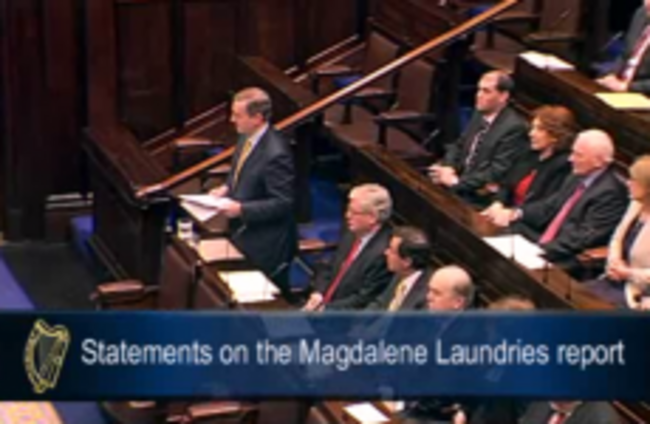
THE FOLLOWING is the full text of the address to Dáil Éireann made by Enda Kenny this evening.
A full audio clip of the Taoiseach’s address can be heard here, or at the end of the transcript below.
In his speech, Kenny said the government and the citizens of Ireland “deeply regret and apologise unreservedly to all those women for the hurt that was done to them”.
I begin today’s debate by thanking Dr Martin McAleese and his team for their excellent work on this report.
I thank equally all the women who met with them to assist in its compilation. I also thank the religious orders who cooperated fully with Dr. McAleese.
Together they have helped provide Ireland with a document of truth.
The Magdalene laundries have cast a long shadow over Irish life over our sense of who we are.
It’s just two weeks since we received this report: the first-ever detailed Report into the State’s involvement in the Magdalene Laundries.
It shines a bright and necessary light on a dark chapter of Ireland’s history.
On coming to office the Government was determined to investigate the facts of the State’s involvement.
The government was adamant that these ageing and elderly women would get the compassion and the recognition for which they have fought for so long deserved so deeply and had, until now, been so abjectly denied.
The reality is that for 90 years Ireland subjected these women and their experience to a profound and studied indifference.
I was determined because of this that this Government – this Dáil – would take the necessary time not just to commission the Report but to actually study it and having done so to reflect on its findings.
I believe that was the best way to formulate a plan and strategy that would help us make amends for the State’s role in the hurt of these extraordinary women.
I’m glad that so many of the women themselves agreed with that approach.
And I’m glad that this time of reflection gave me the chance to do the most important thing of all: to meet personally with the Magdalene Women. To sit down with them, face to face, to listen to their stories.
It was a humbling and inspiring experience.
Today, as their Taoiseach, I am privileged to welcome some of these women to this House many of whom have travelled long distances to be here.
I warmly welcome you every one of you to your national parliament, to Dail Eireann.
What we discuss today is your story. What we address today is how you took this country’s terrible ‘secret’ and made it your own. Burying it carrying it in your hearts here at home, or with you to England and to Canada America and Australia on behalf of Ireland and the Irish people.
But from this moment on you need carry it no more. Because today we take it back. Today we acknowledge the role of the State in your ordeal.
We now know that the State itself was directly involved in over a quarter of all admissions to the Magdalene Laundries.
Be it through the social services reformatories psychiatric institutions county homes the prison and probation service and industrial schools.
In fact we have decided to include all the Magdalene women in our response regardless of how they were admitted.
Dr McAleese set out to investigate five areas in particular;
1: The routes by which the women entered the laundries
2: Regulations of the workplace and State inspections
3: State funding of and financial assistance to the laundries
4: The routes by which the girls and women left the laundries
5: Death registrations, burials and exhumationsIn all five areas there was found to be direct State involvement.
As I read this Report and as I listened to these women, it struck me that for generations Ireland had created a particular portrait of itself as a good living God-fearing nation.
Through this and other reports we know this flattering self-portrait to be fictitious.
It would be easy to explain away all that happened – all we did in those great moral and social salves of ‘the culture back then’ = the ‘order of the day’, ‘the terrible times that were in it’.
Yes, by any standards it was a cruel, pitiless Ireland distinctly lacking in a quality of mercy. That much is clear, both from the ages of the Report, and from the stories of the women I met.
As I sat with these women as they told their stories it was clear that while every woman’s story was different each of them shared a particular experience of a particular Ireland judgemental intolerant petty and prim.
In the laundries themselves some women spent weeks others months more of them years. But the thread that ran through their many stories was a palpable sense of suffocation not just physical in that they were incarcerated but psychological .spiritual social. Their stories were enriched by an astonishing vividness of recall of situation and circumstance.
Here are some of the things I read in the report and they said directly to me:
“The work was so hard, the regime was cruel.”
“I felt all alone, nobody wanted me.”
“They sent me because they thought I was going to a good school.”
“I seen these older people beside me, I used cry myself to sleep.”
“I was bold, I wasn’t going to school.”
“I was locked up I thought I would never get out.”
“We had to sew at night even when we were sick.”
“I heard a radio sometimes in the distance.”
“We were not allowed to talk to each other.”
“Your letters were checked.”
“I was so short I needed a stool to put washing in.”
“The noise was desperate.”
“I thought I would go mad from the silence.”
“The heat was unbelievable.”
“I broke a cup once and had to wear it hanging around my neck for three days.”
“I felt always tired always wet .always humiliated.”
“My father came for me after three months but I was too ashamed to go home.”
“I never saw my Mam again she died while I was in there.”The Magdalene Women might have been told that they were washing away a wrong or a sin but we know now and to our shame they were only ever scrubbing away our nation’s shadow.
Today, just as the State accepts its direct involvement in the Magdalene Laundries society too has its responsibility.
I believe I speak for millions of Irish people all over the world when I say we put away these women because .for too many years we put away our conscience.
We swapped our personal scruples for a solid public apparatus that kept us in tune and in step with a sense of what was ‘proper behaviour’ or the ‘appropriate view’ according to a sort of moral code that was fostered at the time particularly in the 1930s, 40s and 50s.
We lived with the damaging idea that what was desirable and acceptable in the eyes of the Church and the State was the same and interchangeable.
Is it this mindset then this moral subservience that gave us the social mores the required and exclusive ‘values’ of the time that welcomed the compliant, obedient and lucky ‘us’ and banished the more problematic, spirited or unlucky ‘them’?
And to our nation’s shame it must be said that if these women had managed to scale the high walls of the laundries they’d have had their work cut out for them to negotiate the height and the depth of the barricades around society’s ‘proper’ heart. For we saw difference as something to be feared and hidden rather than embraced and celebrated.
But were these our ‘values’?
Because we can ask ourselves for a State – least of all a republic.
What is the ‘value’ of the tacit and unchallenged decree that saw society humiliate and degrade these girls and women?What is the ‘value’ of the ignorance and arrogance that saw us publicly call them ‘Penitents’ for their ‘crime’ of being poor or abused or just plain unlucky enough to be already the inmate of a reformatory, or an industrial school or a psychiatric institution?
We can ask ourselves as the families we were then what was worthy what was good about that great euphemism of ‘putting away’ our daughters our sisters our aunties ?
Those ‘values’ those failures those wrongs characterised Magdalene Ireland.
Today we live in a very different Ireland with a very a different consciousness awareness – an Ireland where we have more compassion empathy insight heart.
We do because at last we are learning those terrible lessons. We do because at last we are giving up our secrets.
We do because in naming and addressing the wrong, as is happening here today, we are trying to make sure we quarantine such abject behaviour in our past and eradicate it from Ireland’s present and Ireland’s future.
In a society guided by the principles of compassion and social justice there never would have been any need for institutions such as the Magdalene Laundries.
The Report shows that the perception that the Magdalene Laundries were reserved for what were offensively and judgementally called “fallen women” is not based upon fact at all but upon prejudice. The women are and always were wholly blameless.
Therefore, I, as Taoiseach, on behalf of the State, the government and our citizens deeply regret and apologise unreservedly to all those women for the hurt that was done to them, and for any stigma they suffered, as a result of the time they spent in a Magdalene Laundry.
I hope that the publication of the McAleese Report and this apology makes some contribution to the healing process.
But in reflecting on this Report I have come to the view that these women deserve more than this formal apology, important though it is. I also want to put in place a process by which we can determine how best to help and support the women in their remaining years.
One of the many things I have learned during my recent meetings with these women is that their circumstances and current needs vary greatly from person to person.
That’s why the Government has today asked the President of the Law Reform Commission, Judge John Quirke, to undertake a three month review and to make recommendations as to the criteria that should be applied in assessing the help that the government can provide in the areas of payments and other supports, including medical cards, psychological and counselling services and other welfare needs.
The terms of reference for Judge Quirke will be published later today and I will also arrange for the representatives of the women to be fully briefed on this process. When Judge Quirke has reported, the government will establish a Fund to assist the women, based on his recommendations.
I am confident that this process will enable us to provide speedy, fair and meaningful help to the women in a compassionate and non adversial way. I am determined that the fund will be primarily used to help the women – as is their stated and strong desire – not for legal or administrative costs.
The McAleese Report also refers to women who recounted similar experiences in other residential laundries, such as the laundry offering services to the public operated in the Training Centre at Stanhope Street, Dublin.
The government has decided that these women should be included in both the apology I have extended today, and in the Fund.
I am also conscious that many of the women I met last week want to see a permanent memorial established to remind us all of this dark part of our history.
I agree that this should be done and intend to engage directly with the representative groups and of as many of the women as possible to agree on the creation of an appropriate memorial to be financed by the Government separately from the funds that are being set aside for the direct assistance for the women.
Let me conclude by again speaking directly to the women whose experiences in Magdalene Laundries have negatively affected their subsequent lives.
As a society, for many years we failed you.
We forgot you or, if we thought of you at all, we did so in untrue and offensive stereotypes.
This is a national shame, for which I again say, I am deeply sorry and offer my full and heartfelt apologies.
At the conclusion of my discussions with one group of the Magdalene Women one of those present sang ‘Whispering Hope’. A line from that song stays in my mind – “when the dark midnight is over, watch for the breaking of day”.
Let me hope that this day and this debate – excuse me – heralds a new dawn for all those who feared that the dark midnight might never end.
https://soundcloud.com/thejournal_gav/state-apology-magdalene-laundries

To embed this post, copy the code below on your site
















have your say