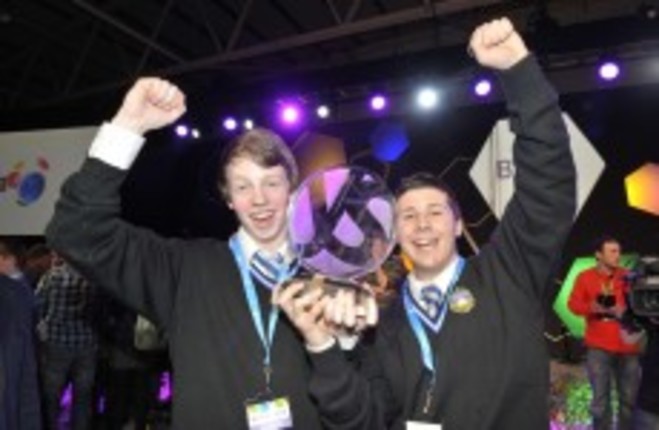
A PROJECT simulating how objects respond to gravity in certain environments – and making it easier to send objects through outer space – has won the top prize at this year’s BT Young Scientist and Technology Exhibition.
‘Simulation Accuracy In The Gravitational Many-Body Problem’ was the entry of Eric Doyle and Mark Kelly from Synge Street CBS, Dublin.
Their project saw them define new algorithms (a series of mathematical ‘steps’) which predict how bodies move in certain scenarios, such as when gravity is not present.
Their work may allow astronomers and physicists to come up with more accurate predictions of how man-made objects like satellites travel through space.
The ‘gravitational many-body problem’ is the name given to the study of how bodies interact with each other through gravity.
The boys share a cheque for €5,000 and a Waterford Crystal trophy, as well as the chance to represent Ireland at the 24th EU Young Scientist competition later this year.
The boys have also been given tickets to the London 2012 Olympic Games to mark their achievements.
The group runner-up award went to Balbriggan pair Deirdre Harford and Colleen Kelly, from Loreto Secondary School, who had examined whether genetics could be exploited to breed potatoes which resist drought.
Best individual award went to Eoin Farrell from St Eunan’s College, Donegal, who researched the reliability of methods for estimating the weight of children in the field of paediatric resuscitation.
The runner-up in the individual category was Aoife Gregg from Loreto College on St Stephen’s Green, who studied the history of cryptography in the Irish language.
Gallery:Â Taoiseach opens this year’s Young Scientist Exhibition
Read:Â Dublin teen scoops top prize at EU Young Scientist competition


Comments (22 Comments)