TheJournal.ie uses cookies. By continuing to browse this site you are agreeing to our use of cookies. Click here to find out more »
Dublin: 16 °C Monday 20 May, 2013

Column: Festivities and trauma – St Patrick’s Day celebrations in the American Civil War

On St Patrick’s Day 150 years ago, the Union Irish Brigade took time out from the American Civil War to embark on a day of celebrations. The ensuing festivities have passed into American Civil War legend, writes Damian Shiels.

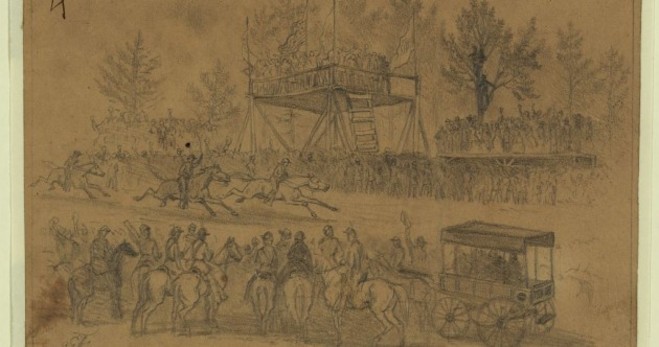
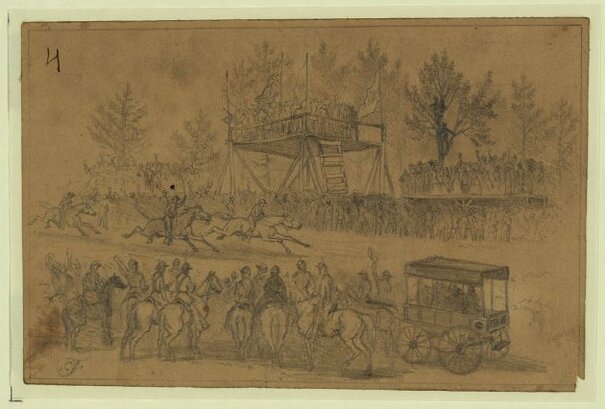
Hurdle Race, St. Patricks Day 1863, Army of the Potomac by Edwin Forbes
Image: Library of Congress

On St Patrick’s Day 150 years ago, the Union Irish Brigade took time out from the American Civil War to embark on a day of celebrations for Ireland’s National Day. The festivities wowed all who witnessed them. The 17 March 1863 has passed into American Civil War legend, a permanent reminder of Irish participation in that conflict. So what took place on that day all those years ago, and why were these men there in the first place?

ON THE EVE of the American Civil War, an incredible 1.6 million people living in the United States were of Irish birth. The majority were clustered around the industrial cities of the North; New York, Boston, Philadelphia, but others had gone further South, particularly to New Orleans and other settlements on the great Mississippi River. A visitor to New York in 1860 would have found that one in every four people they encountered was Irish-born. The majority of these 1.6 million Irish had fled a cataclysm that had nearly cost them their lives, victims of the Great Famine that had engulfed Ireland in the 1840s. Now, as 1860 drew to a close, many were destined to experience the second great trauma of their lives, as the American Civil War loomed on the horizon.

The only conflict in the Irish experience to compare with World War I

The entire Irish-American community in the United States were affected by the Civil War to one degree or another. On the front lines, the Irish contributed at least 150,000 men to the armies of the North, with a further 20,000 serving the South. The majority chose to remain loyal to the State where they lived, be that in the Union or Confederacy. Although no figures survive as to the numbers of Irish who died during the conflict, it certainly ran to tens of thousands, with many more physically or emotionally scarred. It is a little known fact that the American Civil War is the only conflict in the Irish experience to compare with World War I in terms of the number who donned military uniform.

This weekend marks the 150th anniversary of one of the most famous Irish occasions during the American Civil War. In March 1863 the Union Army of the Potomac was camped in northern Virginia, preparing to bring the war once more to the Confederate forces arrayed against them. The Army of the Potomac boasted huge numbers of Irishmen, some of whom served in ‘green flag’ ethnic Irish regiments, such as the 9th Massachusetts Infantry. No group was more famous that Brigadier-General Thomas Francis Meagher’s Irish Brigade, made up of the 63rd, 69th and 88th New York, 28th Massachusetts and 116th Pennsylvania Infantry Regiments. The Brigade had been virtually annihilated in December 1862 at the Battle of Fredericksburg, and as St Patrick’s Day 1863 approached, the Irishmen determined to make it one the entire army would remember.

Column: Festivities and trauma – St Patrick’s Day celebrations in the American Civil War
1 / 6
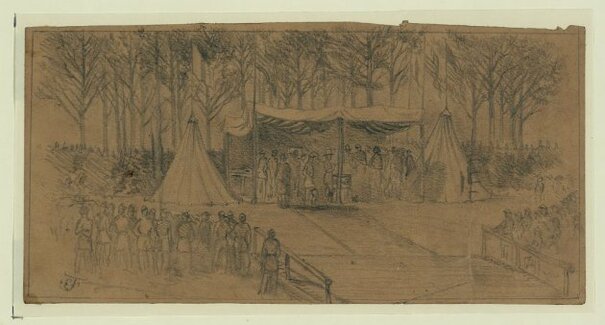
  • General Meagher distributes the prizes, St Patrick's Day 1863

    Sketch by Edwin Forbes, 1863 (Image: Library of Congress)
  • Hurdle Race, St Patricks Day 1863

    Sketch by Edwin Forbes, 1863 (Image: Library of Congress)
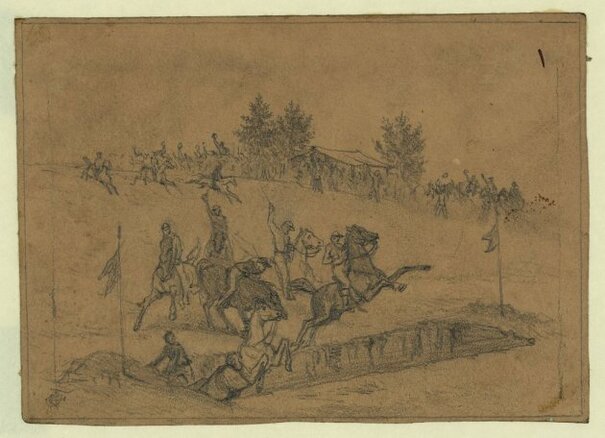
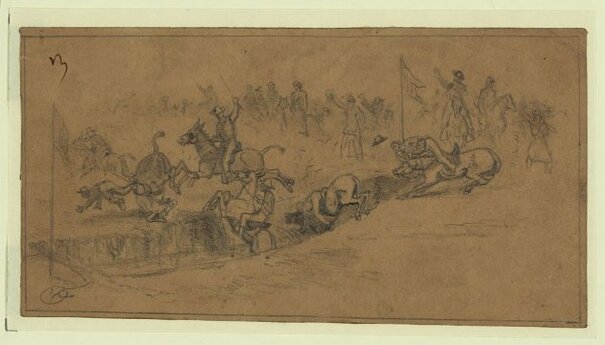
  • Jumping the Ditch, St Patrick's Day 1863

    Sketch by Edwin Forbes, 1863 (Image: Library of Congress)
  • The Grandstand, St Patrick's Day 1863

    Sketch by Edwin Forbes, 1863 (Image: Library of Congress)
  • The Mule Race, St Patrick's Day 1863

    Sketch by Edwin Forbes, 1863 (Image: Library of Congress)
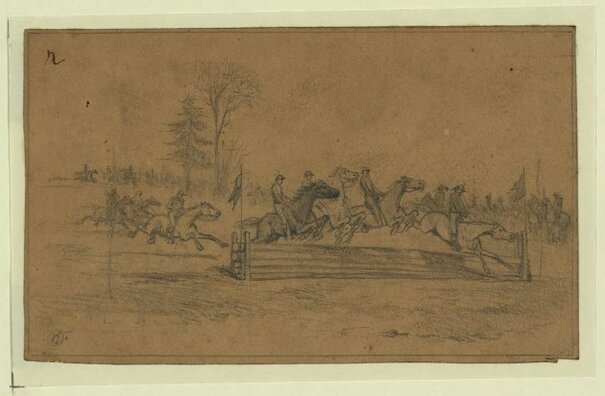
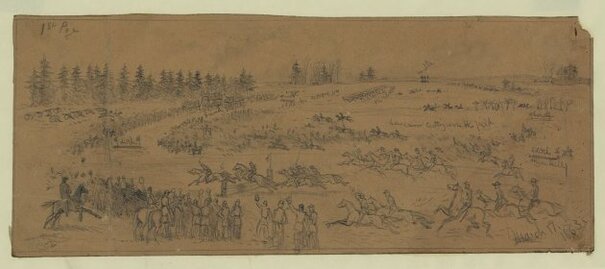
  • The Steeple Chase, St Patrick's Day 1863

    Sketch by Edwin Forbes, 1863 (Image: Library of Congress)

The only entertainment appropriate for the Irish National Day: horse racing

There was only one choice when it came to a form of entertainment appropriate for the Irish National Day– horse racing. The men of the Irish Brigade set to work creating a purpose-built racecourse, complete with Grandstand. A huge post-race banquet was arranged to follow the races, with the Brigade sending to Washington for no fewer than 35 hams, a side of roasted ox, a pig stuffed with boiled turkeys, and countless chickens, ducks and small game. In order to wash it all down they also procured eight baskets of champagne, ten gallons of rum and ten gallons of whiskey. Captain Gosson and Captain Hogan of the Irish Brigade were tasked with mixing the punch, but frequent taste tests meant that both became ‘overpowered by their labours’ and had to be relived from duty.

When St Patrick’s Day 1863 arrived it brought fine sunny weather. The Irish Brigade began the day with religious ceremonies, after which the main festivities kicked off. The first race was scheduled for 11am, and each of the riders had dressed up for the occasion. All had made an effort to wear colours – one Galway native even clad himself in scarlet with a green velvet smoking cap, in an effort to represent the attire of the famed Galway Blazers Club. Thousands of officers and men from the army clamoured around the track, in an audience which included the commander of the army, Major-General Joseph Hooker. A crack of a whip and a note from the bugler set the first race under way. Six runners and riders dashed around the freshly built course, each determined to take the first laurels of the day. Captain Jack Gosson, evidently recovered from his over-exertions with the punch, took the prize, appropriately enough while aboard General Meagher’s grey horse, ‘Jack Hinton’.

Reels, jigs, hornpipes… and chasing the soaped pig

Aside from the horse racing there were many other activities to keep the masses entertained. The enlisted men struggled around the course riding mules, to the hilarity of the assembled crowd. For those not inclined to climb aboard an animal, foot-races, weight casting competitions, hurdle-races, sack-races and wheelbarrow races offered opportunities to participate. Among the most popular was a chase after a soaped pig, with the prize going to the man who managed to hold on to the unfortunate animal. Irish culture was not forgotten, with a prize of $5 available for the man who proved the best dancer to a set of reels, jigs and hornpipes.

After the exertions of the day, the evening was spent in drinking and general merriment. Poems were read and songs were sung, and for a day and a night the worries of the war were left behind. The success of the day was complete, and it was remembered as one of the most joyous in the bloody history of the Army of the Potomac. We are fortunate that Special Artist Edwin Forbes of Frank Leslie’s Magazine was present. His sketches of the event have left us with a pictorial record that hint at what a spectacle it was. As with all things the festivities eventually came to an end, and by 18 March all focus was once again on the impending campaign.

Time to remember the Irish of the American Civil War

Within weeks of St Patrick’s Day many of those who had been present would be dead, fallen on battlefields such as Chancellorsville and Gettysburg. Many more would be killed or maimed before the war’s conclusion almost two years later. Today, we are about to embark on the Decade of Commemorations, when events such as World War I will rightly be remembered. Despite their similar scale, no such commemorations have been organised to remember the Irish of the American Civil War. We are now two years into the 150th anniversary of that conflict; the time has come for the Irish Government to properly recognise the impact this war had on huge numbers of Irish people – part of our diaspora – who experienced the second great trauma of their lives between 1861 and 1865.

Damian Shiels (@irishacw) is an archaeologist and historian. His book ‘The Irish in the American Civil War’ is available in all good bookshops and from The History Press Ireland. He runs the Irish in the American Civil War website, dedicated to telling the stories of the men and women caught up in the conflict (www.irishamericancivilwar.com).

Read next:

Comments (13 Comments)

  • Very interesting!

    Reply
  • A fascinating, entertaining and thought provoking article. I’ll be remembering these people today.

    Reply
  • Great article a reminder that we the Irish played a great part in shaping the modern world.Half the world wants to be in Ireland today so get out and enjoy it.Wear your green and be proud to be Irish.

    Reply
  • Sounds like they transported their supplies in the Irish Rover.

    Reply
  • How about the men of San Patricios St Patricks Battalion who left the American army to go and fight for the Mexicans after they witnessed the slaughter of poor Catholic villages. While some Mexicans deserted or fled the San Patricios held their ground against the American forces and were killed or executed. They are celebrated in Mexico with towns and streets named after them but villified as traitors in America even though very few were citizens. Many parades in Mexico today to honour them.

    Reply
  • Most of those Irish who fought in the union and confederate armys had no choice but fight because there was no alternative,their decendants today still celebrate their achievements in the American civil war and are very proud of their heritage, and today are some of the most powererfull people in the US.The habit of denegrading and refering to the diaspora as plastic paddys is really ignorance of their history and no other country treats their imigrants like this but the Irish.

    Reply
  • There is a good exhibition in Collins Barracks called ‘Soldiers and Chiefs’ it features the Irish in foreign wars as well as in the Irish Army. It has a section devoted to the Irish in the American Civil War.

    Reply
  • I didn’t want that article to end. Brilliant stuff Damian, a highly entertaining read to say the least.

    Reply
  • So many towns and villages in Ireland are also connected to the American Civil War. For more information, go to http://www.irishacwtrail.com.

    Reply
  • Intriguing detail of the ‘goings-on’ on St Patrick’s Day 150 years ago and nice to know that they had a ‘bit of craic’ to distract themselves from the harsh reality that was their lot!
    It is very sad that we do not recognize or acknowledge the incredible part our people played in the formation of the most powerful country in the world, yet we are happy to go with the ‘hand out’ to America for help with green cards, peace processes, inward investments.
    What a great opportunity there is here for our President, for our national politicians, to join in/ create the discourse around this topic, both at home and in the U.S. It would be a win/win for both our countries – Irish America would certainly be proud that their ancestors are not forgotten by their homeland and there is huge tourist potential for American Civil War devotees to visit the Irish places associated with their heroes.

    Reply

Add New Comment