Sign in. It’s quick, free and it’s up to you.
An account is an optional way to support the work we do. Find out more.
Sign in. It’s quick, free and it’s up to you.
An account is an optional way to support the work we do. Find out more.
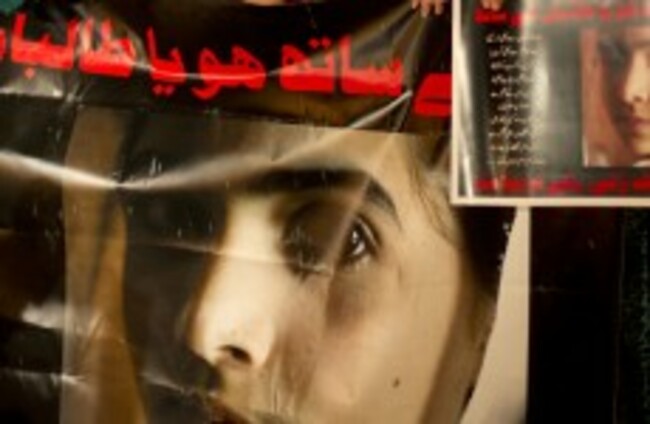

Last week, Malala Yousafzai was shot in the head by the Taliban for campaigning for the right to an education. The attack shocked the world and there is even a campaign for her to be considered for a Nobel Peace Prize. Yousafzai is now in Britain receiving specialist care for her injuries. Dr Ekaterina Yahyaoui writes:
DO YOU KNOW who Iqbal Masih is? And do you know who Malala Yousafzai is? I believe the majority of you would say no to the first question and wonder why they should know this name. The majority of readers will know the story about Malala, a 14-year-old girl from Pakistan shot by the Taliban last week for her activism for girls’ right to education.
However, both cases are very similar in many regards. Iqbal, like Malala, comes from Pakistan. Iqbal’s name became known in western countries when he was a ten-year-old boy. You know about Malala because she started talking about girls’ rights to education and her diary was published on the BBC Urdu blog when she was eleven. The attempt was made to assassinate Malala when she was fourteen. An attempt to assassinate Iqbal was made when he was twelve.
And this attempt was successful. Iqbal died at the age of twelve. We all hope that Malala will survive, but why did I recall Iqbal when I heard about Malala’s case?
Iqbal never had a chance to go to a school. He came from a very poor family which sold him into the carpet industry when he was four. Together with other children, he spent days working very fine looms on hand-made carpets in slave-like conditions. For instance, children were undernourished so that they would not grow and have small fine fingers required for making good quality fine carpets. Once Iqbal managed to escape he was able to mobilise public opinion not only in Pakistan, but most importantly in the West, including the USA. Malala’s activism also goes beyond Pakistani borders and reportedly she made appeals to the West and the USA.
Many children were set free as a result of Iqbal’s activism. They were able to go to school. Iqbal became famous and the carpet industry became less profitable. The circumstances surrounding his killing are less clear than the Taliban’s assassination attempt of Malala, but reports that the carpet industry needed to continue selling their carpet to wealthy western countries may have played a part.
The parallels between the case of Iqbal and of Malala are numerous. But there are also many differences. Malala grew up in a loving and carrying environment with a supportive father. To some extent Malala’s cause is also the cause of her father who is a director of a girls’ school. Some would also say that the notable difference between the two cases is that Iqbal was denied education and exploited by some private unscrupulous persons, while Malala’s battle is directed against an ideology, or even religion.
I believe it is a mistake to regard both cases as being qualitatively distinct in this regard. In both cases children rise against a system, a powerful system, which denies them education and future. A system so attracted by power, control and money that it is ready to kill those who dare to defy it.
While the English Wikipedia page about Iqbal starts by presenting him as a Christian boy from Pakistan, nowhere on the English Wikipedia page about Malala is it mentioned that she is a Muslim girl. However, I believe for the success of the girls’ education in Pakistan and many similar places it is important not to forget that she is a Muslim girl and that she and her father fight for girls education not despite Islam but because they also believe that Islam supports female education. The 2009 documentary film about Malala, Class Dismissed, shows her praying. When girls including Malala speak about their right to education in this film, they often use religious Islamic language to support their arguments. The Taliban’s recourse to Islam is just a propagandist and ideological device.
I hope that the mobilisation behind Malala will help us to remember that, according to the UNESCO Institute of Statistics in 2010, 61 million children of primary school age and another 71 million children of lower secondary school age are out of school for different causes. The commitment and enthusiasm is so important, that border controls, visa regimes and other mechanisms established to separate our part of the world from “theirs” disappear.
Returning to my parallels between both cases, I hope that Malala’s struggle and suffering will not be forgotten with her physical or mental death. If she survives and successfully recovers, I believe she will be able to continue her struggle and mobilise opinion. The danger of forgetting her – as we forgot Iqbal – is real. The need of all children for education is too.
Malala and Iqbal’s cases demonstrate that despite religious, political, cultural and other differences people from all over the world can be united behind certain very valuable causes.
A 2009 documentary by Adam B. Ellick profiled Malala Yousafzai. (Via YouTube/TheNewYorkTimes)
Ekaterina Yahyaoui Krivenko is a Lecturer in Human Rights at the Irish Centre for Human Rights of the NUI Galway. She is a specialist in women’s rights and Islam. A list of her publications can be accessed here.
To embed this post, copy the code below on your site










have your say