TheJournal.ie uses cookies. By continuing to browse this site you are agreeing to our use of cookies. Click here to find out more »
Dublin: 10 °C Saturday 18 May, 2013

Explainer: Have Spain and Italy been ‘bailed out’?

Germany has reportedly relented and will allow the ESM to buy bonds directly, which could save Spain and Italy.

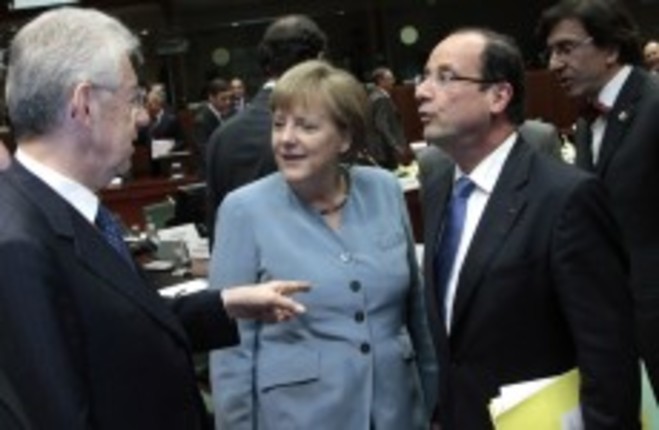
Angela Merkel (centre) is to meet Mario Monti (left) and Francois Hollande (right) later this week to consider allowing the ESM to buy the bonds of member countries.
Image: Yves Logghe/AP

IT’S REPORTED THIS MORNING that Angela Merkel has bowed to demand from other European leaders, and allow the European Union’s bailout funds to buy the bonds of eurozone member states.

This has been cited in some quarters as effectively sanctioning a €750 billion bailout of Spain and Italy, an unprecedented move which would be aimed at drawing a firm line under the eurozone crisis.

But what’s actually happening? What’s been agreed? And where’s the €750 billion going to come from? Let us briefly explain.

The ‘deal’ that isn’t a deal

The leaders of Spain, Italy and France – the three eurozone members attending the annual G20 summit in Mexico – reportedly reached a tentative agreement on the sidelines of the summit in Los Cabos.

Reuters said the proposal, put forward by Italy, is that the two European bailout funds – the temporary European Financial Stability Facility, which currently has lending power of about €350 billion, and the new €500 billion European Stability Mechanism - would be permitted to buy up the bonds of individual countries.

A formal deal has not yet been reached, though the proposal is to be debated at a meeting hosted by Italian premier Mario Monti later this week at which Merkel and French president Francois Hollande would also be in attendance.

While no formal deal has yet been reached, and a German government spokesman told the Independent there had been “no change” in Germany’s position, the fact that Berlin has not dismissed the plan immediately may be a sign of flexibility from Germany.

The Guardian cited a White House official who suggested that Barack Obama had been offering advice on the proposal, a voice which could add further weight to the deal.

Any common platform agreed by those countries would likely form the basis for a deal at the European Council summit of leaders the following week, and could also stimulate talks at tomorrow’s summit of Eurozone finance ministers in Brussels.

A question of firepower

Both the temporary EFSF, and the new permanent ESM due to kick in next month, already have the power to buy the bonds of individual eurozone member states.

However, both require the unanimous approval of member states – and Germany has resisted any moves to do so previously, as it fears Germany’s investment into the funds could end up being written off, if the bonds they bought were to end up being written down.

The massive buying power of the EFSF  - which has about €350 billion left to lend, after funding bailouts of Greece, Ireland and Portugal – and the €500bn ESM would be enough to drive down the yield, or interest rate, that counties pay to borrow money.

In the absence of the EFSF and ESM, only the European Central Bank has been buying the bonds of member countries – but the ECB’s rules expressly forbid it from buying the bonds first-hand, and therefore the ECB’s purchases of second-hand bonds cannot influence the yield that governments pay (which is fixed at the time the bonds are first sold).

This, in turn, could allow countries like Spain and Italy to borrow at more competitive rates and ward off the prospect of needing a full bailout.

The deal could, in theory, also allow bailout funds to buy new bonds issued by the likes of Ireland – a move which would allow Ireland to emerge from the EU-IMF bailout and issue bonds in the routine way, while not being subject to the same rigid terms and conditions that come with a bailout.

Any use of bailout funds to buy sovereign bonds, however, would lessen their ultimate ability to fund formal bailouts and could therefore prove counter-productive.

So what has been agreed?

In a formal communique issued by G20 leaders after the Mexico summit, eurozone countries affirmed their plan to take whatever actions were needed to “break the feedback loop between sovereigns and banks”.

The EU members – who were represented by European Commission president Jose Manuel Barroso and European Council president Herman van Rompuy – also affirmed their plan to make “better use of European financial means such as the European Investment Bank, pilot project bonds, and structural and cohesion funds, for more targeted investment, employment, growth and competitiveness”.

Read: Spanish auction sees cost of short-term loans rocket… again

Read next:

Comments (23 Comments)

  • This is getting way too complicated for me! I quit!!

    Reply
  • Mmmm its begining to look an awful lot like Declan Ganleys proposal to federalise the EU debts using the ESM as the vehicle to facilitate this.

    Reply
    • Correct Sean. Also looking an awful lot like Ganley was right when he said there would be no money left in the ESM by the time Ireland required the second bailout.

      Reply
    • I don’t agree Sean. The fact that knowing that the EFSF and ESM will be able to intervene and buy bonds directly will probably push the yield down even without them actually having to do anything. That will make it possible for countries to actually use the markets instead of the bailout mechanisms.

      If you look at the recent short-term Spanish bond issue it was actually oversubscribed from buyers. Yes, Spain paid a premium because the markets knew that they have no other choice currently but to pay that price. If however the Spanish can simply turn to the EFSF/ESM and sell their bonds to them at a lower yield then the markets will ultimately have to follow because they have to buy and sell bonds to make any money. There the markets will offer the lower rates and the EFSF/ESM won’t actually have to do anything.

      Reply
    • Vic A 20/06/12 #

      @ Jim Walsh

      Your analysis is somewhat skewed.

      Firstly EFSF and ESM do not have the €750 billion being brandied about, this is an imaginary figure because they are just sums that have been promised by EZ member countries including Italy and Spain! Where is it going to come from if it is actually needed?

      Secondly, you sound very simplistic when you assume that the markets will offer lower rates because of (a non existent fund?). That is precisely what was expected when we had this phony €100 billion bailout for Spanish banks 2 weeks ago, rather the markets rightly saw through the charade and the Spanish bond rates has not reduced but topped 7% this week .
      By the time the markets see that this an unholy cross between a sham and scam- it will all start again.

      Reply
    • Fagan's 20/06/12 #

      Jim. 750bn is nowhere near enough to bailout Spain and Italy. It will not solve the crisis only buy more time.

      Reply
  • Peter 20/06/12 #

    Not at all… Italy payed 20% of Spain’s bailout at an interest of 3% … To pay this Italy borrowed from the ESM at 7% … Basically it has put both countries over the edge and now Italy’s closer to boiling…. European union fail…..

    Reply
    • Peter 20/06/12 #

      This is just a precursor to the American dept crisis… The real crash the dollar bust

      Reply
    • Fagan's 20/06/12 #

      750bn would be enough to bailout Spain for this year, but not Spain and Italy.

      Spanish banks borrow over 300bn a month from the ECB, and have 3 trn in debt.

      This is a big step forward but a long way from resolving it. Look at how Greece has nearly swallowed half of that 750 already and it is only 1/14 the size of these two and its banks and private sector have low debt, as opposed to Spain/

      Reply
    • Italy did not borrow from the ESM at 7% – they borrowed on the open markets at 7%

      Reply
  • Sam I Am 20/06/12 #

    I predict this will go ahead and the morning headline will be ‘costs drop on borrowing’ followed by an evening headline of ‘costs rise after morning rest-bite, markets unconvinced’. Whatever they do the markets keep coming back at us harder, we really are slaves to the markets.

    Reply
    • Fagan's 20/06/12 #

      We are slaves to the market but it is a point as well, that half gestures like this, can’t be expected to solve anything.

      Reply
    • The crisis is because of the euro. You cannot have a monetary union without a fiscal union. And you cannot have a fiscal union without political union.

      The parliaments of Europe will never agree to political union

      They will also never agree to fiscal union. The principle power a parliament has is control over the finances. They will never hand over this power to Brussels

      Reply
  • The whole thing is going to burst in 3 years time

    Reply
  • The markets ate sure to look for a way to exploit this if it becomes reality. Is it possible?

    Reply
  • The euro crisis could be over in the morning if the ECB was allowed to buy up sovereign debt. But Dr Merkel will not give them that power. She will only give them that power when there is a fiscal union. And a full fiscal union, if there ever is one, could take years

    For example the Bank of England has bought up a THIRD of UK sovereign debt. That is why Britains yields or interest rates are down at 1.5%. If Spain had its own central bank, it could mop up all their govt debt and have the same low yields

    Reply
  • Sorry that last comment should have been directed at Too Trueleft and not Sean.

    Reply

Add New Comment