TheJournal.ie uses cookies. By continuing to browse this site you are agreeing to our use of cookies. Click here to find out more »
Dublin: 6 °C Friday 24 May, 2013

Syrian fighting torches historic medieval market

The damage to one of the best-preserved old souks in the Middle East was the worst yet to a UNESCO World Heritage site in Syria.

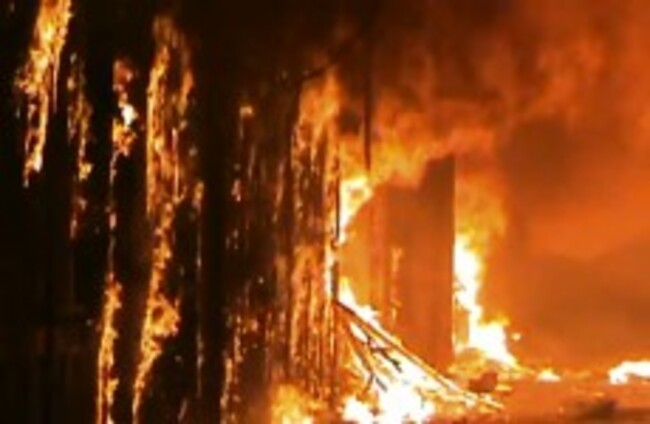
The blaze swept through the medieval market in Aleppo, Syria.
Image: Associated Press

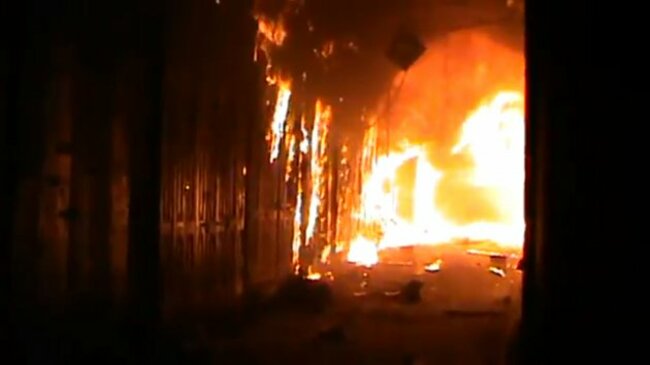
A FIRE SPARKED by battles between Syrian President Bashar Assad’s troops and rebel fighters tore through Aleppo’s centuries-old covered market Saturday, burning wooden doors and scorching stone stalls and vaulted passageways.

The souk is one of a half-dozen renowned cultural sites in the country that have become collateral damage in the civil war.

The damage to one of the best-preserved old souks in the Middle East was the worst yet to a UNESCO World Heritage site in Syria. Across the country, looters have broken into a historic castle, stolen artefacts from museums and damaged ruins in the ancient city of Palmyra, antiquities officials and Syrian experts say.

The Aleppo market, a major tourist attraction with its narrow stone alleys and stores selling perfume, fabrics and spices, had been the site of occasional gun battles and shelling for weeks. But amateur video posted Saturday showed wall-to-wall flames engulfing wooden doors as burning debris fell away from the storefronts. Activists said hundreds of shops were affected.

“It’s a big loss and a tragedy that the old city has now been affected,” Kishore Rao, director of UNESCO’s World Heritage Center, told The Associated Press by telephone from Paris.

Mideast Syria

(Image: Associated Press)

Most of the other sites recognized as heritage sites by UNESCO, the global cultural agency, are also believed to have suffered damage during the 18-month battle to oust Assad, Rao said. The ancient centre of Aleppo — Syria’s largest city — has been hit the hardest, he said.

“It is a very difficult and tragic situation there,” said Ahmad al-Halabi, a local activist speaking by phone from the area. He said rebels and civilians were trying to control the blaze, but only had a few fire extinguishers.

The fire in the souk erupted late Friday and was still burning yesterday, following fierce fighting between regime troops and rebels trying to drive pro-Assad fighters out of the city of 3 million.

Decisive battle

On Thursday, rebels launched what they said would be a “decisive battle” for the city, followed by days of heavy fighting, including shelling and street combat. Amateur video has shown rebels taking cover behind walls and makeshift barriers, attacking regime forces with grenades and assault rifles. Activists reported heavy shelling by pro-Assad troops.

Once considered a bastion of support for Assad, Aleppo has become the focus of the insurgency for the last two months, with rebels taking about half the city. Aleppo would be a major strategic prize: A rebel victory would give Syria’s opposition a major stronghold near the Turkish border, while a regime victory would give Assad some breathing space.

It’s not clear what set off the fire in the old market, made of hundreds of stone stalls that line covered alleys with vaulted ceilings. Amateur footage posted online by activists showed flames engulfing the shops and rebels aiming a water hose at the fire. The shops’ wooden doors, along with the clothes, fabrics and inside some of the businesses, helped fuel the blaze, activists said.

The market stalls lie beneath the city’s towering 13th century citadel, where activists say regime troops and snipers have taken up positions.

The Syrian conflict has killed more than 30,000 people, according to activists. It has also wreaked widespread destruction, particularly in recent weeks as regime forces stepped up air strikes and shelling attacks, and rebels fired mortar shells and rocket-propelled grenades. Entire neighbourhoods in Syria’s three largest cities — Aleppo, the capital Damascus and Homs — have been devastated.

A majority of Syria’s 23 million people live in a thin western sliver of the country; in this territory, rebels have established positions in rural areas, while Assad’s forces are trying to hold on to the cities.

World Heritage site

Aleppo’s old centre was added in 1986 to UNESCO’s list of World Heritage sites. Of the medieval souks in the Middle East, Aleppo’s was among the best-preserved, offering visitors a range of architectural styles covering hundreds of years, said Rodrigo Martin, a Brussels expert on Syrian historical sites.

“It was a unique example of medieval commercial architecture,” said Martin, a spokesman for a group of experts who monitor damage to Syrian historical sites and cooperate with the U.N. cultural agency.

Some of the other prized cultural attractions have also suffered damage.

Earlier this year, looters broke into Crac des Chevaliers, one of the world’s best-preserved Crusader castles, a Syrian antiquities official said at the time. Shelling also damaged the site, said Martin, citing amateur video.

The ruins of the ancient city of Palmyra were damaged by fighting, Martin said, according to reports he received from Syria. He said he had seen video that showed sculptures being taken away from Palmyra in a small truck.

The other World Heritage sites on UNESCO’s list are the old centre of Damascus, one of the most ancient cities in the Middle East; the ancient city of Bosra, once the capital of the Roman province of Arabia; and a group of some 40 villages of north-western Syria that date from the first to seventh centuries.

Rao, the World Heritage chief, said the U.N. agency has asked Syria’s neighbours to be on the alert for attempts to smuggle looted objects out of the country. No incidents had been reported so far.

Lesser sites have also been affected in Syria. Regime shelling of neighbourhoods where the opposition is holed up has smashed historic mosques, churches and souks in the central Homs province and elsewhere in the country. Looters have stolen artefacts from museums.

Martin said the Syrian regime bears the bulk of the responsibility for the destruction because it signed international agreements to protect cultural sites.

For at least two millennia, cultural sites have been threatened or destroyed by wars throughout the Mideast, Martin said.

“History continues, whatever we do,” Martin said. “Mankind can just be really destructive”

Read next:

Comments (9 Comments)

  • unfortunately this is the difference between Western and Middle East cultures – same thing happened in Iraq, and it won’t be fixed, yet the same thing happened in Bosnia Herzegovina but they came thru and rebuilt, it’s a damn shame really – a piece of history lost forever – where’s the UN when u really need them – on another junket talking about it

    Reply
    • I think you’ll find Russia and China are blocking any UN action…

      Reply
    • not quite..close, but no coconut.

      They’re pretty well hijacked by the Pentagonian express. John Bolton applied the final nails to the crate under Cheyney’s rule(he was the one with his hand up W’s jacket making the mouth move).

      As the puppet said,’ Mission Accomplished’. PNAC up and running. Haliburton rules…have a nice war.

      Reply
    • You are not comparing like with like. The cultural looting in Iraq occurred during a foreign invasion and war of occupation, in the course of which the UN actually withdrew from the country (Aug 2003). Since the end of the war in Bosnia the country has been a virtual protectorate of the EU and the UN, with all the advantages (mainly monetary!) that brings.

      The destruction of the souk and the other sites is a huge tragedy though. I visited Syria last year and was entranced by the cultural sites and the mingling of history and everyday life, as well as by the friendliness of the people. When these current troubles finally end I would recommend anyone to visit the country, and every tourist euro will help the rebuilding.

      Reply
    • ‘..the current troubles…’, Kevin are just preliminary to WMD Mk II on Iran.
      The PNAC agenda is what it says on the tin, a project for a new American century of full spectrum dominance, including outer and cyber space/time. We are dealing with a dictatorship of the military/industrial/media corporatariat on mirror totalitarian steroids to the soviet utopian program.
      History indicates that utopian plans lead to dystopian realisations.

      When those ‘troubles’ end it may well be as Einstein predicted when he said he wasn’t sure how the WW III scenario would unfold..but WW IV would be fought with sticks and stones, if at all. PNAC requires the containment(read domination and return to the euphemistic ‘Open Door’ policy of the 19th century imperial carve-ups. I hope I’m wrong…if you think I exagerate correct me. It would make pleasant reading.

      Reply
    • I was replying to the initial post.

      Re the rest of your reply, I also read Engelhardt, as I presume you do..

      Reply
    • B Lowe 30/09/12 #

      As usual Mattoid you are way off the mark re Syria. Russia and China have repeatedly called for dialogue among all parties in the Syria situation.
      It is Qatar/Saudi Arabia/US/France/UK who are NOT in favour of this and will not allow this to happen.
      They are not in favour of dialogue to resolve the matter because they know they will be exposed for their involvement and it is not what they want. They want a different government in Syria.

      Reply
    • mattoid 30/09/12 #

      And as usual B Lowe, you have been highly selective in putting a slant on the situation. Yes, Russia and China have called for dialogue between the sides, but this is conditional on the regime remaining in place.
      And it is a matter of record that they have prevented the UN from having a presence on the ground which may have prevented much of the killing and suffering inflicted on the civilian population.

      Reply
  • B Lowe 30/09/12 #

    This is what happens when the West and other countries(Qatar/Saudi Arabia) launch a proxy invasion in Syria. These so called ‘rebels’ are not what they appear to be. They are made up mainly of foreign jihadist fanatics and Al Qaeda elements. They are trained by Western military personnel in Turkey and armed and paid and sent into Syria to cause mayhem.
    The main opposition groups in Syria, the National Coordination Committee among them do NOT support the FSA or the Syrian National Council. Also, we have officers in the FSA(well, the ones who have not defected back to government) stating that their major problem is that over 70% of the population support the Assad government and they are not getting the support of the people.
    You will not here any of the above on any of the Western major Media outlets.

    Reply

Add New Comment