TheJournal.ie uses cookies. By continuing to browse this site you are agreeing to our use of cookies. Click here to find out more »
Dublin: 10 °C Thursday 23 May, 2013

What would happen to us if Greece defaulted?

TheJournal.ie reporters have been quizzing those in the know to describe the potential fallout of a Greek debt default on Ireland’s economic, social and political scene…

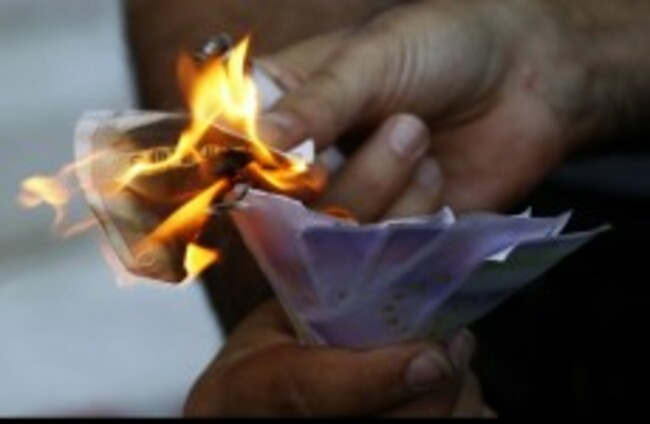
A protestor uses a burning €10 note to set fire to fake banknotes during an anti-austerity protest outside Greece's central bank in Athens today.
Image: AP Photo/Kostas Tsironis

IT’S GETTING (MORE) SERIOUS in Greece. The Prime Minister George Papandreou has just called off a visit to the US, with the Associated Press reporting that he said his priority is to steer his country through this “critical” coming week.

The rush? To meet the financial adjustments required by the EU and IMF so that they release the next batch of loans to stop Greece descending into default on its debts.

TheJournal.ie has asked a raft of experts for their opinion on what would happen should Greece not make the grade in seven days’ time.

What effect would a Greek default have…

…On the Irish economy?

Economist Dr Constantin Gurdgiev believes that while Irish people’s exposure to Greek debt is fairly low, it is the banks that stand to suffer most which would have a knock-on effect on ordinary consumers. If Greece defaults it creates the kind of financial pressures on the ECB which has its own effect in terms of funding other countries in the eurozone. He explains:

Our entire banking system is in effect dead domestically and we are reliant on ECB to provide liquidity and to provide cash into the cash machines. That ‘blood transfusion’ from the ECB will be severely threatened if the rest of Europe goes to the ECB for funds as well.

Mortgage interest rates will rise as will the rates paid on personal loans, not just on new loans but on existing ones. In terms of by how much it is difficult to quantify. Gurdgiev believes we are in “unchartered waters” given this has never happened before, making it difficult to predict what action the ECB will take if Greece defaults.

In the long term, the banking system globally will be affected badly meaning there is less capital, less money to lend and when it is lent, at a much higher interest rate. For Ireland, this will have all sorts of effects in terms of businesses being able to access finance to innovate and create jobs which impacts on employment figures and long term GDP growth.

The effects of the higher cost of borrowing and on home loan interest rates will be devastating: “You’re looking at a a large portion of mortgage holders who will be underwater.”

…On political relations in Europe

The end of the euro? The collapse of the EU? These are just some of the extreme outcomes being predicted if the worst happens and Greece defaults. But are these valid concerns, or an example of a high degree of political brinkmanship?

Professor Daniel Thomas, Director of the Dublin European Institute at UCD says that claims that the very existence of the EU is under threat are overblown.

He says that the EU is facing its biggest crisis since it was founded. The sovereign debt crisis has revealed major flaws in the design of the single currency and in the general economic governance of the EU. However, Professor Thomas said that in the unlikely event that the euro is destroyed, the EU itself is too advantageous for the member states for them to abandon it.

Professor Alun Jones, an expert in political geography at UCD, says that he’d be surprised if Greece is allowed to default as the contagion effect to other peripheral economies would be too intense, and the high exposure of French banks to Greek debt would have serious ramifications. He feels that the current crisis is an extreme example of political brinkmanship, with the power players seeing how far they can push the situation in order to secure a better outcome.

Jones also said that the push for a fiscal union in Europe will intensify, particularly as governments not in the euro, eg the UK, call for decisive action by euro states. This week the British chancellor George Osbourne said that officials from Europe’s major economies are demanding a new treaty to strengthen fiscal integration.

…On Irish consumer sentiment

Gerard O’Neill, chairman of Amárach Research, says that the first effect of a Greek default would be what he calls the “Joe Duffy moment”. He explains:

That’s the moment when people start asking on Liveline about whether money is safe in the banks. Then you have a panic. There will be a rush to save capital, people’s savings and pensions, and there’ll be people cashing out of the euro and exchanging euros for pounds or dollars.
Then in terms of wider psychological effects in the medium term, it’s all about uncertainty. You have to look at whether uncertainty is increasing or decreasing. And unfortunately at the moment it’s increasing. People are risk-averse, and further turbulence will exacerbate that – meaning more saving, more reluctance to borrow money, more reluctance to make big commitments like mortgages and marriages.

He says that one of the measures his group uses to track the national sentiment is people’s agreement with the statement: ‘News from abroad makes me optimistic the recession will be over soon.’ He says: “That’s currently at an all-time low.”

…On the retail sector:

A Greek default would just add to a struggling retail sector’s woes and industry experts say it will not be high on their long list of concerns.  After 42 months of sales declines and long periods of inclement weather, Irish retailers are not sure if things can get much worse – default or no default.

“Worrying about a Greek default is not our highest priority,” Clerys’ CEO PJ Timmons tells TheJournal.ie.

David Fitzsimons, head of Retail Excellence Ireland - a group that represents 650 retailers and 8,500 stores – agrees.

“I honestly don’t know if things can get much worse and we are more worried about other things (other than a Greek default) coming down the line,” he says.

In the coming months, Irish retailers will have to deal with more bad weather, something that destroyed usually-reliable December shopping days last year. Fitzsimons sighed as he told us about predictions for snow as early as October this year. Retailers are also fretting about continuing job insecurity, increasing bank margin interest rates and the 2012 Budget being announced just before the important Christmas season. He said:

If any default by Greece spreads to other countries, then we could be in trouble but for the moment Ireland is on track. We hope we have hit the bottom and there will be no more ‘slash and burning’. We just want to get on with retailing – even if we are bouncing along the bottom for a while.

Fitzsimons is able to take some positives out of the bleak situation. He says:

At least the comparables are weaker. We hope retailers will have a better December this year than in 2010. There will also be more temporary jobs created this year ahead of Christmas shopping time and January sales.

Timmons, as head of one of Ireland’s oldest retailers, also took a positive slant. He says:

Although I do not think it will happen, a Greek default could trigger the EU into proper action. It could prompt European leaders to give the ECB the tools it needs to properly oversee the banking system – giving people confidence that their deposits are safe. Instead of sticking a plaster over the cut, an operation may be carried out. Ultimately, such a situation could be a good thing.

But, overall, Greece is just part of a much bigger story for us.

…On the Irish property market:

Economist Ronan Lyons explains that there are two main channels to consider if Greece were to default: firstly, how the situation would effect the confidence of businesses and households, and secondly, how it could impact the financial system.

“Ideally, the Irish banks would be going to the international capital markets and, ideally, taking out 30-year loans on bond markets to pass on to the customer,” he says. “But, in the case of Greece defaulting, you would be talking about Ireland maybe spending two years off the international markets – making it very difficult for the man on the street to get a mortgage”.

Lyons says that a Greek default would have implications for the Irish property prices, although it was almost impossible to predict the level of the impact.

It is very difficult to say because, currently, there’s no liquidity in the property market – so there’s no knowledge of the house price level in any meaningful way. We know asking prices… and we have some information from the few fire-sales that we’ve had, but that’s it.

One thing is for sure, though, house prices are not going to begin an upwards trajectory soon: “Price houses have already fallen 50 per cent and they won’t stop falling over the next 12 months,” Lyons says.

- Reporting by Jen Wade, Hugh O’Connell, Emer McLysaght, Michael Freeman and Sinead O’Carroll.

Timeline: How did it come to this for Greece?>

Explainer: If Greece goes bust, who gets crushed?>

Read next:

Comments (42 Comments)

  • Greece will default, and no of the crap in this article will happen. Greek debt is spread between several countries with Germany and France (surprise!!) holding the largest. Both countries banks are well positioned to absorb a partial default which is what will be agreed.
    Your article is as sensationalist as lenihans crap about ATMs running dry. Less scaremongering more facts please.

    Reply
    • Good one, Oil!

      Reply
    • Hear hear…. we have been led down the garden path too often , any one remember lisbon , don’t believe the hype ,the experts are being paid to give economic forecasts , no forecasts= no need for economic experts ,if they were any good they would have seen this coming ,even the dogs in the street were talking property crash in 2006 where were all the gurus then.The whole situation is being staged to give the illusion of disaster (swine flu ,avian flu etc) all staged in order to get more fiscal union and control over economies this is the desired result. Greece will not default the euro will not crash watch this space we are being had.

      Reply
  • The Greek situation must be escallating over the weekend as RTE seem to have been avoiding the topic like the plague. Nothing much discused yesterday or this morning… probably due to their public service obligation!

    Reply
  • What’s wrong with just having a Free Trade Area? If they didn’t complicate with bloody treaties and monetary unions and a megalomaniac civil service we wouldn’t be in this mess.

    Reply
    • The banks are a different kettle of fish though.

      Reply
    • Paul 17/09/11 #

      Well said CJ

      Reply
    • It’s called the EEA, CJ. The European Economic Area. It already exists and includes all EU countries as well as Norway, Switzerland, Iceland, etc.

      Reply
    • CJ Ryan 18/09/11 #

      Yes I know. Why we can’t just stick with that? Unfortunately we’ve en entire political class that just can’t stop with meddling in every aspect of our lives. Sigh. It’s a grand life.

      Reply
    • CJ I have a lot of family in Norway and they are forever complaining about the EEA. In fact Norway has to conform more rigorously to EU regulations than EU member states, because their products and services can more easily be excluded than EU member states’ products. Wierd, but true.

      Reply
    • Felicity, your Norwegian family are complaining at the wrong people. The EEA is simply a trade mechanism and agreement. It does mean that countries that are members of the EEA but not of the EU have to adopt EU laws and regulations. Therefore, the problem lies not with the EEA, but with the EU. You say that Norwegian products and services have to conform more rigidly with EU legislation – true, but not as much as American, Chinese, Japanese products etc. EU legislation has become so powerful that most large American companies now have EU legal experts on board to determine whether or not their products can be sold in Europe. Europe interferes in American corporate practices, especially when it comes to mergers and acquisitions by preventing such practices in certain cases. Scrapping the EU would mean we would have an EEA without the burden of EU legislation.

      Reply
    • Felicity, I am an Irish guy that has been living in Norway for 10 years now, and work for a bank here so Insee a lot of eu directives the days. Norway has a better record than almost every country in the EEA for implementing directives, it is not because we have to but because the Norwegian mindset is quite Prussian. It is something they have to do so they just do it.

      Norway does not get the free trade for free,they must pay a ‘fee’ for access to the market. What is bad about the agreement is that the is incredibly high tariffs on some items coming into Norway, cheese, milk etc… This mak tings very expensive here.

      Norway has more oil than you can shake a stick at, so for the time being life is pretty good. But without the oil money, I am not so sure that Norway could maintain the relationship they currently have with the EU.

      Reply
  • “The difference is that in Iceland we allowed the banks to fail. These were private banks and we didn’t pump money into them in order to keep them going; the state did not shoulder the responsibility of the failed private banks.” Olafur Grimsson, President of Iceland.

    According to stats Iceland is recovering. There’s another example; Argentina. Argentina made the same mistake as Ireland. They stopped getting loans from IMF then their economy recovered. A controlled default would be the safest solution for Greece and the global economy. If Ireland becomes like Greece, a controlled default will be inevitable for Ireland. Let’s hope Morgan Kelly is not right!

    Reply
  • A controlled default, like the one Iceland went through, and is widely ignored by mainstream media, could be the safest choice by the Irish government whose nominal interest is the wealth and prosperity of the Irish, set aside foreign lenders and senior bondholders’ interests. A Greek default would probably show the average taxpayer that a default is not as a dire setting of things as as it might seem.

    Reply
  • They wont let it happen. They have too much oil …. Yes granted… Its Olive oil but they don’t know that.

    Reply
  • If greece go bust, our banks will just have an excuse to raise interest rates again,, they got money billions of which they have not touched to help with loan defaults for people like myself who is falling behind with payments, who has no heat last winter and more than likely again this winter, no tv licence , no dog licence , should just give up and go for a council house or rent and get rent allowance, our government does not care about the poor people who have lost jobs, and living on 200 euro a week, suppporting a family, and living on bread and soup, i will do what i have to do eventually but just keep struggling for now, and then u call the suicide line and thats shut down, wonder why,,, greece are doing the right thing and not killing there people with charges, where am i supposed to get money to flush toilet next year and another 100 for a homeowners tax,, lol,,, ireland is a joke, it really is, hitler will never be forgotton when we have a government just crucifying us every chance they get, my kids want to give up school and try and do something to help, i told them they are my only hope if they finish school and get to college, and i will make that happen, once they are gone from home i wont need it , but its our home and haven, and think government should be trying to help,, i would love to go burn our flag outside dail, as they are not working for us irish, they are looking after the rich builders who went bust, and are bailing them out again to finish buildings, they wrote 60 percent of their loans offf, which we are all paying for and they living the life of luxury, i think give our tds, 200 euro a week and see how they survive

    Reply
  • The Euro is a failure based on principles that just don’t work.

    We can take currency arbitrage as happened at the end if the 80′s but we need to control the printing of our own currency and interest rates. It’s economics 101.

    we didn’t get price stability or transparency as promised by joining in a single currency. It’s long past time to go.

    One thing, an important thing is that Ireland can feed itself in totality. This is not the case for Greece or even the UK. Lets get the punt back.

    Germany and France have been the largest benefactors of this Euro experiment with effectively a devalued currency promoting exports.

    Let’s get our sovereignty back and trade out as before.
    DGG2

    Reply
  • Cillian 17/09/11 #

    It isn’t a question of “if” Greece defaults, but “when”.

    Reply
  • What a waste of a ten Euro note.

    Reply
  • I have heard that Europe will contain Greece for the present and then allow a controlled default around November time.

    Reply
  • A single european government is the ultimate aim. Financial turmoil will remain until this is achieved.Common fiscal policy is the first step, and this is edging closer every day.

    Reply
  • If Greece defaults, EC along with euro is the end of era. Hello to punt!

    Reply
  • This might be slightly off topic but it seems from the above posts that many people in this country would be far better served if they learned to spell…

    Reply
  • Many of the points raised by those interviewed for this article, and by the comments on this page will be discussed at a conference organised by The Foundation for the Economics of Sustainability, FEASTA in the Mont Clare Hotel in Dublin next week, Thursday 22 and Friday 23rd September. Prominent international and Irish Economists including Marshall Auerback from the USA, Dan O’Brien from the Irish Times, Fergal O’Brien IBEC, Richard Douthwaite from Feasta, David McWilliams, Paul Sweeney of Unite the Union and others will be talking about national options for dealing with the Eurozone Debt Crisis. See http://www.feasta.org to see the full programme and registration.

    Reply
  • Zeitgeist Addendum on YouTube… Hits the nail on the head! Have a watch :)

    Reply
  • The best thing that could happen is that the euro clapses as well as the EU, and as for the IMF they can fold as well, no country involed with the EU has had a realy happy time and are struggeling now to servive, and as for the IMF its the biggest con trick of this century! The EU is a lame duck, put it out of its misery and build a-new.
    Countrys like Brazil told the IMF to take a hike, and at prestent are doing very nicely indeed!

    Reply
  • It’s "uncharted waters" not "unchartered" that Constantin said. You chart (ie map) waters. You charter ships not waters.

    gramadoc

    Reply
  • From the raft of opinions from the experts above I don’t think you have to look much further than Alun Jones’ concise assessment of the situation, I think it is really spot on.

    Reply
  • i know i lost my job, and having a very difficult time at the moment and know it has to get better, and maybe not as a home owner, but feel we put down our life savings to own a home under a false economy, i have a very small mortgage, but as the celtic tiger hit , we did not put money into schools, and i am not left driving my daughter over 40 miles aday to school, and get no petrol allowance for her and that is the nearest school for me to take her. I am back at college at 50 and struggling as have not used pcs and SPELL CHECKS, but have a job lined up in november when i finish and get certified againnnnn, its not easy for middle age people to restart over again, but i have passed all my tests so far, my kids will go to college, my son goes already , and my daughter will go, its the only thing to do for any sort of life, sorry if i sound so down but times are difficult for some familys, some may deal with it better than others, but we all have an off day or two, but i am optimistic and know you can only go so far down to reach bottom and the rest is uphill, and i will get to the top of the hill again, its hard to go from earning 700 to 900 a week to 200,,, not easy at all, and the bills just get higher, and income lower, sorry if i sound hardened by the turmoil going on in our beautiful country, and know it will get better again and we will all look back , seems ireland is always on the up and down since time began, but sure we will get back to a proper standard of living for all again, when they have finished taxing and taking from all

    Reply
  • Just on a point of priciple on what Jackie Crowe wrote. Developers have NOT had 60% of their loans written off. NAMA purchased the loans from the Banks at a 60% discount, but the full amounts from the Developers are still outstanding. The only change is that the Developers owe NAMA the full amount as opposed to the Banks.

    Reply

Add New Comment