TheJournal.ie uses cookies. By continuing to browse this site you are agreeing to our use of cookies. Click here to find out more »
Dublin: 12 °C Saturday 25 May, 2013

Yes, No or Ask Again: voting in Ireland’s referendums over the years

Abortion, divorce and Europe – just some of the contentious issues that Ireland has voted on over the past 30 years.

AS WE HEAD into another referendum campaign – this time on Children’s Rights in the Constitution – TheJournal.ie has taken a look back at some of the emotive issues that have divided the country over the years.

From divorce to abortion and citizenship to the Good Friday Agreement, both sides of campaigns have used strong imagery and protests to get their arguments across.

A look back at the posters also shows how campaigns just got more interesting – and provocative – the second time around.

Yes, No or Ask Again: voting in Ireland’s referendums over the years
1 / 48
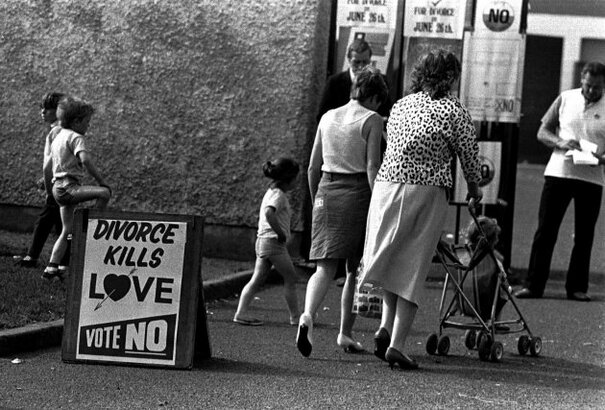
  • Divorce 1986

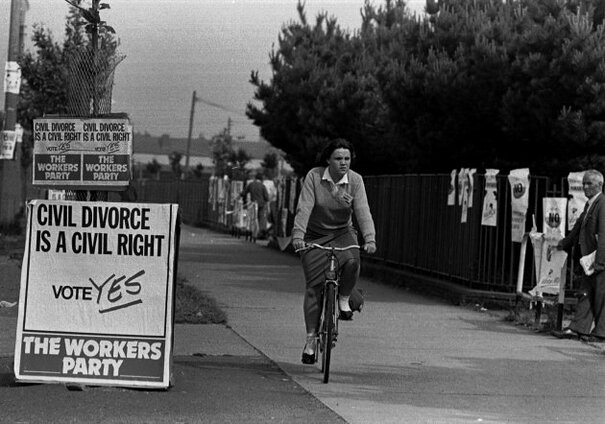
    Polling day in Ballymun in June 1986. Image: Photocall Ireland.
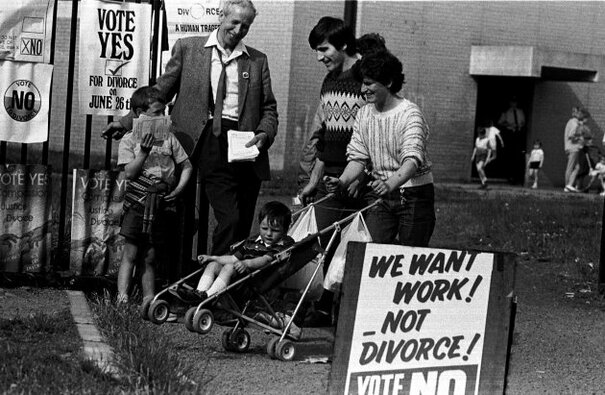
  • Divorce 1986

    Polling day in Ballymun. Image: Photocall Ireland
  • Divorce 1986

    Image: Photocall Ireland
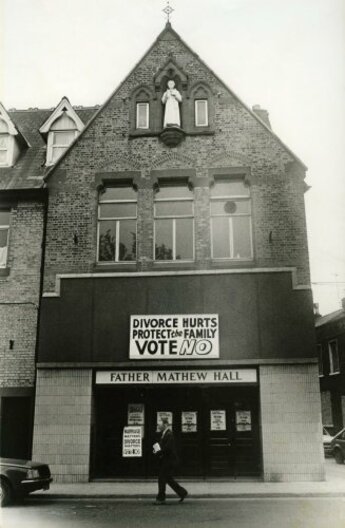
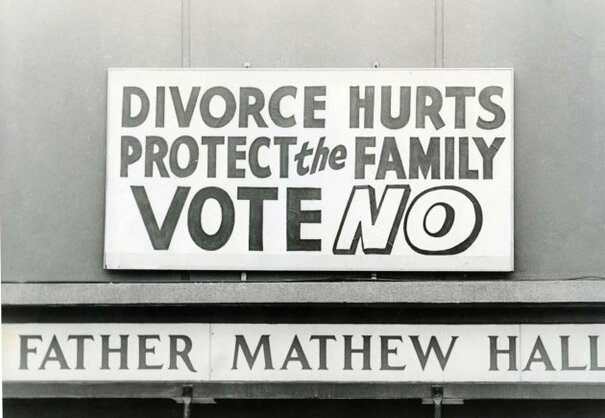
  • Divorce 1986

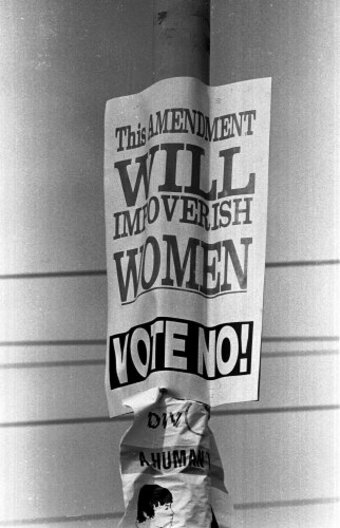
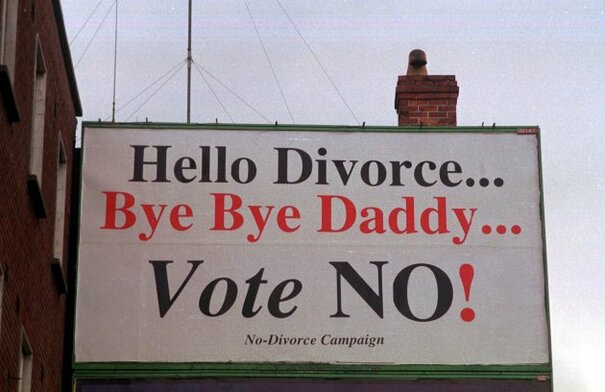
    Anti-divorce posters at the Father Matthew Hall on polling day for the divorce referendum, 26 June 1986. Image: Photocall Ireland
  • Divorce 1986

    Another image from polling day in Ballymun. Image: Photocall Ireland
  • Divorce 1986

    Posters on polling day in June 1986. The vote was the first attempt to repeal the 1937 ban on the dissolution of marriage. It was proposed by the FG-Labour coalition government. Image: Photocall Ireland
  • Divorce 1986

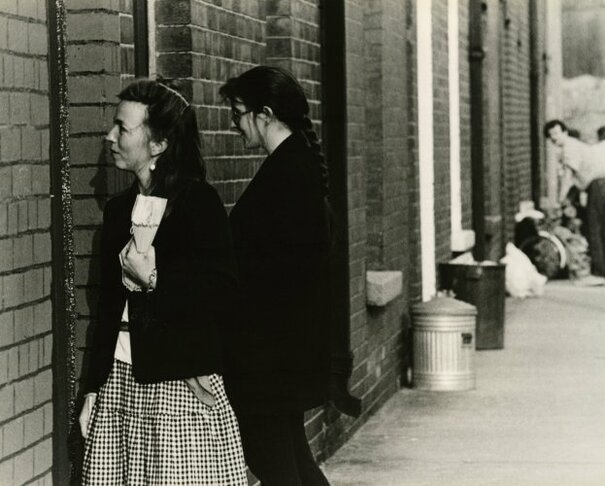
    Pro-Divorce Campaigners Annette Byrne and Ann Kerns knocking on doors while canvassing on the North Strand in Dublin. Image: Eamonn Farrell/Photocall Ireland; Date 19 June 1986)
  • Divorce 1986

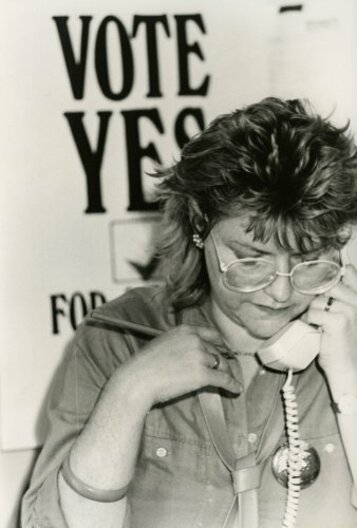
    Kate Egan at the Pro-Divorce HQ in Dublin on 20 June 1986. Image: Eamonn Farrell/Photocall Ireland
  • Divorce 1986

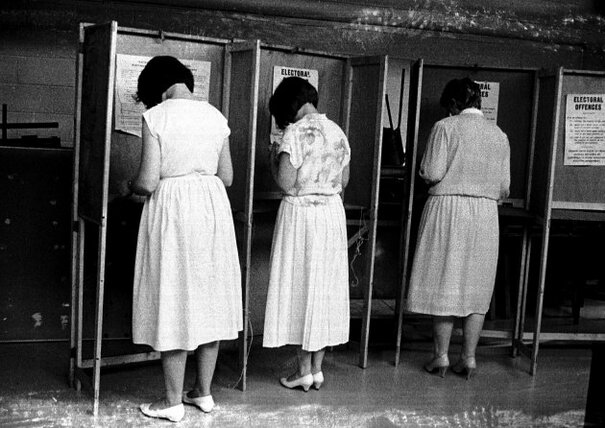
    Women voting in the divorce referendum on 26 June 1986. It was rejected by a 63 per cent majority. Image: Photocall Ireland
  • Divorce 1995

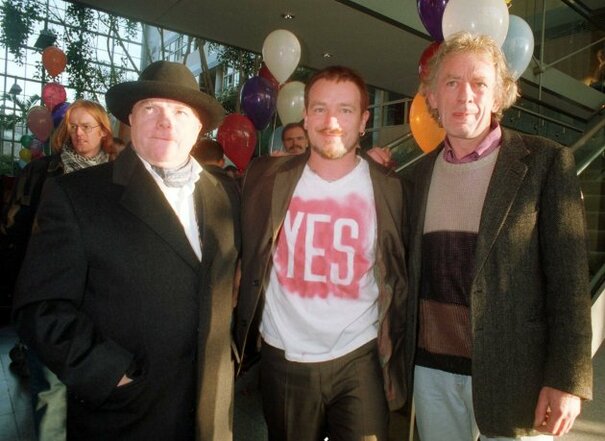
    Musicians Van Morrison and Bono with Glenroe actor Mick Lally at the Right To Remarry campaign at the Civic Offices in Dublin on 19 November 1995. Image: Photocall Ireland
  • Divorce 1995

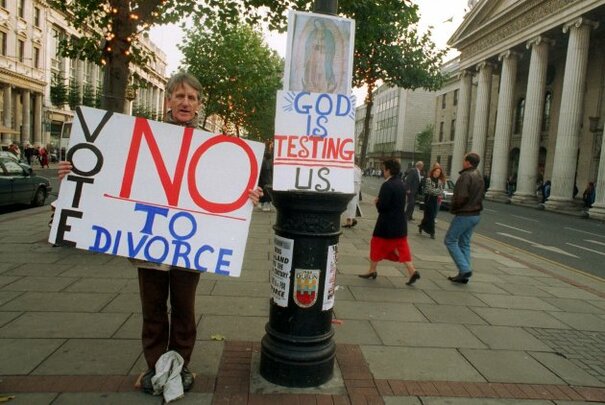
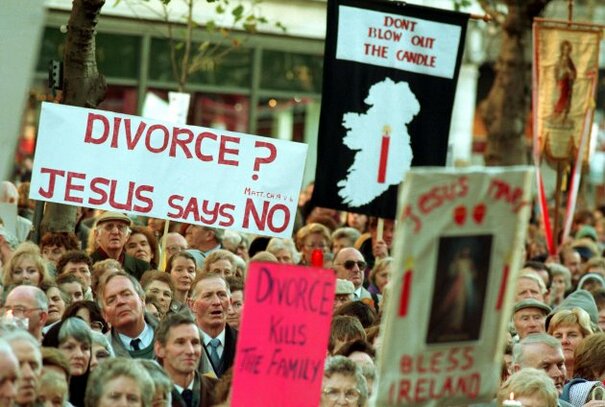
    Anti-divorce protesters outside the GPO in Dublin in November 1995. Image: Photocall Ireland
  • Divorce 1995

    With two days to the divorce referendum, opinion polls showed a dead heat. The same week, the Pope, speaking to Irish pilgrims in Rome, urged electors to block the introduction of divorce. Image: PA Archive
  • Divorce 1995

    The divorce amendments were carried by a slim majority after a vote in June 1995. Image: Photocall Ireland
  • Divorce 1995

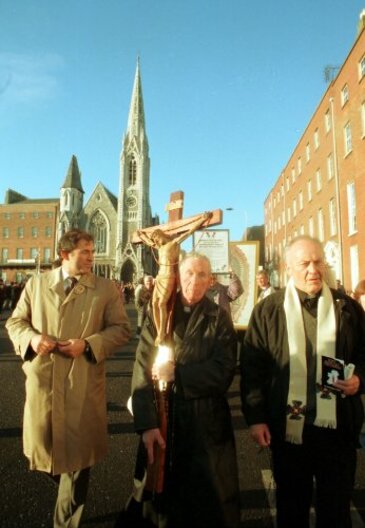
    A Catholic priest carries a crucifix at an anti-divorce rally in Dublin in November 1995. Image: Photocall Ireland
  • Divorce 1995

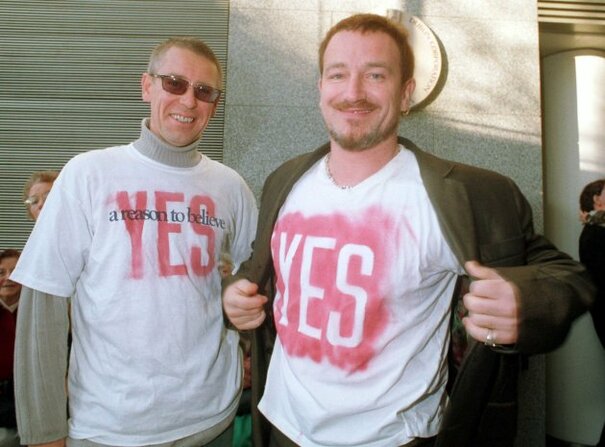
    U2's Adam Clayton and Bono at the Right To Remarry campaign in the Civic Offices in Dublin. (Image: Photocall Ireland; Date: 19 November 1995)
  • Divorce 1995

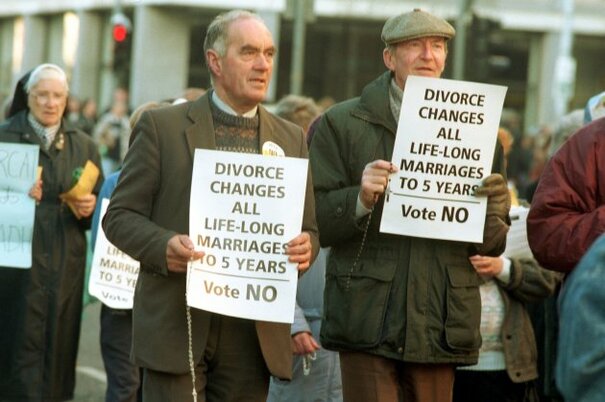
    Men campaign for a No vote during the 1995 divorce referendum campaign. Image: Photocall Ireland
  • Divorce 1995

    An anti-divorce rally in Dublin on 18 November 1995 ahead of the referendum on the dissolution of marriage. Image: Photocall Ireland
  • Good Friday Agreement 1998

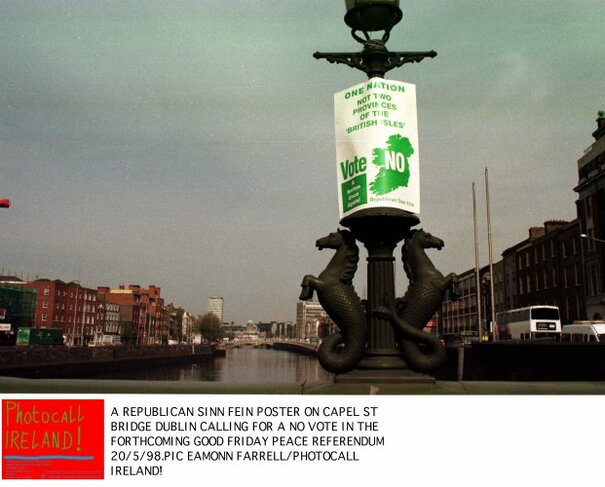
    A Republican Sinn Féin (RSF) poster on Capel Street calling for a no vote in the referendum in May 1998. Image: Photocall Ireland
  • Good Friday Agreement 1998

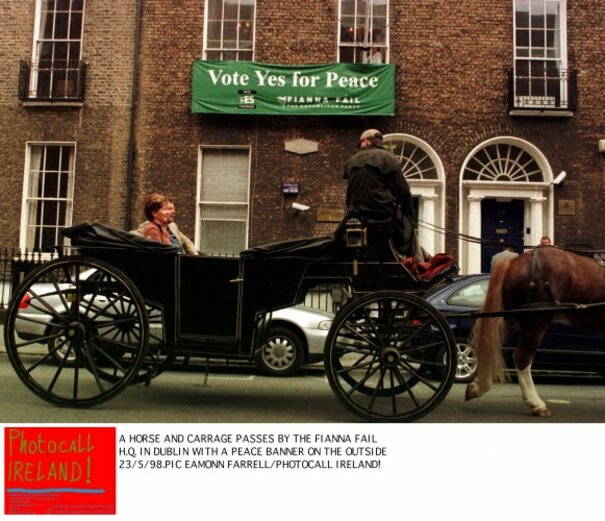
    Outside the FF HQ in 1998. Image: Photocall Ireland
  • Good Friday Agreement 1998

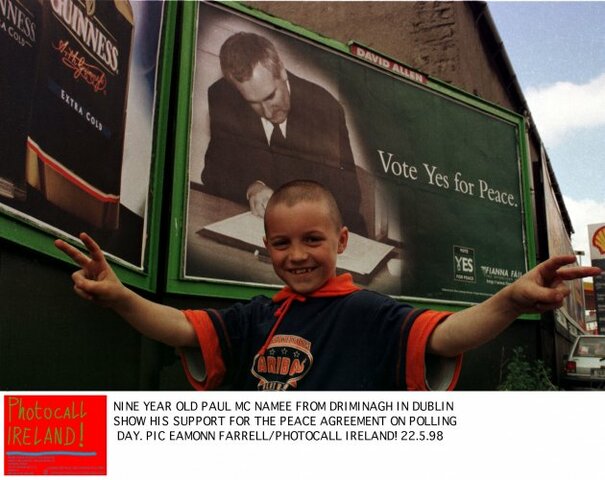
    Nine-year-old Paul McNamee from Drimnagh shows his support for the agreement on polling day, 22 May 1998. Image: Photocall Ireland.
  • Nice II

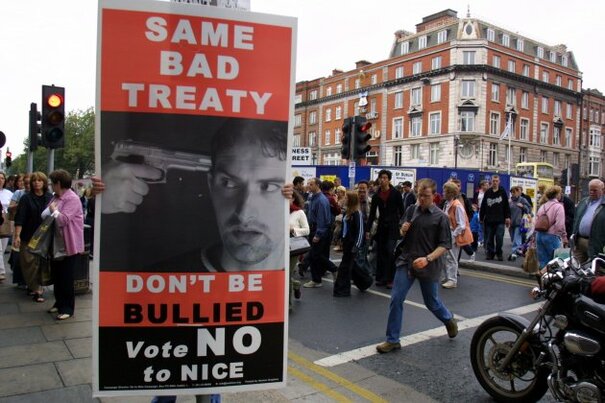
    A giant No to Nice placard on O'Connell Street, Dublin in September 2002.
  • Nice II

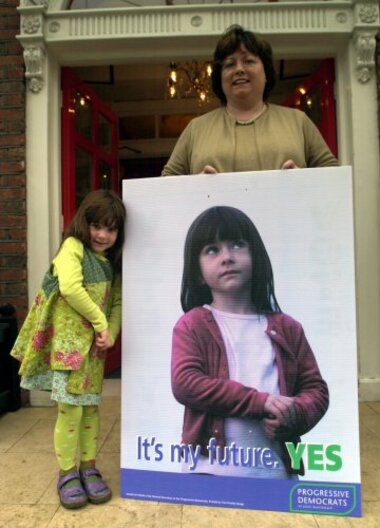
    Sara Tynan, pictured with Mary Harney here, is now 14. Wonder what she thinks of the European treaty? (Image: Photocall Ireland; October 2002)
  • Nice II

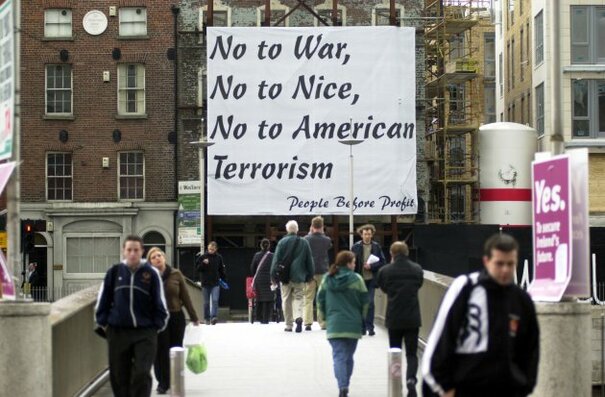
    The building construction company Wallace hung this banner on one of its building sites on Ormond Quay Dublin on 14 October 2002. Image: Photocall Ireland
  • Nice II

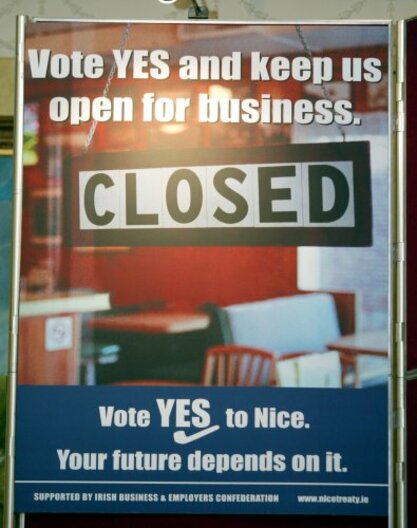
    A poster displayed during a business conference run by IBEC called Our Future in Europe- Nice and Beyond at the Burlington Hotel, Dublin on 20 September 2002. Image: Photocall Ireland
  • Abortion 2002

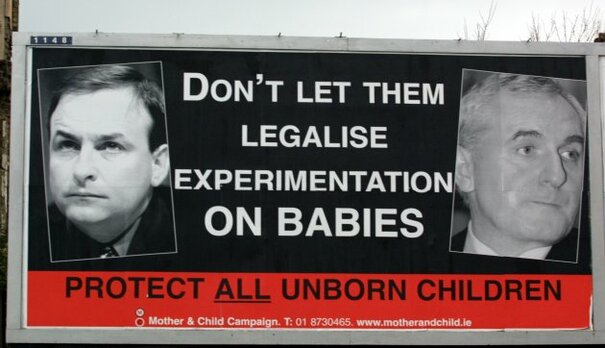
    An anti-abortion poster with the faces of Taoiseach Bertie Ahern and then-Health Minister Micheal Martin by the Mother and Child campaign at Summerhill, Dublin. (Image: Photocall Ireland; Date 2 January 2002)
  • Abortion 2002

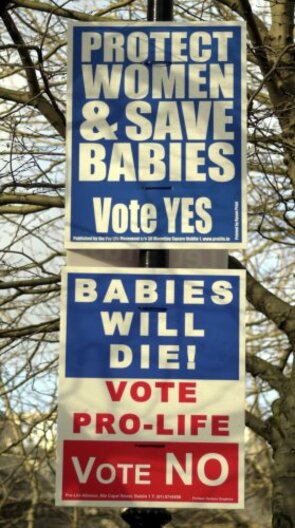
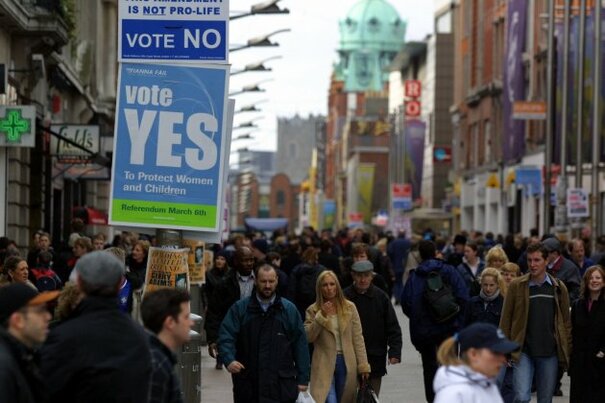
    Anti-abortion referendum campaign posters in Dublin City Centre in February 2002. (Image: Photocall Ireland)
  • Abortion 2002

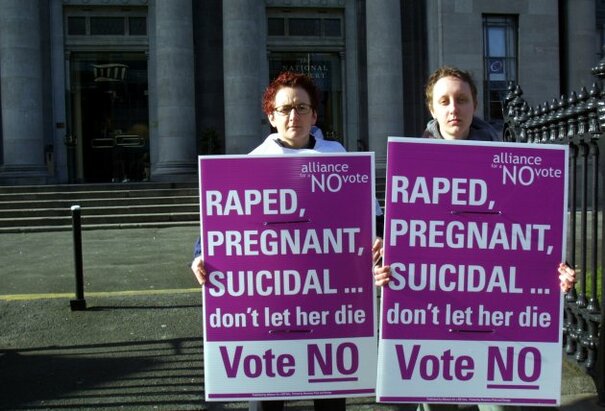
    Members of the Alliance For a No Vote protesting outside the National Concert Hall Dublin where Fianna Fáil were holding a women's conference on 23 February 2002. Image: Photocall Ireland
  • Abortion 2002

    Members of the Alliance For a NO Vote protesting outside the National Concert Hall in 2002. (Image: Photocall Ireland; Date 23 February 2002)
  • Abortion 2002

    A Fianna Fáil Vote Yes Abortion poster on Henry Street, Dublin in February 2002. (Image: Photocall Ireland)
  • Abortion 2002

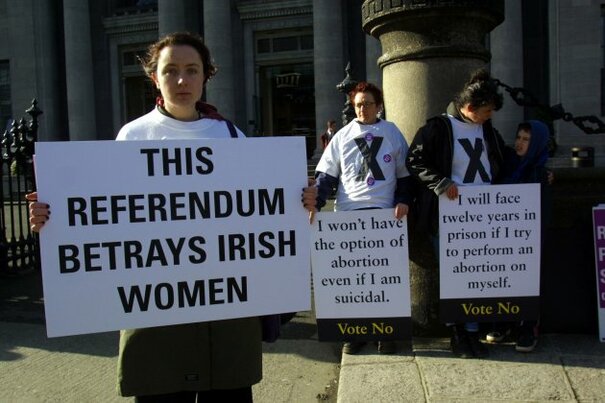
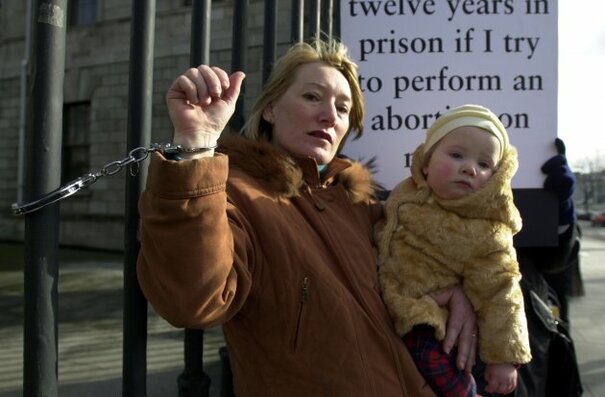
    Sharon Henderson from the Alliance for a No Vote with her daughter Jodie (17 months) handcuffed herself to the Four Courts Dublin to highlight the fact that the government's bill laid down a prison sentence of up to 12 years for a woman who attempts to procure an abortion in Ireland. (Image: Photocall Ireland; Date 29 February 2002)
  • Citizenship 2004

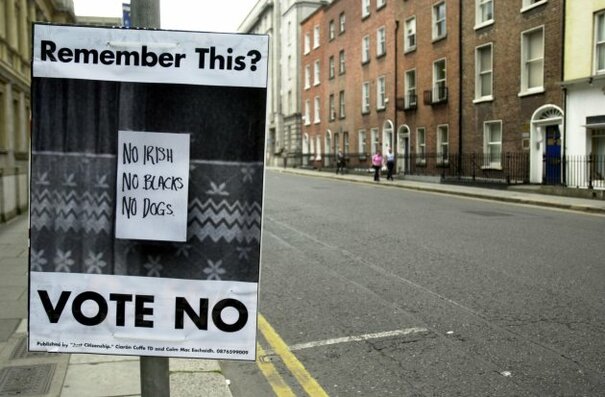
    Was it for this? Image: Photocall Ireland
  • Lisbon I

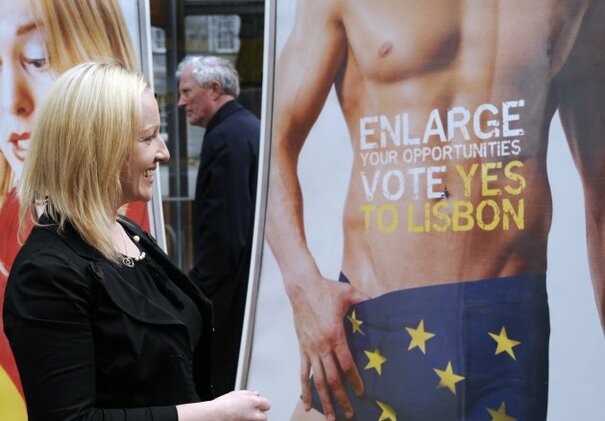
    And it wasn't just the young lads they were after. It was women (including Lucinda) as well. (Image: Laura Hutton/Photocall Ireland; Date 10 April 2008)
  • Lisbon I

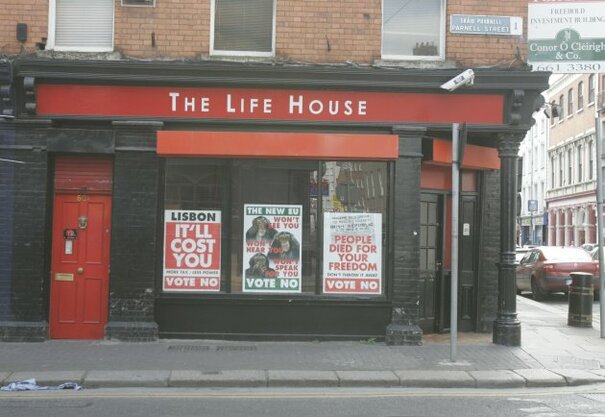
    Vote No to the Lisbon Treaty posters in the windows of a Pro Life office in Dublin City Centre. (Photo: Eamonn Farrell/Photocall Ireland; Date 9 June 2008)
  • Lisbon I

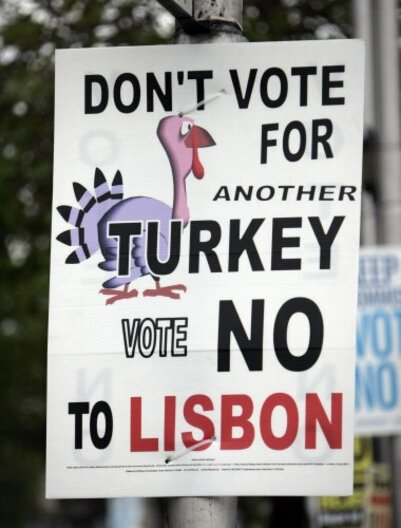
    A Vote No to the Lisbon Treaty poster in Dublin City Centre, which refers to the poor showing of Ireland's entry in the Eurovision song contest - Dustin the Turkey. Image: Eamonn Farrell/Photocall Ireland.
  • Lisbon I

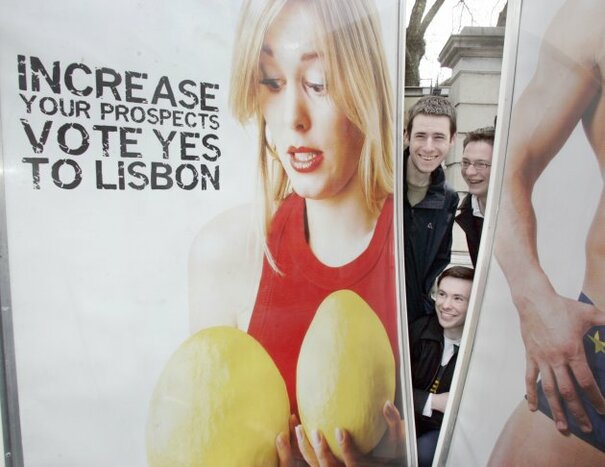
    Young Fine Gael, with these posters, wanted to excite the young electorate to come out and vote on the Lisbon Treaty. (Photo: Mark Stedman/Photocall Ireland; Date: 10 April 2008)
  • Lisbon II

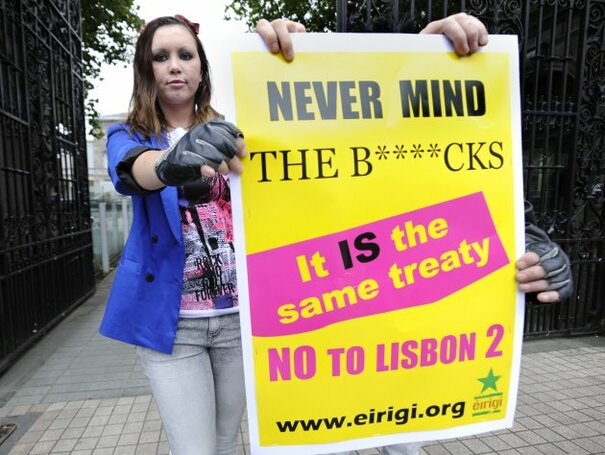
    Eirigi launch 'Never Mind the Bollocks' Second Lisbon posters. Photo: Sasko Lazarov/Photocall Ireland
  • Lisbon II

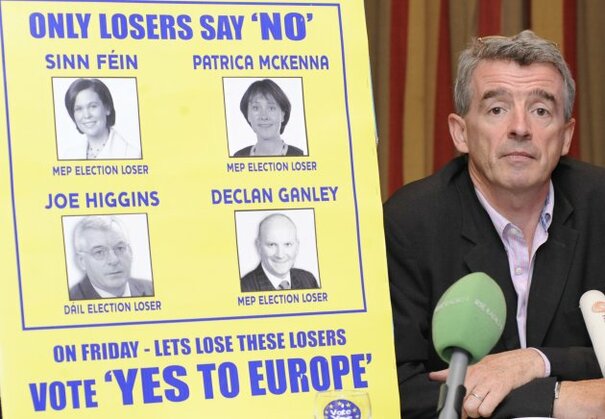
    Ryanair's Michael O'Leary hosts his last political press conference on Lisbon. Photo: Sasko Lazarov/Photocall Ireland!
  • Lisbon II

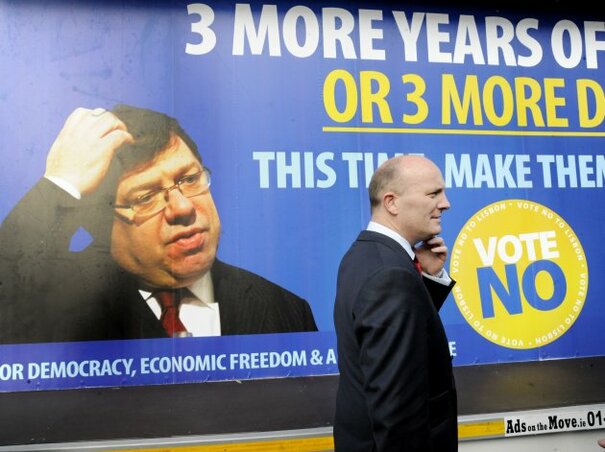
    Libertas leader Declan Ganley urged the Irish public to vote No in the Lisbon Treaty Referendum to force Taoiseach Brian Cowen out and start economic recovery. Photo: Sasko Lazarov/Photocall Ireland!
  • Lisbon II

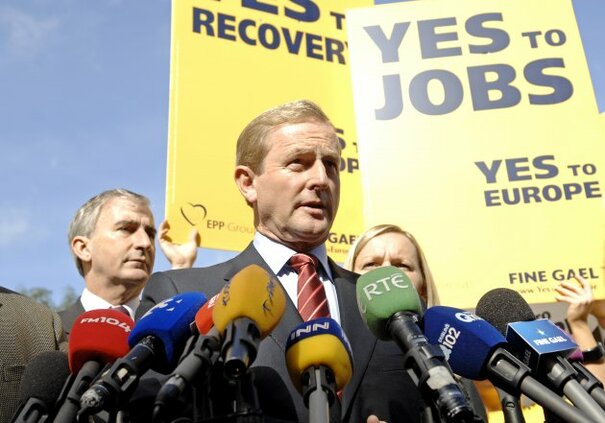
    More jobs. Photo: Laura Hutton/Photocall Ireland
  • Lisbon II

    Photo: Eamonn Farrell/Photocall Ireland; Date 30 August 2009
  • Lisbon II

    Posters spotted in Edenderry, County Offaly during the 2009 Lisbon No Campaign. (Photo: Eamonn Farrell/Photocall Ireland)
  • Lisbon II

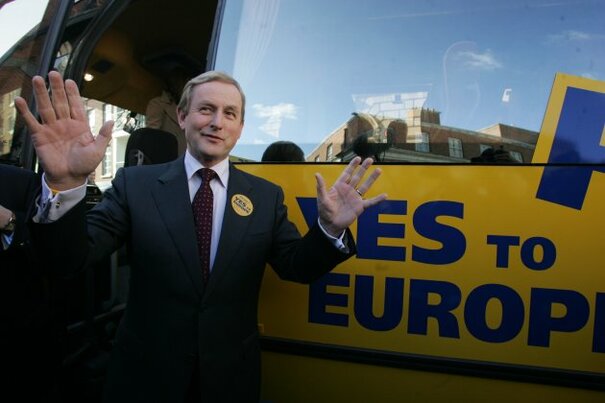
    Fine Gael leader Enda Kenny celebrates a Yes vote victory at Dublin Castle after the second Lisbon Treaty Referendum vote count. Image: Leon Farrell/Photocall Ireland
  • Lisbon

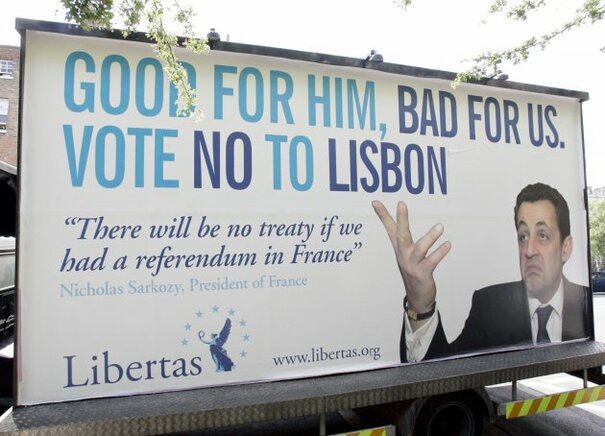
    A Libertas billboard during the Lisbon campaigns.
  • Fiscal Stability Treaty 2012

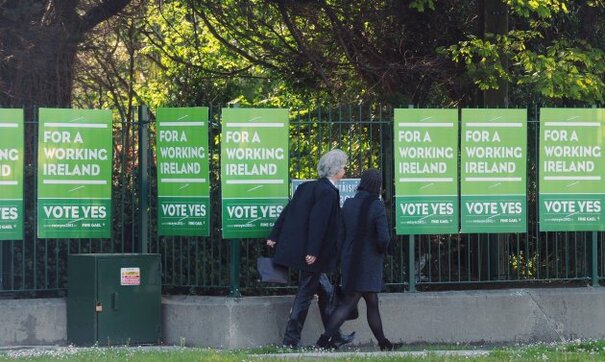
    The Yes side earlier this year linked an affirmative vote to Irish tradition. (Photo: Laura Hutton/Photocall Ireland)
  • Fiscal Stability Treaty 2012

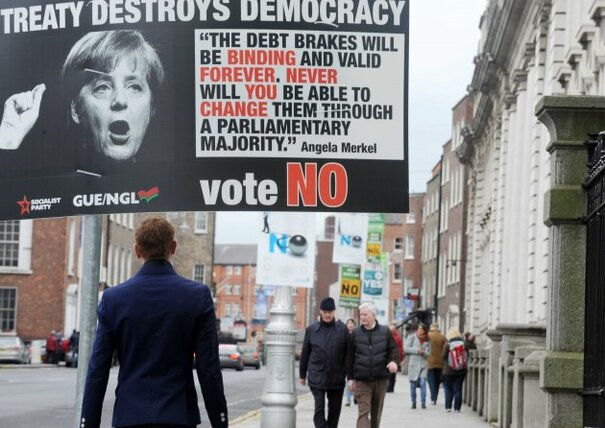
    Angela Merkel as the scary face of Europe. Photo: Laura Hutton/Photocall Ireland
  • Fiscal Stability Treaty 2012

    And the Yes side were all about the jobs again. Image: Laura Hutton/Photocall Ireland
  • Fiscal Stability Treaty 2012

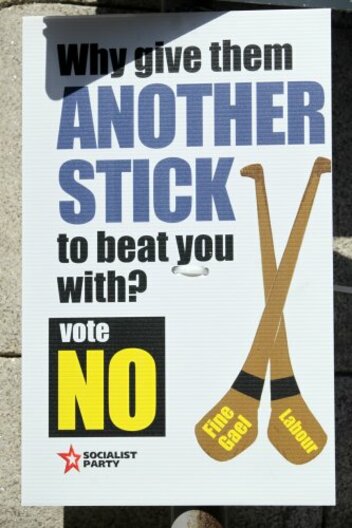
    The Socialist Party's campaign poster which was thought to have an indirect link to an incident which occurred on Dublin's O'Connell street which involved assault with hurleys during the campaigns. (Photo: Sam Boal/Photocall Ireland)
  • Fiscal Stability Treaty 2012

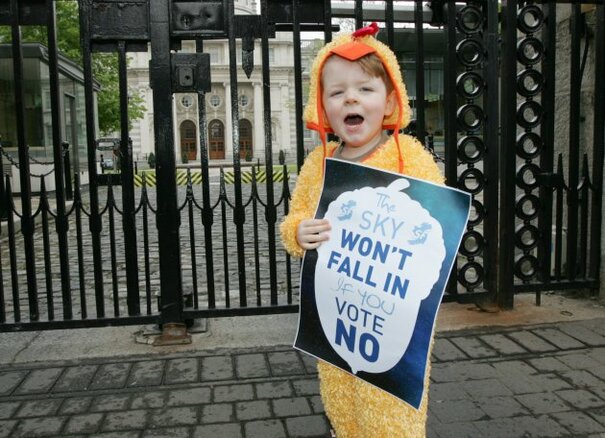
    Three-year-old Toirleach O Murchu (dressed as a chicken - we're not sure why?) outside goverment buildings to demonstrate that the "Sky Wont Fall In" if the electorate vote No in the European Fiscal Stability Treaty Referendum. (Photo: Sam Boal /photocall Ireland; Date: 18 May 2012)

More: Experts weigh in on Children’s Referendum>

Related: Marriage in Ireland rose by nearly 10 per cent in just 5 years – CSO>

Read next:

Comments (44 Comments)

  • Hindsight’s a wonderful thing…the country seems a much, much different place to what it was back n ’86

    Reply
  • Nice bit of history there. How quickly life moves along these days.

    Reply
  • Looking at some of those photos I realise how entrenched we were and still are in fundamentalist religious manipulation. I am a Christian but its scary seeing a priest carry a cross to make a point about divorce. It tells me how completely divorced they are from reality (pun intended).

    Reply
  • Don’t know if it’s been said already but the kid dressed as a chicken is referring to the children’s story “Chicken Licken” who thought the sky was falling because something dropped on him from above, so he went around telling everyone that the sky was falling, they all panicked and hilarity/anarchy ensued until someone in the story told him to calm down. http://en.wikipedia.org/wiki/Henny_Penny

    Reply
  • “love i’m off out for a pack of smokes.”

    Reply
  • Id like to closely examine the wording of the referendum on childerns rights, before I give an answer to whither I will vote “yes/no, or not at all”. I want to be sure Im not being duped into voting for something which will benefit only a few at the top. education ones self is very important when it comes to our childern’s futures .

    Reply
  • ok lets all vote no and forever condemn two people in Limbo who no longer have any feeling for each other. For God sake say yes and free people to at least move on with their lives.

    Reply
  • What’s the difference between the Pro Lisbon posters and the Club orange posters that there was such a stink about recently???
    Absolutely F***ing ridiculous.
    So it’s fine to use sex to sell politics, but not for a fizzy drink????
    FTW

    Reply
  • One of many basic human rights that the Catholic Church still opposes.

    Reply
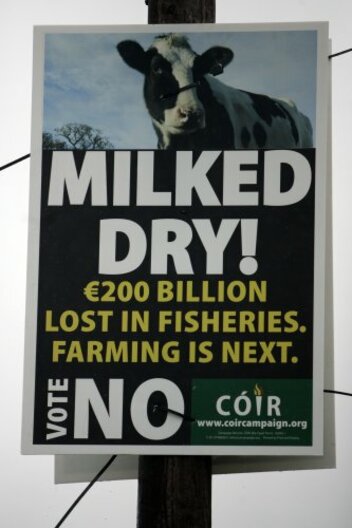
  • Ciaran, the figure of 200 bn maybe excessive, but not by too much. Fisheries was the abandoned waif in the storm during the negotiations and allowed “our waters”to become “European waters”. Fisheries was forgotten at the expense of Agriculture. The figure refers to how much was earned by other countries by fishing in what had been exclusively “our” waters.

    Reply
    • Its not a clear yes or no on abandonment:

      It was agreed by the original Member States before negotiations even began that any vessel of the EEC/EU fleet would have ‘equal access’ to, as you rightly point out, ‘European waters’ – beyond what would later be agreed to a 12nm coastal band limit.

      As with any new state gaining accession, they would have to sign up to all legislation which has been previously agreed upon, meaning Ireland had to accept this legislation or not join – and with the interest in joining weighing heavily of the benefits for the agriculture community, how could Ireland say no?

      Yes, more could have been achieved during negotiations for even the most modest benefits by our representatives. However, their hands were already tied before they even arrived at the table.

      Reply
    • Icarian, don’t think so. The natter was up for discussion as new waters in EEC. Could have got derogations , for example. Further, if you are right about taking things as they were,how did it take more than two years od negotiations? Would it not have been a case of “sign here please”? No , there was huge room for negotiation over two years and more , and Fisheries was not excluded. Would you agree?

      Reply
    • When it comes to accession negotiations, and Ireland went through the same, specific areas of policy such as taxation, agriculture, etc are termed as ‘chapters’ for the course of negotiations. These chapters are not all discussed at once as soon as negotiations open, but ‘open’ and ‘close’ depending on talks, compromise and final agreement – the length this takes depends on what the topic is. For example with Iceland, although negotiations started in 2010, Chapter 13 on fisheries has not even opened it.
      As a compromise by the EEC in terms of Irish fisheries when we were negotiating, we were given a derogation of ten years after accession before ‘equal access’ would come into effect. We were given the 12nm coastal band limit in its places for those ten years, but in the end ‘equal access’ was never applied come 1982 and the 12nm limit has been retained ever since.

      Reply
  • Ryan'O 22/09/12 #

    Amazing that propaganda works, particularly like Lisbon and stability treaty posters, enlarger your prospects LOL. Our grand children will look back in hatred at the blindly obvious scare tactics and lies!! Nice post journal

    Reply
  • I’m just looking at Michael O’Leary’s poster for Libson II and I can’t quite remember who PATRICA McKenna is…

    Reply
  • I would really like to know where that figure of €200 billion lost in fisheries (Image 41) was referenced from.

    Reply
    • Its true, one of the reasons why Norway will not join the EU. When ireland signed up to the Europe they took away Ireland biggest natural resource, its fishing grounds. The billions Ireland received in aid since joining is only a small fraction to what Europe makes from Irelands fishing waters.

      Reply
    • Its true, what swung Norway’s rejection of EU membership on both occasions (1972 and 1994) was the negative post-accession situation for fisheries, which their economy and culture have been historically centered around – just like Ireland and agriculture.

      As I mentioned in a reply to this post below, its not a clear yes or no on abandonment:

      It was agreed by the original Member States before Irish negotiations even began that any vessel of the EEC/EU fleet would have ‘equal access’ to ‘European waters’ – beyond what would later be agreed to a 12nm coastal band limit.
      As with any new state gaining accession, they would have to sign up to all legislation which has been previously agreed upon, meaning Ireland had to accept this legislation or not join – and with the interest in joining weighing heavily of the benefits for the agriculture community, how could Ireland say no?

      Yes, more could have been achieved during negotiations for even the most modest benefits by our representatives. However, their hands were already tied before they even arrived at the table.

      Reply
    • It would great for Ireland if they could take back their fishing grounds. Norways fishing industry is worth over €6 Billion a year, employs 13,000 people. It is the countries 2nd biggest export after oil & gas. Ireland has the potential to do the same, with its rich fishing grounds to the west. Ireland is in the EU nearlly 40 years, €6 billion times by 40, €240 billion. How much has Ireland received in aid since joining the EU, they say Ireland received €60 billion in aid in the last 40 years, paid back €20 billion. The EU is €200 billion better off from Ireland joining. Ireland needs to get a better deal on its biggest natural resource.
      Reply
    • Icarian , sorry to be blunt , but you are wrong about the 12 mile limit as being agreed. It was not , and it took the ECJ to impose it on Ireland. Please, let’s have facts here.

      Reply
    • Mark, spot on. The default position you indicated is exactly what Ciaran does not seem to understand. There were many derogations open to us to seek , but the EEC recognised , more than our negotiators, the value of the waters. The Irish fleet was badly under-capitalised at the time and the potential was not recognised by the Government of the time. I feel it is the same , now, with our Oil reserves. Just switch one for the other and. You have the same scenario. We are continuing to give wealth away . It is wrong, wrong , wrong.

      Reply
    • I’d like to know what is the balance of payments with regard to Europe, without solid facts at hand, I have a feeling we are more likely to have bled them dry than us them! Particularly in the agri sector?

      Reply
  • In the last one where you’re “not sure why” the kid is dressed as a chikcen, it’s a reference to the story Chicken Licken where the chicken thinks the sky is falling in after an acorn drops on his head. Hence why the poster he’s holding says: “The Sky won’t fall in if you vote No”.

    Reply
  • The first GFA poster was a RSF poster, not a Sinn Fèin poster as your caption indicates.

    Reply
  • Referendums, and for the grammer police referendae, dont actually make a difference, life just carries on as it did anyway. No matter what way we vote, and if we choose the “wrong” one the govt just give us another one and whip us into shape, whats the point in holding one

    Reply
  • Issues like abortion, divorce, even the recent debate on the children’s referendum are smoke screens, these issues are no where near a pressing as the economic issues which we face right this minute. Every time a government is floundering these debates resurface with only one purpose. Its to take your mind of what is really happening around you. The Labour/FG coalition and their friends in the media have been splurting out nothing but divisive sound bites since this governments popularity fell below the 24% approval mark. The recent Croke Park debate which pitted public sector workers against their private counterparts was a blatant attempt to divide the public while this government carry on implementing the unrealistic dictats of the Troika. I’m not saying the above issues should not be discussed, I’m saying there are more pressing issues both we and our government should be addressing.

    Reply
  • listen to http://www.criticalmassradio.co.uk and http://www.oriontalkradio.com this friday and saturday the earth needs rebels show 7pm friday 2pm saturday dublin time

    Reply
  • Ciaran

    Reply
  • Actually they had a point the victims of divorce are the children plain and simple!

    Reply
    • Children would also be victims of a highly dysfunctional household without divorce. Children are not victims of divorce, they’re victims of bad situations where divorce can actually bring some level of normality.

      As with anything, if you look at it from a particular point of view you’ll find the argument you want to make.

      Reply
    • Would you rather the children grow up in a household where their parents are miserable and fight, leaving the kids damaged mentally and a skewed sense of what a relationship should be like?

      Reply
  • divorce in Ireland would not work, they would put to much pain and ache into it, as they do everything else, and lawyers would not be happy with divorce lawyers coming in and biting at their share of the wealth, its all a wrapped up game here, rob a car, get the tax man to pay the lawyer, do it again and tax man will still pay for lawyer,, lawyers love repeat offenders as they know they get the case, ,, children do not suffer from divorce anymore different to legal separation, or mommy or daddy just going off to live with someone else, worse to see kids in a home of fighting and abuse,,, that’s how they learn to carry on as they grow into adults, abortion should be legal, as we cant really afford children s allowance anymore and the cost of the after care after having abortion abroad is just as costly, if a person is going to get an abortion they will , and a flight to England can be got for under 20 euro, so why not just give it to them at home, we are no longer a catholic country, as we have so many religions here, and we should cater for all to be ethical, and that’s my boredom of the same crap coming up year after year

    Reply
  • Introduction of divorce started our moral decline as a nation i’m afraid :(

    Very little respect for our elders and authority in general around these days :(

    :(

    Reply
    • Moral decline is forcing a couple to live together in the same house and pretend to love each other when they don’t. What’s moral about that.

      You don’t have to get divorced if you fall out of love with your wife. If you stop loving her just do the Irish catholic thing and put up with it.

      Forcing your opinion on others is wrong. If divorce was illegal then it favours your opinion 100%. If it’s legal then it favours both parties: You can remain married unhappily while others can move on.

      Reply
    • Moral decline started with divorce! You must be too young to remember the preceding political corruption, the bombing of children and the abuse of power by both the church and organs of the state.

      ‘Elders’, teachers (of which I am one) politicians, priests and guards have primarily lost their automatic respect. In general this is not a bad thing in my view. In fact it is a sign of a more educated, less superstitious population. That said courtesy should be automatic but respect must be earned by all.

      Reply
    • Unfortunately, when it comes to divorce, according to recent reports, more men are “moving on” than women. Divorce seems to have a more negative effect on the financial status of women than it has on men.

      Reply
    • Little respect for elders and authority?

      You mean people should have respect for the priests that were sexually abusing kids for decades, for example?

      Reply

Add New Comment