We need your help now

Support from readers like you keeps The Journal open.

You are visiting us because we have something you value. Independent, unbiased news that tells the truth. Advertising revenue goes some way to support our mission, but this year it has not been enough.

If you've seen value in our reporting, please contribute what you can, so we can continue to produce accurate and meaningful journalism. For everyone who needs it.

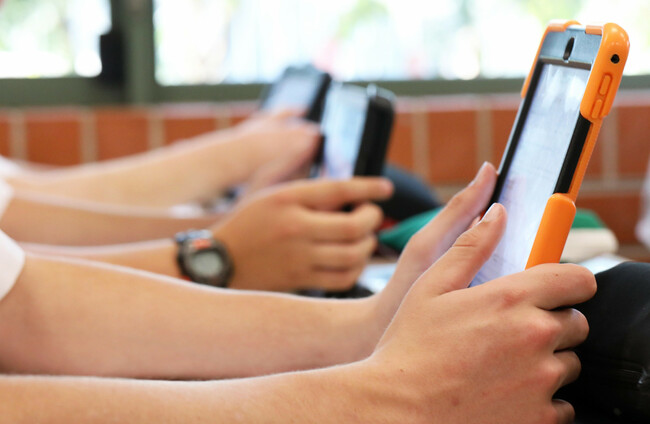
Many schools, especially at secondary level, want students to have a digital device like a laptop or tablet. Alamy Stock Photo

Money saved through free schoolbooks scheme is being swallowed up by school laptops, parents say

Stressed parents are going into debt or skipping bills to find the money for back-to-school costs, a new survey has revealed.

MONEY THAT PARENTS have been able to save on back-to-school costs through the government’s free schoolbooks scheme is being swallowed up by the cost of schools requiring students to have electronic devices like a laptop or tablet, according to a new survey of parents.

Parents struggling to afford mounting back-to-school costs are taking out loans or failing to make utility bill payments to try to keep up with the expense of the new school year beginning next month.

A new Back to School Survey by children’s charity Barnardos found that half of parents of primary school pupils are worried about affording the costs of returning to school this year.

That figure rises to 60% of parents of secondary school students, with only 34% of secondary school parents feeling that the costs are manageable.

Barnardos conducted an online survey of parents that received 830 responses. Respondents came from a “representative geographic spread” across the country. Two-thirds had children in non-Deis schools and one-third had children in Deis schools. Two-thirds were living in married couples, whils 17% were on-parent households.

“We won’t have enough money for all of it. I can’t afford the costs for my kids,” said one primary school parent.

Adding up the bill

Barnardos asked parents how much they will need to spend on school costs this year.

The average expected cost for uniforms, voluntary contributions and classroom resources amounted to €263 for primary schools and €406 for secondary schools.

More expenses like school tours and trips, extra-curricular activities within schools and digital costs are expected to drive those totals up further.

At secondary school level, parents anticipate that digital costs alone will set them back €430.

Half of secondary school parents say their child’s school requires them to buy digital devices.

Some parents expressed that the benefit of the free schoolbooks scheme that is being extended to all secondary schools this year has been lost by schools using it as an opportunity to switch students over to working on tablets or laptops.

“[The] principal told the child’s class that the money saved by free books, they can now spend on a laptop,” one secondary school parent said.

Another said: “My son is going into 5th year. This was the first time we were entitled to free schoolbooks, but then we were called to a meeting in the school where they advised that we would have to buy a ChromeBook for our child which cost €500, so there is no benefit for us for the free schoolbooks. If anything, the cost has gone up.”

grab-from-pa-video-of-minister-for-education-helen-mcentee-speaking-to-the-media-institutions-and-religious-orders-involved-in-historical-sex-abuse-in-schools-will-be-held-accountable-for-the-awfu Minister for Education Helen McEntee has said almost one million students will get free schoolbooks from the start of the 2025/2026 school year. Alamy Stock Photo Alamy Stock Photo

The Barnardos report said that it is “clear that some parents are concerned that savings made with the introduction of free schoolbooks is being eroded by digital costs while other parents simply expressed their concerns about the increasing costs of digital device

It said that some parents “appreciated that their children needed digital devices in their day to day lives” but “felt those requested by the school were unnecessarily expensive”.

“There is a risk that some parents are facing difficult financial decisions and considerable sacrifices to afford these digital devices,” it said.

No parent should face financial hardship as a result of these costs.

“The Department of Education must further investigate the use of these devices across schools; how many mandate expensive items, and explore piloting a digital tools fund for low income parents.”

Voluntary contributions

Another unpopular expense is the ‘voluntary contributions’ that many schools request parents make.

78% of primary and 84% of secondary school parents said that their schools requested a voluntary contribution.

The average amount was €87 for primary school parents and €133 for secondary school parents.

However, 73% of primary and 78% of secondary school parents said the payment did not feel voluntary. 

On top of voluntary contributions, more fundraising events throughout the school year put continued pressure on parents, who said that the government must do more to ensure that schools are properly funded from the top down rather than needing to turn to parents for money. 

“Every month, it feels like there is a fee due for something,” one primary school parent said.

“I feel the school has to fundraise through the parent council to meet basic needs that the government should be covering the cost of.” 

Finding the funds

Staring down the face of back-to-school costs, parents have had to come up with ways to make ends meet.

More than one-quarter of secondary school parents and 14% of primary school parents said they’ll be dipping into their savings to afford the cost of sending their kids back to school.

For more than one in ten (15%) of secondary parents, the answer has been to take out a loan or borrow from family and friends.

That number is lower among primary school parents (8%).

Additionally, many parents have decided to go without meeting other needs or cutting back on other essentials, with some saying they won’t be able to pay other bills because of needing to divert money to school costs.

“My regular bills are not going to be paid in order to meet back to school costs,” one secondary school parent said.

Another secondary school parent said: “I will not pay gas and electric bill in August, I will borrow a loan and use [buy now, pay later with interest services] to get as much as I can for back to school items.”

“I will go into debt until March the following year until it’s all paid back, then it repeats again in August. My worries are if I can keep this up year after year,” they said.

And another one said: ”I juggle finances all of the time. I worry that I will not be able to afford utility bills in September/October to cover school costs. I have credit card debt which will increase in August.”

One primary school parent said that the “cost of the uniforms and all the supplies at once means we have no expendable income for the month”.

“We are on a very tight budget as we have three kids,” they continued.

“Everything has gone so expensive. I’m going to have to skip paying some bills to be able to afford everything,” another said.

Readers like you are keeping these stories free for everyone...
A mix of advertising and supporting contributions helps keep paywalls away from valuable information like this article. Over 5,000 readers like you have already stepped up and support us with a monthly payment or a once-off donation.

Close
74 Comments
This is YOUR comments community. Stay civil, stay constructive, stay on topic. Please familiarise yourself with our comments policy here before taking part.
Leave a Comment
    Submit a report
    Please help us understand how this comment violates our community guidelines.
    Thank you for the feedback
    Your feedback has been sent to our team for review.

    Leave a commentcancel

     
    JournalTv
    News in 60 seconds