We need your help now

Support from readers like you keeps The Journal open.

You are visiting us because we have something you value. Independent, unbiased news that tells the truth. Advertising revenue goes some way to support our mission, but this year it has not been enough.

If you've seen value in our reporting, please contribute what you can, so we can continue to produce accurate and meaningful journalism. For everyone who needs it.

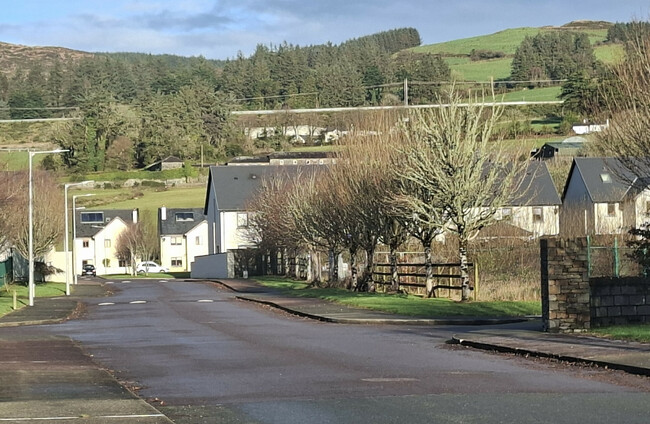
More housing is needed in Gaeltacht areas to maintain the use of Irish as a community language as well as protect schools and support sporting clubs.

More than 12,000 homes needed in Gaeltacht to cater for young generation - new analysis

More than 32,000 extra homes will be needed to accommodate people seeking housing in Gaeltacht areas over the next ten years, according to a new analysis.

(Seo alt ónár bhfoireann Gaeltachta. Is féidir an bunleagan as Gaeilge a léamh anseo.)

ACCORDING TO a new website, which is analysing statistics from the Central Statistics Office, more than 12,000 houses are needed in the Gaeltacht to meet the current housing needs of communities in the various areas

According to One Million Homes, 12,635 houses are needed in the Gaeltacht areas so that these areas reach the basic level of housing in the European Union. This is equivalent to 50 houses for every 100 people. Currently, there are 37.9 houses for every 100 people in the country’s Gaeltacht areas.

If this rate of construction continues without increasing, Gaeltacht communities across the country will be left without enough children to keep local schools open and have sufficient members in GAA or other sports clubs.  

This figures highlighted on this website will put additional pressure on the Department of Rural, Community and Gaeltacht Development on the housing issue. Last week, the housing group, Bánú, protested at the Department’s headquarters in Connemara, and the complaint focused on the lack of action by the Gaeltacht Minister, Dara Calleary, on the housing issue.

The authors of the site, sustainable housing developer Rob Cass and former executive with the computing company Intel and expert in AI, Edward Dixon, believe that the two million young people between the ages of 18-44 are not being counted by the Government and local authorities.

Explaining why they chose 1m new homes as their target, they said that the two million in that age group were in the country itself, along with many others who are abroad and would like to come home to live in Ireland.

“This number of homes is needed because of the shortage of supply in the last decade – a period in which around 750,000 new jobs were created but only around 200,000 new homes were built and the 750,000 – 1m new jobs that are expected to be created in the next decade,” they said.

“It is estimated that each household will have two children on average and this will create additional demand in the years to come.”

According to their estimates, 8 million people will be living in the country by 2045 (excluding Northern Ireland) and to accommodate this, 4.5 million homes will be needed, six million under 45 years of age and 4m under 18 years of age.

In terms of the various Gaeltacht areas, it is estimated that a total of 32,000 houses will be needed over the next 10 years. According to the analysis published on the various Gaeltacht areas on the website, 7,375 will be needed in Galway, 2,362 in Donegal, 920 in Mayo, 704 in Kerry, 561 in Cork, 397 in Meath and 316 in the Decies.

According to the analysis on the website, the construction rate in Gaeltacht communities, 1.1 new houses per 1,000 people in the last five years, is well behind the average construction rate across the country, which is 3.9%.

Although it has recently been revealed that 36,000 houses were built across the country last year, the figure quoted for construction in Gaeltacht areas is a much smaller one, just 234 houses in total.

According to the site, 642 houses were built in the Gaeltacht areas of Galway, more than half of the total, over the ten year period.

When you look at that figure, however, it is revealed that 243 houses, more than a third, were built in Moycullen, 204 in Bearna and 100 in Baile Chláir and 65 in Baile Chláir. 11 houses were built in An Cheathrú Rua, 11 in Cluain Bú, 4 houses in An Spidéal and 4 houses in Cill Rónáin on Inis Meáin.

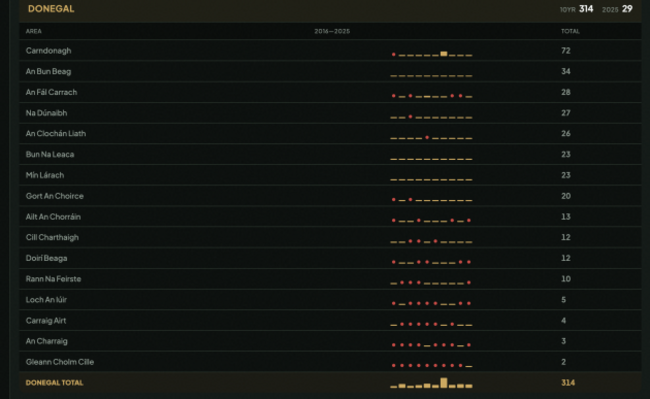
Screenshot 2026-02-03 at 14.53.15 This screenshot from the One Million Homes website shows the data relating to how many homes were built in the different communities in the Donegal Gaeltacht during the 2016-25 period. One Million Homes One Million Homes

In Donegal, a total of 314 houses were reported to have been built, 72 of which were in Carn Domhnach, 34 in An Bun Beag, 28 in An Fal Carach, 27 in Na Dúnaibh  and 26 in An Chlochán Liath. 23 houses were built in Bun na Leaca, 20 in Gort a Choirce, 13 in Ailt a’ Chorráin, 12 in Cill Charthach and Na Doirí Beaga 10 in Rann na Feirste, 5 in Loch an Iúir, 4 in Carraig Airt, three houses in An Charraig and two in Gleann Colmncille.

In the Kingdom, figures are given for the Daingean Uí Chúis area where 139 houses were built during the ten-year period 2016-25 and, across the border in County Cork, 52 houses were built during the period, 38 in Baile Mhic Íre and 14 in Béal Átha’n Ghaorthaidh.

In Gaeltacht na nDéise in Waterford, 36 houses were built in An Rinn and, in Mayo, 51 houses were built, 47 in Béal a’ Mhuirthead and four houses in Gob a’Choire. Figures for the Gaeltacht areas in County Meath were not given.

Readers like you are keeping these stories free for everyone...
A mix of advertising and supporting contributions helps keep paywalls away from valuable information like this article. Over 5,000 readers like you have already stepped up and support us with a monthly payment or a once-off donation.

Close
Comments
This is YOUR comments community. Stay civil, stay constructive, stay on topic. Please familiarise yourself with our comments policy here before taking part.
Leave a Comment
    Submit a report
    Please help us understand how this comment violates our community guidelines.
    Thank you for the feedback
    Your feedback has been sent to our team for review.

    Leave a commentcancel

     
    JournalTv
    News in 60 seconds