TheJournal.ie uses cookies. By continuing to browse this site you are agreeing to our use of cookies. Click here to find out more »
Dublin: 15 °C Wednesday 19 June, 2013

British business leaders warn Cameron over risks of EU exit

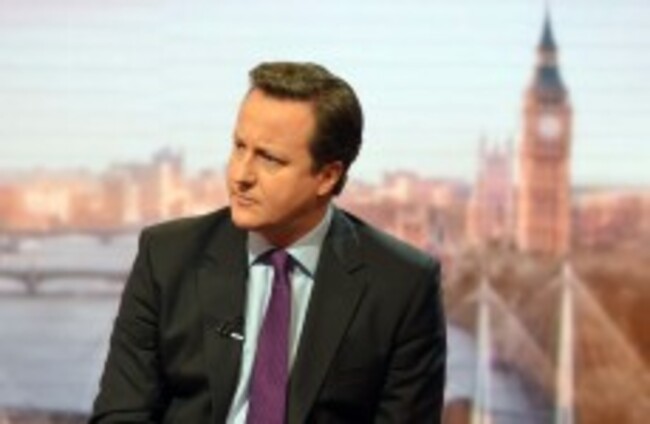
Cameron has expressed a desire to renegotiate the conditions of its membership with the 27-country bloc.

Image: Jeff Overs/BBC/PA Wire/Press Association Images

MAJOR BRITISH BUSINESS figures warned Prime Minister David Cameron on Wednesday that the renegotiation of the country’s relationship with Europe could risk its exit from the EU, with “damaging” consequences for the economy and businesses.

Ten top business leaders – including Virgin tycoon Richard Branson, WPP advertising agency chief executive Martin Sorrell and Rio Tinto chairman Jan du Plessis – also called for “urgent” EU reform in an open letter to the Financial Times.

“We urgently need more EU reform, not least of the working time directive and the antiquated EU budget, and completion of the single market in services such as digital, telecoms and energy,” the letter read.

“Britain should be forthright in seeking the lead to achieve these changes. But equally, we must be very careful not to call for a wholesale renegotiation of our EU membership, which would certainly be rejected.”

Cameron is due to give a major speech this month about Britain’s strained relationship with the EU, but has already said he wants to renegotiate the conditions of its membership with the 27-country bloc.

“To call for such a move in these circumstances would be to put our membership of the EU at risk and create damaging uncertainty for British business, which are the last things the prime minister would want to do,” the letter added.

“We need a strong reformed EU with Britain at the heart of it.”

The premier had vowed on Sunday that he wanted to serve as prime minister until at least 2020 to oversee a range of reforms — including a renegotiation of Britain’s relationship with Europe.

The letter was also signed by Roger Carr, president of powerful business lobby the Confederation of British Industry (CBI), as well as London Stock Exchange chairman Chris Gibson-Smith and BT chairman Michael Rake.

- © AFP, 2012

  • Share on Facebook
  • Email this article
  •  

Read next:

Comments (37 Comments)

  • Yea Norway has to comply with most EU law to access the Single Market and it contributes to the EU budget but has zero influence in any EU negotiations as it’s not a member of the EU. If the UK was to leave, it could negotiate a similar status. Be subject to EU law with no input into deciding the law and pay into the budget – the euro sceptics will love that..

    Reply
    • Norway’s engagement with the EU over and above its EEA obligations is entirely voluntary.

      Reply
    • Yes Norway voluntarily chooses to accept EU law and pay money into the EU budget for the privilege of having access to the Single Market. The UK could choose to do the same or not. But either way, they’d be outside the EU. That’s my point really – Cameron is pretending that the UK can stay inside the EU but have a different status than the other member states. It can’t and it won’t.

      Reply
    • Well at least he’s going to try to get a better deal rather than dance for Angela Merkel’s amusement.

      Reply
    • He’ll certainly try to set up a few set piece arguments with the other EU countries for the chums back home (preferably involving some anti-German rhetoric) but ultimately he’ll lose.

      Reply
  • If the UK left the EU, would British based EU Headquarters jump ship to Ireland to stay in an English speaking country?

    Reply
  • I think the British people should decide for themselves through a referendum. Let everybody make their arguments and see what happens, there is always an assumption that the general public won’t understand the complexities, this is bull in my opinion.

    Reply
  • Are you forgetting the 7 billion they lent us,and the big multinationals are only here because of the low corporation tax,there world is money money money.

    Reply
  • The Tory Government is naturally, conventionally anti-Europe. From a number of articles in the Guardian on this subject it would seem that Cameron wants to distance the UK from the EU, but not fully sever ties; he wants the benefits of being within the EU but without the defects.

    It would be interesting to see how the British public would vote on this.

    Reply
  • Cameron is trying to placate the now mainstream anti-EU Tories by pretending that the UK can negotiate a special relationship with the rest of the EU in return for enabling the euro zone countries to move forward with further integration. He’ll eventually be told where to get off. If he wants to veto a new EU treaty on integration, the other countries who want to move ahead will do so with a non-EU treaty – just as they did with the Fiscal Compact Treaty. At that stage the UK may indeed have a referendum on the EU. But the only question will be are they in or out. Cameron’s suggestion that the UK can renegotiate current treaty provisions is pure fiction.

    Reply
  • John 09/01/13 #

    The more Eurosceptic Britain becomes, the more foreign direct investment Ireland will receive. What foreign multinational would put their European operations in a country with ambivalent feelings towards the EU?

    Reply
  • Mjhint 09/01/13 #

    Cameron is doing exactly what thatcher did. He is making shapes with the plan of making the eu nervous. The UK are sick of eu legislation that is protecting mainland europe as it has always done & I say well done to him. I hope he succeeds. The eu needs to be reeled in big time. If he does manage to do this he will be held in the same light as the iron lady & that would garuntee his re election.

    Reply
  • And so the Eurozone will come falling down, this is all them pesky Loyalists fault, not to mention Luis Suarez!

    Reply
  • Cameron is playing a dangerous game here with the EU, increasingly the UK is seen as a moaning child sat in the corner throwing its toys out of the pram, holding up treaties and criticizing plans and actions of the Commission and Eurozone, even when they act in the public interest, while offering very little in return! Eg, a very important document and treaty which aims at stabilizing the Eurozone and ECB is being held up by Britain because they’re using it as a lever ahead of Cameron’s speech. The UK doesn’t put any money into the bailout to help its neighbours and has done very little to aid EU economic recovery, but conveniently used us as a scapegoat when things go wrong with its own economy.

    The main benefit to us is that businesses are more likely to look at Ireland as the safe gateway into the world’s largest market, and you can see it starting; the more uncertain the UK’s future in the EU, the more we seem to hear about companies setting up shop in Ireland and our economic recovery starting to take shape!

    Reply
  • Whatever Cameron desire to redefine the UK’s relationship with the EU may be too late to achieve. British public want OUT of the EU and it’s regulations and immigration policies . UKIP party appear to be growing in support amongst the British public and fall for Tory/ Lib Dem and Labour. Danger for Ireland is we send 60% of our goods still to the UK after 40 years of EU membership.
    UK impose new high taxes and tariffs on imports to protect British jobs. Sterling appreciates in value and not tied into the financial rules of the EU attracts new foreign direct investment.
    Ireland is screwed with higher unemployment and major market closed off. Irish government may have to decide to LEAVE the EURO and the EU to restore Economic success.
    Norway and Switzerland export MORE goods to EVERY EU state than Ireland.

    Reply
    • Britain also is a large exporter. Introducing trade tariffs is so last century. It doesn’t work because when one country does it, the states that they export to (often the same as who they import from) return the favour, which without fail exacerbates the original problem.

      Didn’t work for DeValera either.

      Reply
  • The EU is bad for Ireland and our people, unless you are a banker or a politician.

    Reply
  • The EU as a project has failed. It only makes sense for big business now, there are 26 million people unemployed in the EU with the leadership having not the first or last clue as to how to deal with that crisis. The more we devolve power to this beaurocratic monstrosity, the poorer we seem to become on a macroeconomic level, the more emigration we see, the more poverty we see, yet the wealthier our big businesses seem to get.

    Reply
  • Damocles 09/01/13 #

    That’s kind of them. Publicly destroying his negotiating strategy for him.

    Reply
  • Does the EU not need UK as a financial contributor in order to operate CAP and other such questionably wasteful subsidy based funding plans. And if so, surely the UK has a good negotiating position? And if Ireland sat quietly, as we often do, surely it would benefit us to have both EU and a close non-EU trading partner? Only asking.

    Reply
  • The Republic of Ireland, should consider together with all its near neighbours should, as a matter of priority and great urgency, form a mutually beneficial alliance, end the compromised, anti-democratic, economically harmful, full European Union membership, and then having reclaimed democratic responsibility for ourselves, collectively with our near international neighbours, unhurriedly negotiate a mutually beneficial collective-joint associate arrangement with the EU.

    Reply

Add New Comment