TheJournal.ie uses cookies. By continuing to browse this site you are agreeing to our use of cookies. Click here to find out more »
Dublin: 5 °C Friday 24 May, 2013

Doha talks hope to agree follow-up to Kyoto emissions deal

The Kyoto protocol – the only binding international deal on emissions – begins to expire this year, with no successor in place.

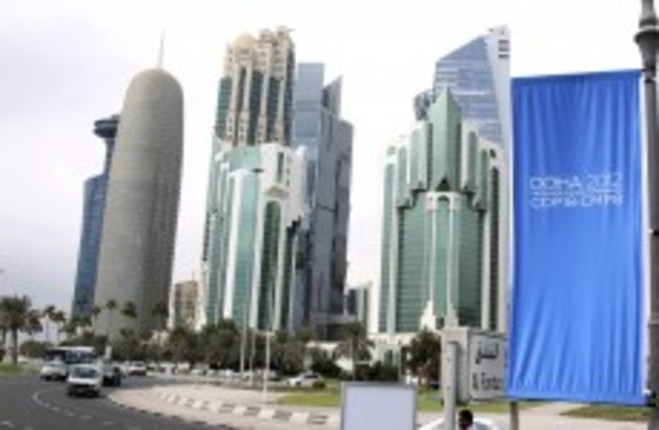
Conference flags are displayed ahead of the Doha Climate Change Conference, in Doha, Qatar.
Image: Osama Faisal/AP

AN INTERNATIONAL CONFERENCE is beginning in Doha, Qatar today – with hopes that the summit could see progression on a deal to replace the only binding treaty on international emissions which will begin to expire this year.

The 2012 UN Climate Change Conference will aim to see agreement on a deal to replace the Kyoto Protocol, which was agreed in 1997 and came into effect in 2005.

The Kyoto Protocol, as an attachment to the UN Framework Convention on Climate Change, is the only legally enforceable agreement on international carbon emissions – but its first round of emissions limits will expire at the end of this year.

No replacement deal has yet been agreed – with little progress on a new deal at previous UN summits in Bali, Poznan, Copenhagen, Mexico and Johannesburg.

Delegates hope that this year’s conference may provide more concrete progress, however, with Canada having withdrawn from Kyoto at the end of last year and with the United States – the highest-profile non-signatory – having borne the brunt of several climate-related disasters since Kyoto was agreed.

Delegates hope to work out a 36-month programme to arrive at a new, global climate deal that must enter into force by 2020, when the last of Kyoto’s provisions expire.

Opening the conference, South African foreign minister Maite Nkoana-Mashabane said climate change was the world’s “most serious sustainable environment challenge” and that politicians need to act now.

Negotiators at the conference, which will continue for the next two weeks, will be joined by cabinet ministers from over 100 countries for the last days of the summit.

Oxfam has likened the expiry of the 2012 targets as being “a climate ‘fiscal cliff’”, with no certainty about the funding that could be provided by developed countries on how to adapt to climate change.

Read: Report says climate change impacting negatively on human health

Gallery: These islands are first to be powered by solar energy alone

Read next:

Comments (7 Comments)

  • Australia are without doubt one of the biggest global polluters, but they recently signed up to the second phase of Kyoto and introduced a carbon tax this year.

    Reply
  • I know I’m in the minority on this issue, but i would like to see the planet destroyed.

    Reply
  • The protocol is so important and it’s getting little media coverage, just looking at our climate the couple of years we had freaky flooding and freezing temps away worse than the averages. America, Canada ,Australian and most importantly china are terrible polluters and have large fossil fuel resources are fecking it all up for EU states who are by far leading the battle against climate change.

    Reply
  • This is not going to be a popular comment… But here goes…
    Environmentalists are dead set against the 2 technologies that could really make a difference to global warming.

    1. Fracking: the US CO2 emissions are down to 1990 levels, partly due to the recession, but mostly due to replacing coal power plants with electricity generated due to natural gas produced from fracking. Fracking is noy perfect, but its far far better than coal, there is a lot of propaganda flying around, such as the extremely biased documentary, Gasland,

    2. Nuclear power: the german decision to abandon nuclear power is not based on logic or even science, its based on emotional fear of nuclear energy and politics. germany are already gearing up burn lots more coal to replace their low carbon nuclear reactors, ironically coal releases far more radiation due to Uranium and thorium deposits in coal going up the chimney.

    Im sick of people telling me that wind/renewable energy is free, it is in fact very expensive and has a questionable impact on climate change since it must be backed up 100% with coal/gas power plants.

    We need to be pragmatic, pick the lesser of two evils, fracking and nuclear in the medium term, thorium and fusion in the long term.

    Reply
    • Also, Biofuels have turned out to be very negative, driving up world food prices while having little to no effect on carbon emissions, many environmental groups now accept this, scientists warned of this early on but were shouted down as being in the pocket of the oil industry.
      im convinced that 10 years from now people will come to a similar conclusion about wind farms.
      We need to make our decisions based on science and logic, if anyone tries to sway you with emotion it usually means they dont have facts to back up their argument.

      Reply
  • I d like to know if the targets set by the Kyoto protocol been reached in the first place by the signatories countries ? If china , USA , Canada , Australia , India aren’t on board I think it’s a bit pointless has they’re some of the biggest polluters on the planet !

    Reply
  • The terrible truth is that the most powerful nations who have and are causing man made climate change are at the beck and call of the global fossil fuel and nuclear industries. Look at recent developments in the UK as they move back to coal mining shale gas nuclear. Same in USA, climate change was a toxic phrase. The European Environment Agency report on climate change had this to say about Ireland.

    Key findings include -

    While rainfall is decreasing in southern regions, it is increasing in Ireland and the rest of northern Europe.
    The last decade was the warmest on record in Ireland, with land temperature 1.3°C warmer than the pre-industrial average.
    We could be 2.5-4°C warmer in the later part of the 21st Century, compared to the 1961-1990 average.
    Climate change is projected to increase river flooding as temperatures rises intensify the water cycle.
    Sea levels are rising, raising the risk of coastal flooding during storms.
    Global average sea levels have risen by 1.7mm a year in the 20th Century and by 3mm a year in recent decades. It is likely that 21st Century sea-level rise will be greater than during the 20th Century.

    Reply

Add New Comment