We need your help now

Support from readers like you keeps The Journal open.

You are visiting us because we have something you value. Independent, unbiased news that tells the truth. Advertising revenue goes some way to support our mission, but this year it has not been enough.

If you've seen value in our reporting, please contribute what you can, so we can continue to produce accurate and meaningful journalism. For everyone who needs it.

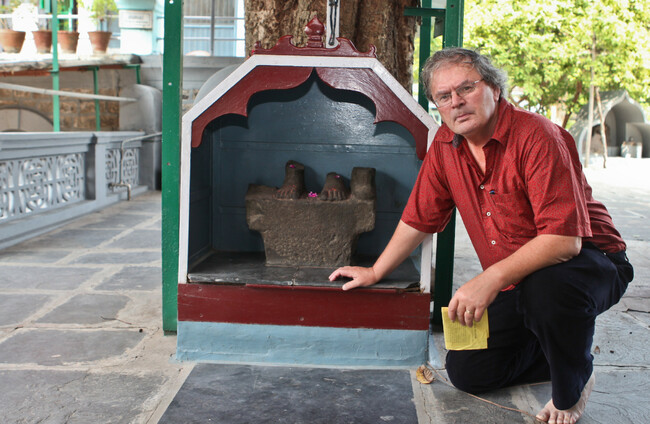
Gabriel Rosenstock, 1949-2026 RTE

President pays tribute to 'extraordinary career' of Irish language poet, Gabriel Rosenstock

The death occurred on the same day a programme featuring conversations between the poet and his son about life’s big questions is to be broadcast on RTÉ RnaG.

(Seo alt ónár bhfoireann Gaeltachta – is féidir an bunleagan as Gaeilge a léamh anseo.)

THE PRESIDENT OF Ireland, Catherine Connolly, has paid tribute to what she described as the extraordinary career of Gabriel Rosenstock, the Irish language poet and translator whose death was announced earlier today. 

Rosenstock, who was 76 years of age, had been ill for some time. A programme about his cancer diary — in which he sought to make sense of his illness and grapple with the great questions of life — was broadcast this evening on RTÉ Raidió na Gaeltachta.

He was originally from Kilfinane in County Limerick but spent most of his life in Dublin, where he worked with the Irish language publisher An Gúm.

Over the course of his life he published more than 400 books, the majority of them in Irish, among them works of poetry, translations, novels, prose and spiritual essays. He had a particular affinity for the Japanese form of the haiku, and his seventeen-syllable verses were published in various Irish language publications, including the daily Irish language newspaper Lá/Lá Nua.

He is survived by his wife Eithne, two daughters, Saffron and Héilean, and a son, Tristan. Another daughter, Éabha, passed away around this time four years ago.

He attended University College Cork in the early 1970s, where he met other noted Irish language poets — Michael Davitt, Liam Ó Muirthille and Nuala Ní Dhomhnaill. The four of them came under the influence of the Irish language professor and poet Seán Ó Tuama. Together they published the literary journal INNTÍ, which sent shockwaves through Irish language literary life and is now recognised as a catalyst for a new generation of writers and poets in Irish.

President Catherine Connolly paid tribute to Rosenstock this evening and his “particularly special contribution to the Irish language”. She praised his “broad body of his own work” and his “remarkably diverse set of translations, through which he brought so many of the great writers of the world to the Irish language”.

“His writing has been enjoyed, and will continue to be enjoyed, by people of all ages, while his translations will continue to ensure an engagement between our language and so many of the other cultures of the world” she said.

She expressed condolences to the late poet’s family, his colleagues in Aosdána, and “to his many readers and admirers around the world” and said he will be “deeply missed”.

In her tribute, President Connolly made a particular reference to the poet’s contribution as a translator. 

She said he left “not only a broad body of his own work, but also a remarkably diverse set of translations, through which he brought so many of the great writers of the world to the Irish language.”

Among those whose works he translated were  Seamus Heaney, Georg Trakl, Günter Grass, Peter Huchel, K. Satchidanandan, Rabindranath Tagore, Hilde Domin qand Samuel Beckett.

He also provided translations for the Irish language literary festival, Imram, of songs by Taylor Swift, Leonard Cohen, Bob Dylan agus Joni Mitchell.

He was a member of Aosdána and served as chairman of Poetry Ireland. He was also a Lineage Holder of Celtic Buddhism

This evening a programme made by Gabriel Rosenstock with his son Tristan — a producer with RTÉ Raidió na Gaeltachta — was broadcast on the station Gabriel Rosenstock — An Fear Nár Saolaíodh Riamh (The Man Who Was Never Born) was recorded as a series of conversations between the two, with the father seeking to make sense of the illness that was afflicting him and reflecting on questions such as what happens to us after death.

Rosenstock explained to his son that he was deeply moved by the line from the hymn  set to music by Seán Ó Riada, Ag Críost an Síol — ‘ní críoch ach ath-fhás’ (not an end but a regrowth) — and they drew inspiration for the title of the programme from the writings of the Indian philosopher Osho, who said ‘never born, never died’.

The Journal’s Gaeltacht initiative is supported by the Local Democracy Reporting Scheme

Readers like you are keeping these stories free for everyone...
A mix of advertising and supporting contributions helps keep paywalls away from valuable information like this article. Over 5,000 readers like you have already stepped up and support us with a monthly payment or a once-off donation.

Close
7 Comments
This is YOUR comments community. Stay civil, stay constructive, stay on topic. Please familiarise yourself with our comments policy here before taking part.
Leave a Comment
    Submit a report
    Please help us understand how this comment violates our community guidelines.
    Thank you for the feedback
    Your feedback has been sent to our team for review.

    Leave a commentcancel

     
    JournalTv
    News in 60 seconds