Sign in. It’s quick, free and it’s up to you.
An account is an optional way to support the work we do. Find out more.
Sign in. It’s quick, free and it’s up to you.
An account is an optional way to support the work we do. Find out more.
THE NEWLY-CREATED working group on direct provision and the asylum process has been criticised for not including any current asylum seekers.
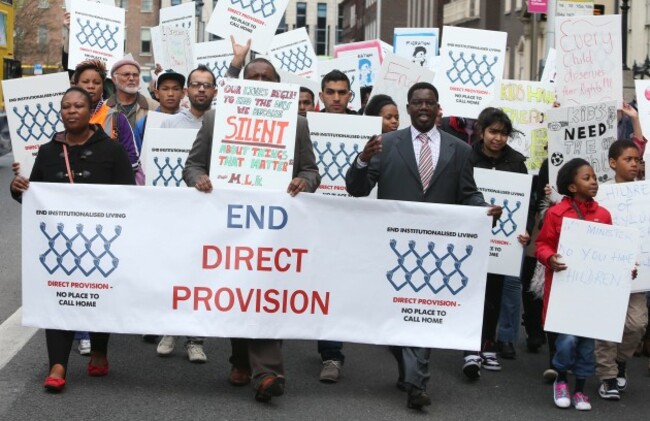
Anti-deportation Ireland (ADI), an activist group which campaigns for the abolition of the direct provision system, has condemned the formation of the working group, whose members were announced on Monday.
The very people whose lives will be affected by the findings of the Working Group, asylum seekers living within the direct provision system, must be directly and well represented on the Group.
“For the working group to have true legitimacy, asylum seekers from across the 34 centres must have direct representation,” said Joe Moore from ADI.
Justice Minister Frances Fitzgerald and Junior Minister Aodhán Ó’Ríordáin set up the group “to report to Government on improvements to the protection process, including Direct Provision and supports to asylum seekers.”
The group, chaired by retired High Court Judge Bryan McMahon, includes representatives from the Irish Refugee Council, Jesuit Refugee Service, NASC, as well as Reuben Hambakachere, a former asylum seeker representing the Irish Refugee Council’s Core Group of Asylum Seekers and Refugees.
It does not include any current residents of direct provision centres.
‘It’s not a fair share, but it’s a step in the right direction’
Irish Refugee Council CEO Sue Conlan said she would have preferred to see stronger representation of current asylum seekers in the group, of which she is a member.
“Of course it’s not a fair share, but it is a step in the right direction,” she told TheJournal.ie this afternoon.
Conlan noted that Hambakachere could make a particularly valuable contribution to the group, given that he and his family had been in direct provision for eight years, before completing the transition out of that system, some six months ago.
A spokesperson for NASC, whose CEO Fiona Finn was appointed to the working group, told TheJournal.ie the organisation was “disappointed that more of an effort wasn’t made” to include better representation of current asylum-seekers.
In a statement yesterday, Finn expressed hesitation about the prospects of the group:
Although we are disappointed that the terms of reference for the Working Group seem quite narrow, we believe it is better to be at the table and try to effect change than to not take part.
Another working group member, Eugene Quinn from the Limerick-based Jesuit Refugee Service, told TheJournal.ie “it would always be better to have stronger representation from asylum-seekers.”
Sophie Magennis from the Irish office of the UN High Commission for Refugees (UNHCR) said only that she welcomed the inclusion of Hambakachere.
We welcome the inclusion of key NGOs in the area, including a representative of an NGO made up of people who are currently in or have gone through the asylum process.
A spokesperson for the Department of Justice told TheJournal.ie Reuben Hambakachere “has the advantage of being able to speak about the experience of transition from direct provision to life in the community and all that that entails.”
In establishing the Working Group, a key concern was to ensure the inclusion of a representative of an NGO made up of people who are currently in or have gone through the asylum process.
The Irish Refugee Council Core Group was asked to nominate someone, and chose Hambakachere, the spokesperson added.
The Working Group will later include an as yet undefined number of “representatives from relevant government departments,” according to the Justice Department.
However, here’s a list of its 11 members:
The Department of Justice did not respond to enquiries by TheJournal.ie, in time for publication.

To embed this post, copy the code below on your site
















have your say