TheJournal.ie uses cookies. By continuing to browse this site you are agreeing to our use of cookies. Click here to find out more »
Dublin: 9 °C Saturday 18 May, 2013

France’s face veil ban to take effect next month

The banning of some religious dress in European countries have drawn criticism by human rights groups – who say the laws discriminate against Muslims and impede an individual’s freedom of expression.

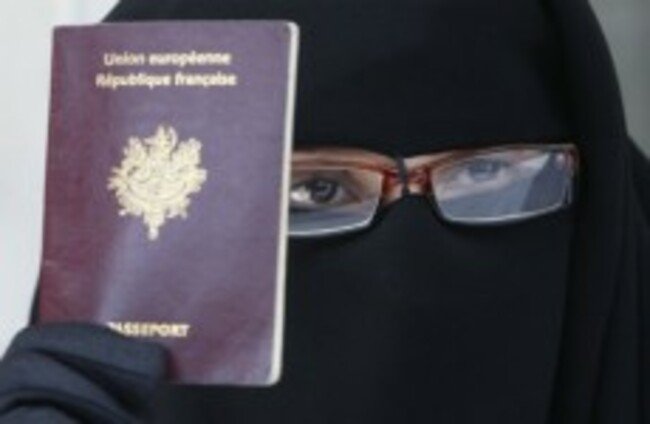
French woman Najat shows her European passport, as dressed in a niqab.
Image: Remy de la Mauviniere/AP/Press Association Images.

A NEW FRENCH law banning full-face veils in public places will take effect from next month – a move widely accepted as targeting the country’s Muslim population.

The law follows France’s so-called burqa ban, which outlawed the wearing of the full-length garment worn by women in some Islamic traditions. From 11 April, the full-face veil will be illegal to wear in public places – on the street, in the supermarket, in classrooms, in museums, on buses and in parks. The only exceptions to a woman wearing the niqab in public will be if she is travelling in a private car or worshipping in a religious place.

French President Nicolas Sarkozy has been accused of trying to secure the vote of the far-right with the new legislation. Critics have pointed out that tiny minority of women in France wear full niqab – Muslim groups have estimated that just a few hundred people, in a country with a population of five million, wear the garment.

Those falling foul of the new law will face fines of €150 and be forced to attend a citizenship class, which will outline the ‘secular values’ of the republic. (Although, confusingly, Sarkozy yesterday gave a speech praising the “Christian heritage of France”, reports the Guardian.)

Those who are proved to have forced a woman to wear a veil can be fined €30,000 and spend a year in prison.

Meanwhile, some local authorities have been forced to step in to stop “pork and wine aperitifs” evenings proposed by some on the extreme right, which were to be deliberately held beside mosques.

Promoting gender equality

However, the French authorities are insisting that the law is not intended to stigmatise Muslims but to promote gender equality. As such, the wording of the legislation – which does not specify that the niqab is outlawed – has proved tricky. As a “full-face covering” naturally includes motorcycle helmets and some sports equipment, exemptions for these items have had to be included in subsequent drafts.

Last year, the French government announced: “Given the damage it produces on those rules which allow the life in community, ensure the dignity of the person and equality between sexes, this practice, even if it is voluntary, cannot be tolerated in any public place,” reports CNN.

Laws that ban garments worn by some Muslims have been criticised by humans rights groups in various European countries. Last year, Belgium banned the wearing of the niqab in public and was chastised by Amnesty International. “A general ban on the wearing of full face veils would violate the rights to freedom of expression and religion of those women who choose to express their identity or beliefs in this way,” said Claudio Cordone, Amnesty International’s Interim Secretary General.

“At the same time the Belgian authorities must make sure that all women who wear the full veil do so without coercion, harassment and discrimination,” she added.

See this Irish Times report for some perspectives of Muslim women in Ireland.

Read next:

Comments (3 Comments)

  • The reasoning put forward by Hezbollah in Lebanon some months ago and Hamas in their current Virtue drive in Gaza align with the Iran clerics claim women not dressing properly cause earthquakes and are responsible for the inappropriate behavior men subject them to including rape.

    These statements reinforce the reality the burqa is not a freely worn garment given the clear stigma Muslim women, who do not wear the burqa or even the veil, are subject to in Muslim communities.

    If it is such a free choice how is it Muslim men are not covered in a ton of black fabric or cotton veils to cover their masculinity? Are Muslim men not sexual beings?

    It is only when Muslim men are compelled to wear the burqa and veils that there will be equality in Islam between men and women, along with changes to divorce settlements. Inheritance and equality under law for the same crimes, and Muslim men can be beaten by women and children as Muslim men have the right to do so to women and children now.

    The burqa is as much a political statement as a naked woman walking in the streets to advocate public nudity as a right which should be accepted by the rest of society. One of subservience to men’s dogma not independence.

    Nudism is a cultural and political movement advocating and defending social nudity in private and in public. It may also refer to a lifestyle based on personal, family and/or social nudism.

    Society in general has decided public nudism can be very confronting, inappropriate, and even regarded as obscene by some. Although nudism is often practiced in a persons home or garden, either alone or with members of the family public and in restricted venues public nudity is a behavior which society in general have deemed should be restricted and subject to judicial penalty.

    The burqa is much more of an obscenity than nudity. For where nudism seeks to expand the societal bounds and diminish prejudice the burqa politically advocates a denigrating, subservient role in society for women.

    The burqa reinforces the notion women are not only to blame for men’s behavior towards them in regards sexual assaults but also women’s aspirations should be necessarily be different and subservient to a man’s definition of what a woman’s life should be.

    The public wearing of the burqa is a categorical political act which seeks to advance the notion of the acceptance of the subservience and restriction of women’s opportunities in life relative to men which is absolutely obscene and must therefore be subject to judicial penalty.

    Everything we do is political. A woman deciding to wear shorts given human history is a political statement in itself. For it can be deemed as simply a relatively freely decided fashion statement. The Burqa is an antitheist of this and very much a political statement of subjugation and in no way can be regarded as a fashion statement or a modern principle. No matter how many times and subtle colorful variations get dragged down the catwalk.

    Reply
  • Barry R. 04/03/11 #

    Maybe this is what happens when we try to shoehorn different cultures together with nothing in common, all in the name of ….multiculturalism ??…community ???….global family ??
    I’m sure the liberals amongst us here will quickly wrestle me to the ground and tut-tut me with accusations of racism !
    Before you do I would only ask that you focus on the message not the messenger.

    Reply
  • Barry – you don’t say what “this” is but I’m guessing you don’t mean that western governments, in times of economic stress, make stupid decisions to reassure the natives that they’re the best and these other cultures are suspect – however that’s exactly what “this” is.

    With regard to women who *want* to wear veils, they are now being oppressed by the state having not previously been oppressed by anyone else. With regard to women who were forced to wear the veil by ignorant male relatives or partners, those males will not suddenly become paragons of tolerance but instead react by forcing these women to stay out of sight in their homes.

    Dumbest solution ever.

    Reply

Add New Comment