We need your help now

Support from readers like you keeps The Journal open.

You are visiting us because we have something you value. Independent, unbiased news that tells the truth. Advertising revenue goes some way to support our mission, but this year it has not been enough.

If you've seen value in our reporting, please contribute what you can, so we can continue to produce accurate and meaningful journalism. For everyone who needs it.

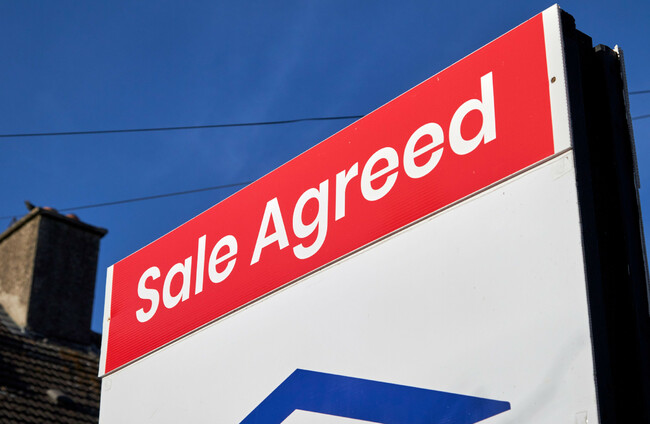
A 'Sale Agreed' sign outside a house in Co Dublin in January. Alamy Stock Photo

Group of estate agents believe housing prices will soon level off, says SCSI survey

Supply was flagged as the main factor driving up price inflation by just over half of the 175 agents surveyed.

SOARING HOUSE PRICES have continued, and appear set to continue scaling upwards – but a number of estate agents believe housing prices will soon level off.

That’s according to a new survey carried out by the Society of Chartered Surveyors Ireland (SCSI). The results of the SCSI’s survey are based on the responses of 175 estate agents.

The report states that the estate agents expect national property prices to increase by an average of 5% over the next year – and close to 90% of estate agents believe that current residential property prices are “expensive or very expensive” at present.

Six in ten agents believe that housing prices are soon to level off after a further climb, while a further 16% believe that prices have already peaked.

Last month, a report from property website Daft found that house price inflation has reached a ten-year-high.

Prices increased nationally by 3% during the second quarter of this year, with the typically listed property cost reaching €357,851. They are almost 13% higher than last year and 40% higher than pre-covid levels, the Daft report stated.

In today’s SCSI report, seven in ten of estate agents surveyed reported low stock levels, and over half say the lack of supply is the main driver of price inflation.

President of the SCSI, Gerard O’Toole, said the report indicates mounting concern over the supply shortage with a recent slowdown in home construction.

He said that just over half of its agents (51%) in the survey cite lack of supply as the main factor driving up price inflation. A year ago it was 46%, and in 2023 it was 35%.

“We can really see the impact the lack of supply is having on house prices. At the same time, 70% of agents are reporting low stock levels of new and second-hand homes, again underscoring the persistent challenge of limited supply in the market.

“Over the past five years more than half of agents have consistently highlighted low stock levels, stressing that constrained supply remains a fundamental issue impacting the market.”

He said that the ESRI’s forecasting of a significantly lesser number of homes built this year than the government’s target of 41,000 shows there is an “urgent need to address infrastructural shortcomings”, as well as a need for the Housing Activation Office to become fully operational as soon as possible.

The Housing Activation Office was established by Housing Minister James Brown in April, with its goal being to identify “barriers and actions required to speed up the delivery of housing”. It is to focus on infrastructure needed at a local level to support housing delivery on multiple sites.

O’Toole continued, “Eighty-eight percent of agents believe property prices are expensive or very expensive, the highest figure we’ve recorded. We have had 12 years of continuous price growth and the level of increases we have seen in recent years is just not sustainable.

“Looking at where we are in the market cycle, 78% of agents believe prices will level off soon or have already peaked. In the medium to long term, the only way to ensure prices stabilise is to ramp up supply.” 

The report found that affordability challenges have intensified for first time buyers around the country.

As an example, it included the scenario of a couple comprised of a garda and a nurse making a combined income of €107,000 with a 10% deposit having availed of the Help to Buy Scheme along with their savings seeking to buy “an averagely priced new 3 bed semi-d” in five locations: Cork, Meath, Galway, Wicklow, and Kildare.

“In the two most expensive counties, Wicklow and Kildare, the couple will face shortfalls of €65,000 and €22,000 respectively for that house type,” the report said.

It said that affordability would be met in Cork, and that the couple in question “should be able to overcome” the gap in Meath and Galway with additional savings.

“These findings highlight the persistent structural barrier which exists to homeownership, even for dual-income households in stable public sector roles,” O’Toole said, adding that it underscores concerns around housing sustainability, increasing commuter burdens and the potential impact on quality of life.

“In addition, there are thousands of people on lower salaries who will not be able to buy and will require support.”

Readers like you are keeping these stories free for everyone...
A mix of advertising and supporting contributions helps keep paywalls away from valuable information like this article. Over 5,000 readers like you have already stepped up and support us with a monthly payment or a once-off donation.

View 36 comments
Close
36 Comments
This is YOUR comments community. Stay civil, stay constructive, stay on topic. Please familiarise yourself with our comments policy here before taking part.
Leave a Comment
    Submit a report
    Please help us understand how this comment violates our community guidelines.
    Thank you for the feedback
    Your feedback has been sent to our team for review.

    Leave a commentcancel

     
    JournalTv
    News in 60 seconds