We need your help now

Support from readers like you keeps The Journal open.

You are visiting us because we have something you value. Independent, unbiased news that tells the truth. Advertising revenue goes some way to support our mission, but this year it has not been enough.

If you've seen value in our reporting, please contribute what you can, so we can continue to produce accurate and meaningful journalism. For everyone who needs it.

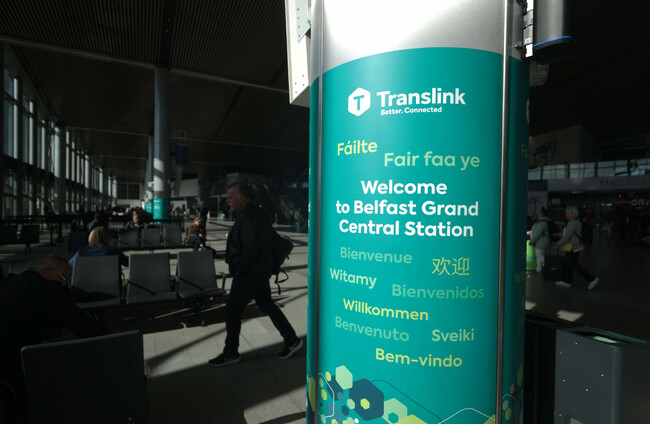
The controversy over dual language signage in Belfast's Grand Central Station will be among the matters in the in-tray of the new Irish Language Commissioner. Alamy Stock Photo

Grand Central Station dual language row on top of North's new Irish Commissioner in-tray

Many challenges await the new Irish language commissioner who has finally been appointed in Northern Ireland.

(Seo alt ónár bhfoireann nua Gaeltachta.  Is féidir an bunleagan as Gaeilge a léamh anseo.)

THE newly appointed Irish Language Commissioner for Northern Ireland is not yet behind his desk but his inbox is already overflowing with language controversies, not least the dispute over the bilingual signage ordered for the new public transport station in central Belfast.

It took more than five years since Sinn Féin and the DUP agreed  in the New Decade New Approach deal  to have an Irish Language Commissionerand an equivalent for Ulster-Scots and British Culture in the north and a further seven months for the recruitment process.

But, finally, a written statement issued on the Northern Ireland Executive website announced that Pól Deeds, deputy chief executive of Foras na Gaeilge, and Lee Reynolds, a DUP councillor and activist in Ulster-Scots organisations, had been officially appointed as Irish Language and Ulster-Scots/British Culture Commissioners.

The names of the two have been in the public domain for two months after it was revealed in August that they had come through the recruitment process that began in March, but until this week there had been no official statement about the process from the Executive other than that the process was “nearing completion”.

In the statement issued on Tuesday, there were no individual quotes attributed to Sinn Féin’s First Minister Michelle O’Neill or Deputy First Minister Emma Little-Pengelly (DUP), other than a statement attributed to them both collectively

We wish them every success in their roles and look forward to working with them.

This contrasts  with the enthusiastic welcome given by Conradh na Gaeilge to Deeds’ appointment as Irish Language Commissioner.

According to Ciarán Mac Giolla Bhéin, president of the language advocacy organisation, the appointment is a “historic step forward” although his statement recognises that the legislation under which the Irish Language Commissioner will operate is only “the beginning of a journey”.

For the first time, a strong voice for the Irish language will be embedded at the heart of the state system.

“We said clearly at the time that this new Act is not perfect, that it is not in any way strong enough, that it does not fulfil the Act promised in 2006 according to the Welsh model and that we will have to fight every day to ensure our language rights through the current mechanism.”

Among the issues that will face Deeds when he begins his five-year role on 13 November will be the dispute over bilingual signage at Belfast’s main bus and train station, Grand Central Station.

Unionist activist Jamie Bryson is seeking a judicial review of the decision by Sinn Féin Infrastructure Minister Liz Kimmins to have signage in both Irish and English at the station. At a hearing last month, the judge recommended that the matter be referred to the new Commissioner, who had not yet been officially announced but whose identity was in the public domain at that point.

There are many other issues that the new Commissioner will hopefully be able to address and they will no doubt be closely watched by parties on all sides.

The salary paid to the Commissioners and the Director is £88,268 (€100,000).

Spokespeople for Sinn Féin and the SDLP welcomed the appointments but there was no statement published on the DUP website about the decision announced yesterday.

Sinn Féin chairman Declan Kearney said the appointment of the Irish Language Commissioner was a ‘major step forward’ for Irish speakers in the north.

“The Commissioner will play a leading role in improving and protecting the language across our public services and in everyday life.”

There was no mention of the Ulster-Scots and British Commissioner in the Sinn Féin spokesperson’s statement.

The appointments were an opportunity to move on from the controversy surrounding these issues, by encouraging respect and mutual understanding for different traditions, said the SDLP’s Irish language spokesperson, Patsy McGlone, although she questioned the experience of members on the board of the Office of Equality and Cultural Expression on language issues.

“Everyone has the right to celebrate their culture and it is deeply disappointing that these issues have been treated as a political football for this so often in the past.”

In a statement from the UUP, the party’s deputy leader Robbie Butler said that building trust – not division – should be the goal of the Language Commissioners. Sinn Féin’s Chain Butler said that the discussions on this issue were between the two major parties and, he said, he did not have the support of many others.

Language promotion can be positive but it should not be forced on communities that do not need it.

The Traditional Unionist Voice extended a hostile reception to the appointments. According to a statement from the MLA Timothy Gaston, it was the duty of the DUP to “stop any attempt by their Irish Language Commissioner to intervene in the matter of Irish language signage in the Central Station or to issue guidance that would be in line with the policy of the Irish Language League”.

The new Irish Language Commissioner certainly faces a challenge as he will need to liaise with the Executive Office on contentious issues, given the length it took the Executive to complete the recruitment process

 The Journal’s Gaeltacht initiative is supported by the Local Democracy Reporting Scheme

Readers like you are keeping these stories free for everyone...
A mix of advertising and supporting contributions helps keep paywalls away from valuable information like this article. Over 5,000 readers like you have already stepped up and support us with a monthly payment or a once-off donation.

Close
Comments
This is YOUR comments community. Stay civil, stay constructive, stay on topic. Please familiarise yourself with our comments policy here before taking part.
Leave a Comment
    Submit a report
    Please help us understand how this comment violates our community guidelines.
    Thank you for the feedback
    Your feedback has been sent to our team for review.

    Leave a commentcancel

     
    JournalTv
    News in 60 seconds