TheJournal.ie uses cookies. By continuing to browse this site you are agreeing to our use of cookies. Click here to find out more »
Dublin: 19 °C Wednesday 19 June, 2013

Column: Dolphin’s Barn residents dreading a damp Christmas

Authorities have broken up the Dolphin House community – but stalled regeneration of their homes and left them subsisting in horrible living conditions, write Eoin Lynch.

Eoin Lynch

WITH THE COLLAPSE of the public/private partnership in 2009 between Dublin City Council and several private developers, residents of Dublin’s Dolphin’s Barn have been left in living conditions far worse than those previous to the proposed regeneration of the area.

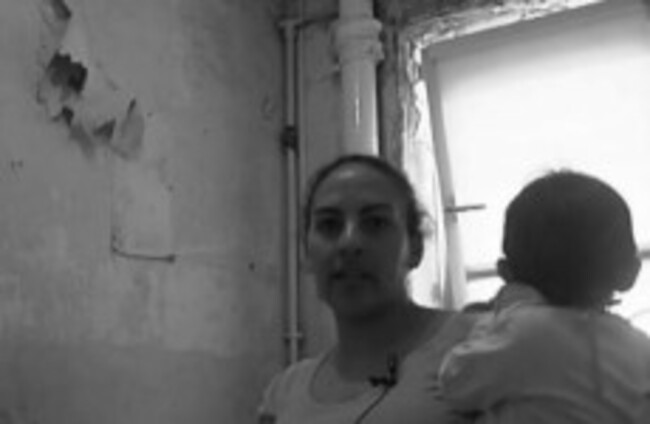
For over 20 years Dolphin House has been troubled by severe damp and in more recent years by raw sewage rising up through sinks, baths, toilets and also into washing machines. The effect these conditions are having on the living standards and health of residents is highlighted in a recent survey that found 45 per cent of adults and 42 per cent of children, either has suffered, or is suffering from some form of pulmonary disease.

Sabina Byrne, a mother of four and long-term resident of Dolphin House, describes how her youngest daughter spent her first birthday in hospital with pneumonia and bronchitis and has now developed asthma, a condition which she now shares with her two older brothers.

Negotiations on the proposed regeneration began in 2005 between the Council and local community groups, with the intention of developing a plan that would not only see the complex rebuilt to modern standards, but also to provide education and employment in the area, address social issues and create initiatives around family support.

However, public-private partnerships, the intended method of the Council to regenerate Dolphin’s Barn and 14 other similar areas in Dublin city centre, are essentially commercial ventures whereby the Council invites a private developer to build units on public land, with the developer taking a certain number of these units as payment, and the Council taking the rest for local authority usage. In other words it is property speculation.

In many areas, only the first stage of regeneration – de-tenanting – has been undertaken

Dolphin’s Barn is made up of 436 local authority units, 392 of these make up Dolphin House, with the remaining 44 units making up Dolphin Park which is a block specifically for elderly members of the community. The public-private partnership would have seen 600 housing, commercial and community units being built, with 300 units going to the developers and 300 units to the Council.

The Council’s approach to regeneration is surmised by their mantra of: De-tenant, Destroy and Develop. Had this cycle been completed, it is very likely that the regeneration would have been hailed a success, as is the case with the Fatima Mansions complex. However, Fatima is currently the only area where the process has been completed. In many areas only the first stage, that of de-tenanting, has been undertaken. This has left areas such as O’Devaney Gardens with a community of 98 families where once there were 276 families or St Teresa’s Gardens where there were 340 occupied flats and now 120 of these are unoccupied.

Not only has this mismanagement on the behalf of Dublin City Council broken up communities – the exact opposite of what the regeneration of an area is intended to do – it has also meant that many flats are left empty, while neighbouring flats are occupied. This adds to corrosive damp in the flats, where insufficient insulation has meant that the problem is already widespread.

In late 2009, under the guidance of the Community Action Network (CAN) and community workers, residents of Dolphin’s Barn set up the Rialto Rights in Action Group, and organisation that is taking a Human Rights approach to the community’s plight. What residents are claiming is that the Council and the Irish government are in breach of the International Convention on Economic, Social and Cultural Rights (ICESCR), a convention that Ireland signed up to under the Labour/Fine Gael coalition in 1973. What this means, is that under international law the state is responsible for providing adequate housing that safeguards against damp and health threats, and also to provide and maintain a functioning sewage system.

The Human Rights approach uses a system called the Principle of Progressive Realisation. This system has allowed the residents to monitor and evaluate the States compliance with Human Rights obligations through the tracking of both qualitative and quantitative indicators over a sustained period of time. The evidence gathered from these indicators shows that the State is not fulfilling its responsibility.

This video shows the conditions in which some residents are living:


YouTube video via DCTV/Dolphin House Community Project/CAN.

Eoin Lynch is a writer and film-maker with Tengger Productions.

  • Share on Facebook
  • Email this article
  •  

Read next:

Comments (15 Comments)

  • I feel sick even thinking about that. Even a trace of that black mould in my apartment, and I notice what it does to my health. The thought of living in a house where it is covered in it is beyond intolerable. I’d rather live in a tent – no joke.

    Reply
  • I suffer from damp in an apartment that cost me €200,000, the difference is I pay €1000 a month mortgage……. I know, I know, I can go to hell

    Reply
  • 21st century tenements.

    Reply
  • I understand that these people are proud and community orientated but for the love of Jehovah can the state not buy up these f*****g eye sore of “ghost estates” and relocate these TENANTS. I am sure they would live a new home and they will at least know here neighbors.

    Reply
  • I worked their for a couple of years. The living conditions are disgraceful in dome of the flats. We spent billions on new houses and apartments during the boom years, yet there were people in Dolphin house living in dwellings that were officially sub standard and not fit for human dwelling.

    Reply
  • Thanks Eoin. Sadly the most recent news begs belief based on what you have documented in your video. Last Friday three community development projects received letters from the Dept of Environment suspending funding for 3 part time posts effective 31st December next (with no explanation given). These posts are based in St Michaels Estate, Inchciore (a failedd PPP site) the former Fatima Mansions and Dolphin House Rialto. The work carried out by each of the three community development workers is crucial in creating health programmes, managing the human rights approach and creating safe and sustainable regeneration in each estate.

    These positions have been funded for over 13 years through the Local Drugs Task Force strategy and 50% of the funding has been mainstreamed through the Department of the Environment since 2001.

    In support and protest you could do the following today:

    Write a letter protesting against the posts removal to:
    Minister Phil Hogan and Junior Minister Roisin Shorthall; 5 Dublin South Central TDs and your own TDs requesting the reinstatement of the mainstream funding for these posts from the Department of the Environment, Community and Local Government. Email addresses can be found here: http://contact.ie/sites/default/files/img./TDs-Email-Addresses.txt .

    Reply
  • Eric 20/12/11 #

    just goes to show you that Dublin city council are unable and unwilling to follow through and execute on anything , except maybe cutting your water off during big freezes, charging you for bin lifts that never happened, and building monstrous buildings on top of historic viking sites . they are a complete joke of an organisation and the epitome of the wasteful, over subscribed , inefficient and unaccountable public sector body.

    Reply
  • Just watched the video…that is inhumane…is it a case of lack of heating too? also wondering what is that black sludge?

    Reply
    • Hi Laura, The black sludge is probably related to the dreadful sewage problems some of the homes also had in the recent past. Sewage was backing up into people’s houses through their drains and flooding them. Pretty horrific.

      Reply
  • It isn’t only dolphins barn. The council during the boom years went in to a lot of inner city complexes and made cosmetic changes to make them look more modern but on the inside we still had the same problems with black mould on the walls and faulty wiring.

    Reply
  • show me one place in the world where council housing works …. there are way more negatives than pros

    Reply
  • They should set up a scheme where some of the flats are sold, there has to be a certain amount of people who’d like to live in the area. I’d move in like a flash.

    Reply
  • “under international law the state is responsible for providing adequate housing that safeguards against damp and health threats, and also to provide and maintain a functioning sewage system”

    So if my house is damp I can sue the State? How about when it rains? :-)

    Reply
    • Hi Giovanni,

      Article 11 of the ICESCR states that:

      The States Parties to the present Covenant recognize the right of everyone to an adequate standard of living for himself and his family, including adequate food, clothing and housing, and to the continuous improvement of living conditions. The States Parties will take appropriate steps to ensure the realization of this right, recognizing to this effect the essential importance of international co-operation based on free consent.

      The people of Dolphin House have recorded their living conditions over a sustained period of time. Their recordings show that the State is not providing “an adequate standard of living”.

      The Covenant is legally binding on those countries that have ratified it, Ireland ratified in 1973.
      If you rent a house or flat the landlord must ensure that the building meets with certain standards – if he or she does not fulfil this obligation then your next step would be to contact your local County Council who will instruct the landlord to fulfil their obligation. In the case of people living in local authority housing they are in a catch 22 because Dublin County Council is the landlord, and that is what makes the above situation in Dolphin House so frustrating.

      I hope this clears things up for you.

      Eoin

      Reply

Add New Comment