TheJournal.ie uses cookies. By continuing to browse this site you are agreeing to our use of cookies. Click here to find out more »
Dublin: 11 °C Saturday 25 May, 2013

Column: Fiscal compact? Time to send Merkozy back to Economics 101

The EU fiscal treaty shows a level of economic illiteracy that would embarrass most college students, writes Ronan Lyons.

Ronan Lyons

THIS YEAR, I’M teaching first year undergraduates at Trinity. I’ve a gang of about 400 and they’re mostly students not interested in studying economics after this course. My job is to try and make them economically literate as they head off into the world. Part of the course is about macroeconomics in their everyday life: how the jobs market works, how the housing market works, that kind of thing.

But the first part of the course is about giving them the grounding to understand the bulk of major headlines at the moment. Unemployment, negative equity, emigration, bailouts, quantitative easing, bondholders, recessions and business cycles… it is hard these days to be an educated citizen without a thorough grasp of what monetary and fiscal policy are and indeed how the modern banking system works.

Back to school for some

Surprisingly hard, it turns out, to be an educated policymaker or politician these days too. Leaders of twenty-five European countries have signed up to a fiscal compact that would, I hope, be soundly trashed by a II.1-standard student if I set this in the summer exam.

Any first year undergrads that have been paying attention to my lectures will know that there is a limited number of tools available to policymakers to smooth out the bumps (recessions) that modern economies face as living standards grow from one generation to the next. Trade policy – using tariffs or quotas to protect domestic producers (at the expense of domestic consumers) – was a classic response but is not an option for members of the World Trade Organisation.

The next most popular instrument has traditionally been monetary policy, in particular a Central Bank setting the interest rate in an economy. The lower the interest rate, the cheaper it is for firms and households to borrow – and thus economic activity (even if it’s just buying homes) should be stimulated. Members of a currency union, however, such as Wales within the UK, Florida within the US or Ireland within the Eurozone, don’t have this option either.

In the middle of a huge recession, it may seem odd that most economies (particularly if you view the US as a collection of cities and states at very different points in the business cycle) have no recourse to either trade policy or monetary policy. But there is clear justification for both: trade policy is all about protecting domestic producers at the expense of domestic consumers (and producers elsewhere). Having your own currency and interest rate exposes you to the vagaries of international exchange rate markets, meaning – as older Irish borrowers know all too well – high and volatile interest rates, which reduce investment.

The importance of fiscal policy

This leaves just one set of tools for policymakers to smooth the ups and downs that modern economies inevitably face: fiscal policy, the government’s taxing and spending decisions. Given that spending has to rise in bad times and fall (at least relatively) in the good times, the watchword is discretion. You need judgement to be exercised, based on context, when thinking about how to use fiscal policy.

Unfortunately, though, the Fiscal Compact has gone the opposite way. It is as though it has been designed by diehard fans of the recent fashion in monetary policy for rules and automatic mechanisms, people who think that what worked so well in one area (by ‘well’, I mean sort of well at least until the Great Recession came along) can be copied and pasted into another area.

Fair enough, you might say, but if the rules are good ones, then what’s the worry? Unfortunately, the rules are populist but economically illiterate. For example, the start of Article 3 of the Compact states the overall aim: “The budgetary position of the general government… shall be balanced or in surplus.” In brief, the EU Fiscal Compact takes the last remaining tool for stabilising the economy away from policymakers.

EU to member states: borrowing to better yourself is bad

This is the country-level equivalent of telling a student that they can’t borrow to go to college so that their future earnings will be higher – instead they have to live within their means. Because countries, unlike households, don’t age and die, there is nothing wrong about having a national debt and not paying it back. In fact, unless there’s an abundance of natural resources, only a silly country would ever attempt the pain of paying back the principal of national debt, rather than simply roll it over and keep on growing until the debt is small.

Countries shouldn’t be just allowed to borrow ad infinitum – provided they are investing in projects that boost growth, they should be practically required to borrow. If a government’s capital spending is consistently boosting the country’s output by 5% a year, the markets are not going to stop that government from borrowing 5% of GDP a year, every year. But now the EU Fiscal Compact will ban such spending.

As long as current spending is in balance and capital spending is based on the boost it gives to future output, markets will lend. The trouble is that government finances have not been organised along these lines. In that vacuum, financial markets have come up with their own measures of sustainability, in particular the “primary surplus”.

Who’s measuring what now?

The primary surplus is government’s balance, excluding interest repayments. It is economically meaningless, with only the veneer of sustainability… “but if we didn’t have all this debt, we’d be fine”. But it is mathematically compelling, because it turns the focus to comparing the interest rate on national debt (say 6% if Ireland returned to the markets) and the economy’s growth rate (say 3% in a benign scenario).

Quite how this tool of necessity on the part of financial analysts, due to dereliction of duty by governments, has become one of the measurement tools of choice by governments is beyond me. But that is the lesser of two evils, when it comes to how bad a job EU governments are doing at putting their finances on a sound footing.

The other key measurement of choice – written throughout the EU Fiscal Compact – is deficit relative to “potential output”. Nobody actually knows what potential output is: technically, it’s the level of GDP that would have happened if the economy were in balance… which of course it never is, so how on earth do we know what it is? This didn’t, of course, stop EU policymakers from putting it front line and centre in the Compact. From the same Article 3: “the [above] rule shall be deemed to be respected if the annual structural balance of the general government is at [no worse than] a structural deficit of 0.5 % of GDP at market prices.”
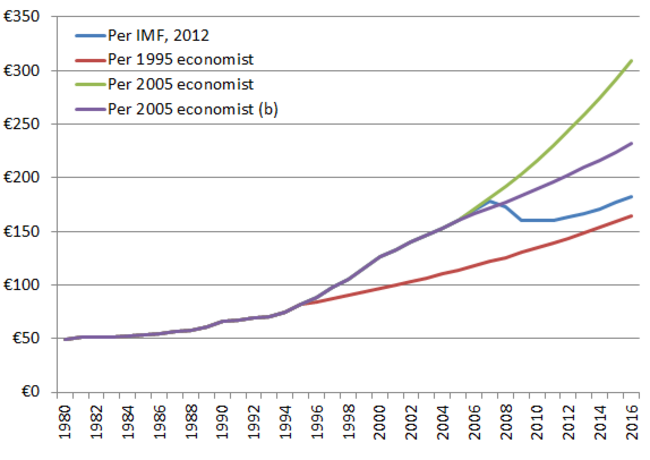
ronan graph
Output and potential output in Ireland 1980-2016, for different years of calculation

Potential output and the potential for error

Why might economists say this is crazy? To show this, let’s consider “potential output” in 2016 – shown in the graph above. As of 1995, real growth in Ireland had been an average of 3.4% a year since 1980 so an economist at the time might have thought this a reasonable basis on which to project potential output. By this calculation, output would have been €114bn in 2005 and €164bn in 2016 (the red line in the graph above; I’m setting aside inflation to show that this point holds even in constant prices).

Output was actually €161bn in 2005 (in today’s prices) so our economist would either have to conclude that Ireland was running an absolutely enormous structural surplus or that his model was wrong. So let’s say he thinks his model is wrong and that he now knows Ireland’s potential output grows by 6% a year (which is what it had done on average between 1990 and 2005). He now confidently predicts that potential output in Ireland in 2016 will be €309bn (the green line), almost twice his initial projection for 2016.

Well, as of last September, the IMF expected output in 2016 to be €183bn (the blue line). Even a more level-headed economist, as of 2007, might have thought potential output would grow by 3.4% a year (i.e. back at pre-Celtic Tiger rates), in which case potential output would be €232bn in 2016 (the purple line). Either way, the margin for error is huge. We don’t ever actually see “potential output” (heck, even calculating GDP is dodgy enough) so why would we put it in our constitution?!

In a way, though, the whole potential output thing – while attracting a bit of attention – is a bit of a sideshow. There are two main issues with the Fiscal Compact. Firstly, it brings rules to an area where there should be discretion – fiscal policy is not monetary policy and flexibility is key. Secondly, and much more worryingly, it is bringing the wrong rules. By thinking deficits are a bad thing, it will actually prevent the investment that – in the long run – will boost living standards and repay the interest on the borrowings which it is worried about.

And yet, despite all this, Irish citizens should vote yes! I’ll explain why next week.

PS. Similar sentiment are expressed by Karl Whelan here. A more benign assessment of the impact of the EU Fiscal Compact is given by Philip Lane.

Ronan Lyons is an Irish economist based at Oxford University, and runs the Economic Research unit at Daft.ie. You can read more articles on his blog, where this piece originally appeared.

Read next:

Comments (90 Comments)

  • Great piece, very informative. Most definitely a no still for me!

    Reply
  • Great Article

    Reply
  • I’m curious to know why the issue of money as debt is almost never raised by economists, who also fail to mention that a value-based interest-free monetary alternative is available that doesn’t trap countries in permanent debt. The only thing is, it requires politicians with spines and principles to carry it out, as it is highly unpopular with those in the parasites in the central banking world who think they have a right to live off our productivity.

    I can’t recall when any economist ever explained that for our national debt and that of other eurozone members to be repaid, it would require that every single euro real or virtual be taken out of circulation. That, to me, is Economics 101, but it is rarely if ever taught.

    Reply
  • Sean 06/03/12 #

    Excellent article, this compact wouldn’t have prevented our recession nor is anyone advocating the use of it to get us out of the recession.

    Another example of politics before economics

    Reply
  • This compact will put a stranglehold on our economy for years,it is basically being pushed to satisfy Frau Merkels core voters.As to what damage it does to Ireland does not interest Frau Merkel.

    Reply
    • France are going to renegotiate once hollande gets elected on the basis that its is all austerity and no growth and the spaniards are already saying they have no intention of sticking to the figures and instead are going to set their own targets. This treaty is falling apart at the seams, I dont think its will even get far enough for a referendum. Why are we debating its when other countries are already standing up and saying no.

      Reply
    • Norman if you haven’t read this already….it is interesting.

      http://m.spiegel.de/international/europe/a-818966.html#spRedirectedFrom=www

      Reply
    • @Thanks Niamh i will but i have read the treaty and it is a pointless exercise and sop to the German electorate it will do nothing to stop the fundmental crisis in Europe.They are trying a one size fits all approach,it is doomed to failure even when 12 or more countries sign.In regards to France we could in theory have two referendum this year.

      Reply
    • I don’t know if we’ll have any. The germans have backed themselves into a corner, if the euro breaks up they have the most to lose. They are over a barrel, they have to keep it going now, wotever the costs. I think that its is increasingly likely that this treaty will be torn up and we will be back to the drawing board.

      Reply
    • @ Niamh: I’m very cynical as to whether Hollande, if he gets elected, will do all he says he will. He’s promised rolling the retirement age back from 62 to 60 (an unpopular move on Sarkozy’s part). He’s also promising more teachers and other increases in public spending. Yet he seems sketchy on how he will fund a lot of this bar 75% taxes on the rich. If 12 or more countries have ratified the agreement by May, he might just say that the time has passed and his hands are tied.

      As for the Spanish, if they have signed up then they can be taken to the European courts. I’d imagine it is the kind of Brussels bashing we sometimes get here.

      Re the Germans, I completely understand why they the fiscal measures that work for them imposed on the rest of Europe. We, with other European countries, laughed at their industry intensive economy and their high saving rate – while we spent, spent, spent in the ultimate consumption spree. Its not necessarily a sop to her electorate for Merkel who faces re-election next year, its a fear that the same thing will happen again. However I also completely agree with Norman’s comment on one size fitting all not working.

      Reply
    • @ Ryan I guess you missed the bit about Germany exceeding the 3% when it suited them after the Masstricht treaty was signed?

      Reply
    • In response to the Der Spiegel link pasted by Niamh:
      1) The Bundesbank and the Central Bank of Ireland are not independent Cental Banks, they are regional offices of the ECB (Eurosystem). This point is important in this discussion.
      2) ” “These countries simply pull money off the printing press,” Sinn complains.” Excluding forgery, only a Central Bank can ‘print’ money so no money is being printed here (apart from what the ECB authorised)
      3) As part of normal ECB-approved Fractional Reserve Banking, Irish Banks were undoubtedly lending ‘new money’ which caused so much trouble later when the bubble burst.
      4) It is highly likely that the Bundesbank funds that the article says are loaned to Ireland keeps Irish Bank afloat.
      5) This Bundesbank loan is secured by Irish Banks assets (e.g Irish property held as collateral)

      Reply
    • Hi george, I’m not sure I understand ur point. I am sure sinn factored this all in his point regarding greece (using greece rather than ireland as an example as each country leaving would have different impact) is that if they are to leave all monies leant/invested/borrowed would become worthless, this would leave germany banks very vulnerable because being the strongest country (on paper) would stands to lose the most. Im not an economist and dont have the levels of understanding that you have but I can see how this is a huge potential problem for germany…not just if greece goes but if the euro goes.

      @ryan, that is always a possibility but I think if he rows back on anything it will be the pensions (eh…60…seriously??) I think he is right that the treaty is too focussed on fiscal tightening (for wanted of a better word) and not enough focus on growth. I think once the seeds of doubt have been planted in the public mind, not just in ireland, that there is going to be far more
      scrutiny of what exactly this treaty is about and what direction the eu is taking.

      Reply
    • With regards to brussels bashing by the spanish, that is untrue. They have massive unemployment, if they implement the targets as set out in the treaty the country will be crippled, they have to maintain stability while implementing cuts without increasing unemployment even further all the while trying to create growth and jobs while maintaining a level of tax collection to support the country…..you can see why they are concerned ryan…as should we be. Thats not brussels bashing, its common sense.

      Reply
  • My suggestion if any members of the government read thejournal.ie is to hold off until late summer before holding the referendum. Spain’s PM who only signed the treaty last week said yesterday he is not going to follow the targets as announced to bring his countries ratio to 3% as it is not possible. France’s likely future president Hollande who according to the polls will beat the current president (hope Sarkozy being unemployed) has said he will hold a referendum on the treaty if he wins. Best advice is to spend no money on getting ready for a referendum as this treaty will not last the summer.

    Reply
  • I have to say the conversation its sparked is just as good as the article. great debate given by all. its a no for me bob.

    Reply
  • Helpful analysis Ronan, thanks.

    I have trouble believing the person above that says Ronan predicted rents would rise in 2007. Is this the article that person is talking about? http://www.daft.ie/report/ronan-lyons And if it is – then there’s nothing in that as definite as ‘rent rising next year’, just a factual analysis of rents on Daft.

    @Tom – can you point out what is wrong with the main point of the article ; “that the Fiscal compact is introducing the wrong rules”, and why (if?) you disagree with that?

    Reply
  • Hi John,
    The point I was making was precisely the one that sounds illogical: because countries don’t die, debts don’t have to be paid off, only rolled over – and thus you never have to balance the books. This is not a Ponzi scheme, this is just the mathematics of growth. For example, Ireland’s crippling national debt from the 1980s was never actually paid off, it was just rolled over and the country grew until the burden wasn’t so bad.

    This is not, however, a carte blanche for countries to run any deficits they want – the argument I was making was that current spending needs to be balanced and borrowing is only for capital spending that has quantified returns. Hope that clears things up.

    Reply
    • Thanks Ronan,I do kind of understand your point, which seems fine while an economy is moving forward or even stagnant for a while, When your stuck in reverse for years with a large debt, it’s kinda hard to believe borrowing is the solution, I understand the argument being made for outgrowing your debt, but by the same token, when your economy is shrinking then your debt is increasing and a tipping point comes where your smothered by the debt. Simple maths says if you continue to spend more than you take in, it will eventually catch up and hard decisions (like the ones being taken) have to be made.The biggest question is, if we did not go down the road of tough austerity and tried to borrow to stimulate the economy and outgrow our debt, Who would lend to us ?

      Reply
    • I understand your points, however fail to see how they prove economic illiteracy on the part of Europe.

      Surely if the debt of a country is rolled over, what this in fact means is that it is paid off and replaced by new debt on a continual basis. To state it is never paid is wrong, is your argument then that debt should never be zero?

      Yes of course borrowing is important for growth, that is a given.

      However in order to borrow, the lender requires confidence you will pay it back, irrespective of whether you refinance afterwards.

      Few lenders would have this confidence for countries with enormous deficits. (exceptions being the IMF and troika). Once back in the markets controls must be in place to ensure countries do not expose themselves to collapses of the degree we have witnessed.

      Without this measure we would be free to repeat the same mistakes, and nothing would have been learned at all.

      Reply
    • P.S. What is mutually exclusive about balanced books and borrowing?

      By balanced books I mean the national budget (the closer the better), and it would follow that we would be more likely to attract cheap lending if we were in this position.

      Reply
    • It’s good to read something positive about the role that government needs to play in the economy.

      I would put it more generally. When the private sector can’t or won’t step up, the government must or we suffer the double whammy of the loss of productive activity & welfare costs of the inevitable high unemployment.

      I don’t agree with your distinction regarding capital spending. Revenue spending is just as likely to stimulate productive investment (& ‘real return’) in the private sector. Just as much ‘private’ revenue spending does.

      The real problem arises when money is ‘invested’ in speculative asset bubbles where there is little or no productive return to the real economy. Like buying land at €200,000 per acre. Such activity becomes purely extractive on the real economy.

      To put it another way, the Money-Goods-Money parallel speculation cycle gets out of hand with the Goods-Money-Goods cycle. Of course, this another issue not being addressed – the behaviour of the financial sector & its relationship to the real economy..

      But in the present situation my preference is for an MMT style Job Guarantee program financed by ECB ‘created’ money at no cost or further debt to anyone. Get growth going while the rest of the Euro structural mess & bankster operations get sorted out.

      Reply
  • “Countries shouldn’t be just allowed to borrow ad infinitum – provided they are investing in projects that boost growth, they should be practically required to borrow” well I am not lecturing in Trinity or anywhere and I do not profess to be an economic expert, but surely you have to balance the books at some stage, The borrowing advocated is why the USA owes trillions and is why so many countries, Italy etc are in trouble. If you are borrowed up to the max then when the unexpected hits you are unable to ride it out. Whether you like the Germans or not you have to say that they appear to be able to keep the balance between spending and borrowing about right. So while it would be useful to go above the 0.5% allowed on occasion to boost growth, the problem in many countries is that is the only approach used, which clearly can’t go on indefinitely

    Reply
    • Very valid point. Unfortunately a lot of governments have used borrowing to plug gaps in social protection and day to day spending as well as to buy elections rather than investing in projects to boost growth.

      Reply
  • I am very disappointed as I have always agreed with the authors general analysis’s.

    While the article is good there are some glaring holes it seems to me, in an ideal world his argument is sound, and in the theoretical realm.

    Consider the absence of consideration of the irrational markets, unless I am reading him wrong he is arguing that countries should be allowed to borrow unrestricted if they want to maximize growth. This assumes the presence of a market willing to lend to them.

    So long as growth rates predicted are achieved then there is not a problem, but if state spending far exceeds income and the growth never materializes…..then the market will disappear and no money will be available.

    Then obviously the country will quickly find it does not have the money to meet day to say requirements and a crisis will ensue.

    It is a question of balance, balance between risk and reward. And responsibility and irresponsibility.

    I will be voting yea for these reasons, and anyone making the argument against regulation following the greatest failure of regulation and it’s obvious effects should be more carefully in there thinking.

    Reply
    • P.S. Hit return by accident….one final point…..

      Do we want to allow the freedom to peruse maximum growth or protect against maximum collapse?
      We need to think about what balance between these two is best for stability, just look where the pursuit of maximum growth during the “boom” brought us.

      By we I am referring to Europe as a whole…….I don’t see a future world populated by giant emerging economies being a place we want to be isolated in alone on the outskirts of a Euro-zone.

      Reply
    • Japan has public debt of 230 per cent of GDP doesn’t seem to worry the markets seeing as Japanese 10 year bonds are priced at under 1%…

      Reply
    • Japan is an economic powerhouse, a “miracle” after WW2, combining an innovative blend of capitalism and state guided economy.
      They suffered a property collapse that is a good analogy to ours it is true.

      However all the fundamental economy pillars are completely different, they are not dependent on foreign investment, they have huge indiginous corporation with enormous profits selling directly in to emerging economies’ of china and india. Also a work ethic and standard of production second to none except perhaps germany.

      Wow i wish we could be compared to japan in any other way except our debt as as result of property collapse……….unfortunately in every other area we are opposite.

      Reply
    • So maybe we should be able to borrow to invest in indiginous corporations? Not totally unrestricted btw but if we cannot borrow to create jobs we will be in the same place in 30 years.

      Reply
  • Correct me if I’m wrong but didn’t Ronan Lyons say that rents wouldn’t drop and would stabilise in 2007?

    Reply
    • Three people thumbed down….but didn’t comment. Do they believe I was wrong about Ronan’s predictions for the rental market in 2007 or are they just annoyed?

      Reply
    • Tom – that’s false logic. Lazy too. Address his argument and point out the flaws all you want but the fact he called it incorrectly does not in any way affect the logic of his argument above.

      Reply
    • Stop talking claptrap will ya. Deal with the issue not the author. I see you’re still not using your own mind, would rather roll out lines discrediting people cause your overlords told you what you should think or vote!

      Reply
    • Have a read Tom. http://www.ronanlyons.com/2010/01/19/spotting-the-swallows-irelands-rental-market-in-2010/

      What’s your point? He was wrong. So what? We all make mistakes and call it wrong sometimes.

      Reply
    • Sorry Paul,

      I posted a response to his argument above, but will do so again and I will expand further.

      The govt, and especially the Taoiseach, are not suggesting this as a panacea to the current ills. In fact entirely the opposite, they are portraying it as a de facto insurance mechanism that will ensure more favourable bailout terms at a future date if futher bailouts are needed.

      The college analagy is a bit off and let me explain why. The fiscal compact is not designed to stifle economic growth by investing in the economy, but rather to curb overspending and everything has its price even college education. If someone said the cost of getting a good quality IT degree in the current climate was 25k, most would agree that this is probably a reasonable price. If however I said the price of getting the same degree was 750K, it would not represent good value, as most graduates would not repay such an investment in their lives. In short, everything has a price, whether we like it or not. It is simply disengenuous to portray it otherwise as Ronan has done.

      I appreciate that pointing out his 2007 analysis was a cheap shot….but he did draw those conclusions at a time when Morgan Kelly was going to town on the property market, both sales and rental.

      But my main beef is that he portrays the Fiscal Compact as being agreed by politicians who think it is a panacea. In fact politicians are going out of their way to say that it is not a panacea and it is a rather lazy comment by Ronan Lyons to say otherwise.

      Reply
    • How does it assure more favourable “bailout” terms? Aren’t the terms of the IMF portion of our current “bailout” better than those we’re getting from the EU? Because the EU portion has “moral hazard” priced in.

      Reply
  • I hope the No Voters have a plan B if the EU cut of funding to Ireland.

    Reply
  • People who voted Yes are to blame for all the misery. You voted No to the Lisbon Treaty and then you voted Yes. Its you’re fault

    Reply
    • Gibberish, Lisbon has nothing to do with the economic situation.

      Reply
    • mart_n 06/03/12 #

      It’s done very little to stabilise the situation either, Adrian. Since Lisbon was ratified; uncertainty seems to have increased.. and that’s despite the apparent assurances given by some quarters that a Yes vote was our ticket out of this hole.

      Would you have said that the Lisbon Treaty had ‘nothing to do with our economic situation’ back in 2009 when you were persuading others to vote Yes?

      Reply
    • Nah, it’s all your fault Darren.

      Reply
    • Well the people who said we should vote no said that with a yes vote on lisbon 2 we’d have the right to abortion (finally), a European army (which we already have) and a few other things that never came to pass. Seems like neither the yes or the no camps were right.

      Reply
    • One of the reasons rents are falling is because the government as a major rent payer ( through rent allowances) has consistently pushed the limits at which people may rent, down for the last few years. In the present climate rent allowance tenants are the only show in town for many landlords.

      Reply
    • About once a week I point this out on the Journal.
      Recession / Bubble Bursts / Massive job losses = 2008
      Lisbon treaty into law = December 2009
      The Lisbon treaty could not have caused something to happen before it came into effect, that would be physically impossible. Our exports have been booming since, it’s just the domestic market that’s in trouble.

      Reply
  • Your piece assumes that the market forces that drive investment into a country are solely the result of that countries returns and ignores the risk that the country defaults or amasses an unsustainable debt load… The investment that poured into the likes of Greece was less based on returns and more due to fact that investors assumed the strong economic policy of germany meant the risk was being disclosed and indeed managed. The risk was in effect and being enforced when it wasn’t…

    So the policy isn’t entirely worthless as you imply… It reintroduces the idea that the risk being presented is believeable and genuine.

    No matter how ‘great’ the presented returns… It’s useless if investors believe they will never see them

    Reply
  • Newsflash!

    The Job Guarantee scheme I’ve been proposing here for the Eurozone is being proposed for the UK on a prominent Liberal Democrat website.

    ‘Liberal Democrat Voice’ (“…The most-read website by & for Lib Dem supporters…”)

    http://www.libdemvoice.org/opinion-job-guarantees-a-economic-stimulus-worth-considering-27360.html

    Reply
  • Ardo Ci 08/03/12 #

    Good article. If economics are so clear though that even his new students recognise the flaws in the current system ( mind you I believe anyone with an abacus could do it) then why oh why are the ‘economists’ who advise governments allowing the current malaise to exist? As always things always have a hidden agenda that flies in the face of natural reason.

    Reply
    • @ Ardo, It’s always easy for people in the wings to simplfy things, I think it is more a case of lots of differing agendas, as opposed to hidden agenda’s. If it was simple economics, ok, but like it or not it is as much political as economic. example, political parties have their own agenda, anti european parties will never see anything good in something that brings europe closer, while pro europpean have the same in reverse.

      Reply
  • @ mike, twice a detailed reply to you disappeared, so I give up :)
    Simply I was saying, if we (politicans) as a country can’t work together without continually bickering, blaming and entering into cheap point scoring, what chance has 17 nations of working together

    Reply
    • @ John

      I tnink that’s a great difficulty at the moment too. It would be simpler in many respects to go back to our own currency. Getting to near full employment would be quite easy if we adopted the right policies.

      One of the biggest issues is the way what should be pure economics ‘fact’ gets mangled & incorporated into politics & vested interests. That’s one reason I propose the MMT system – much of which merely describes the actual monetary operations structure as it exists right now. MMT is agnostic on the issue of relative public private sector size, one of the biggest political arguing points.

      But probably +the+ biggest issue we have is that virtually no citizens or TDs, and even a lot of so-called ‘economists’ actually understand how the macro economy works. Sadly, I’m +not+ overstating this. My own study of (macro) economics has been a real eye opener. I came across this audio-visual online explainer recently. It’s based on the US, but with the minor detail of substituting our collective governmental authority & ECB for the currency issuer, it is essentially just how every other (fiat) money economy works. Really we should all understand how this works. It’s a disgrace that our education system does not teach this & even many economics course get it wrong. See here: (It includes the Job Guarantee as an +optional+ feature to show how it works, together with one or two other optional features. As it says, leave your politics at the door, pick them up when you leave.)

      http://econviz.org/how-the-economy-works-visual-tutorial/

      Reply
  • This is an absolutely MUST WATCH video.

    Thanks to Raimonds for this

    http://www.youtube.com/watch?v=EPcWHBPYOSU

    Please post on your FB page is this frightens the shite out of you like it does me…….

    Reply
  • Borrowing is fine if you’re not already up to your neck in debt. When a sizeable percentage of your GDP is being swallowed up by INTEREST payments alone, then adding to that burden is questionable. Same goes with private household borrowing. In the end, it’s not the government that pays the debt interest, it’s the private households. These enormous debts can never possibly be paid back, so it’s time to stop the pretense that they can. Instead, generations will pay INTEREST to mysterious institutions who loaned us money they conjured up out of thin air. I wouldn’t like to be an economist these days.

    Reply
  • Well I’m voting Yes

    Reply
  • This treaty will stop Politicians from buying re-election as FF has done in the past

    Reply
  • This is an economist in a box. Capitalism is the problem.

    Reply
  • A good article from Ronan, & informative. Nice to see some quality engagement from the profession in the media.

    Yes, the ‘fiscal compact’ does nothing at all to help the current situation of low/no growth & high unemployment. Depending on how it is applied from where we are now with high debt/deficits, it could do a lot of harm.

    It also seems that the economics thinking at the core of the Eurozone is even worse than I thought.

    Nor does the compact address any of the fundamental imbalances & flaws of the Eurozone structure.

    I suggest people transpose the situation & structure of the Eurozone countries to Ireland’s regions. Imagine the core countries like Germany as Dublin, and the weaker ‘PIIGS’ as, say, Kerry or Donegal. Sorry Kerry/Donegal….no more fiscal transfers for you guys. You’ve to balance your own ‘books’ & we’re going to impose this compact to make sure you do. You’ll just have to do whatever it takes….close your schools & hospitals, halve your wages, make yourselves ‘competitive’, whatever, it’s your problem, tough.

    Reply
    • Good points, and well put.

      I would just make one addition to your analogy, for it to work presumably the taxes from all provinces are centrally controlled.

      So would you be in favor of complete taxation integration throughout Europe? And a full federal system?

      At the moment all countries jealously gaurs their own taxation sovereignty. Are you against this?

      Reply
    • well using your analogy, if the kerrymen could take early retirement @55 & normal at 65, while early retirement for the dubs was 65 with normal @ 67, Do you think the Dubs would be saying, You take it easy down there, heres a few bob to keep you going, or would they be saying, Jazzzusss i’m bleedin sick of them lot

      Reply
    • @John,

      Well put, I think you hit the nail on the head.

      Reply
    • Well, my starting point is that there needs to be +some+ means of avoiding ‘mercantilist’ exploitation of the weaker countries (whether deliberate or not).

      The idea that we can all ‘compete’ to be become equally economically productive is nothing more than a race to the bottom (at least for wage earners) & even to try is a multi-decade project. Part of the reason imbalances have already become worse is because Germany itself undertook a process of reducing returns to wages. Presumably from some combination of ideology & perhaps to further enhance its ability to export outside the Eurozone, to low wage sweat shop economies like China for example.

      I would like to see a full blown MMT structure with ‘functional finance’ and their permanent Job Guarantee scheme. The latter puts a comprehensive ‘floor’ under wage earners. No one who wants it need be without at least a minimum wage job. Variations in economic development would still exist between regions, for various reasons including the fact that true mobility of labour is still hampered by language barriers (which my analogy doesn’t have).

      There would need to be a consolidated federal authority combining some taxation ability together with currency issuance authority (a newly structured & mandated ECB). Central to this is the realisation that such a consolidated entity would have no need whatever to borrow (or incur interest charges) in order to net spend (spending greater than federal tax ‘income’) when & as required to ensure overall maximum (near full) & price stability. Net spending adds money to the economy, for ‘stimulus’, net taxation extinguishes (removes) to control aggregate demand & inflation. The concept to grasp here is that taxation +does not+ ‘finance’ anything – it’s purely a control mechanism to curb excess demand & inflation. A currency issuing authority has by definition its own ‘means’ of ‘finance’.

      I know this concept is hard to accept, but in operational terms, in a sovereign (fiat) currency system, this is how it already effectively functions. There is nothing like some bucket of money or household bank account into which us currency +users+ must peer to decide if something can be ‘afforded’. This is ‘functional finance’. The decision to net spend or net tax is solely based on the the prevailing conditions & direction of the economy as a whole – are we losing jobs & contracting or are we overheating & getting inflation? The consolidated federal currency issue/tax authority functions to counter balances the desires & performance, the ‘business cycle’, of the private sector. A far more clear & effective way of managing the economy & ensuring stability. (And no one gets left behind.)

      The regional governments could still retain considerable autonomy in local tax/spending powers, within some Euro wide agreed limits.

      I think such a system would be far, far easier to negotiate than the messy, beggar-thy-neighbour approach now, riddled with all the added corruption of private vested interests as well. In operational/institutional terms, very little change would be needed. Beyond ideological ‘politics’ it’s very doable.

      But without some kind of federalisation, fundamentally, a currency union is going to be an ongoing series of crises for one country or another & overall, wasteful of economic, real resources.

      MMT takes a bit studying, there’s about a 20 year body of work behind it. But please note this. The Job Guarantee is +not+ part of the normal ‘public’ sector, but separate & stand alone. In practice, well managed, I would expect rarely more than 2 to 5 % of the workforce needing to avail of it (& unemployment probably never above 2%). In all other respects MMT, a system, is completely +agnostic+ as regards the relative size of public/private sector – left to democratic politics to decide.

      If you want to read more:

      The best commentary blog is by Prof Bill Mitchell, a co-founder & developer of MMT over the last 20 years. Bill hyperlinks all the important concepts to further explanations in previous blogs. It takes a little time & care to study thoroughly – macro economics is proundly different to the ‘micro’ of our households & businesses. For that reason it tends to be counter intuitive. Bill’s blog is here:

      http://bilbo.economicoutlook.net/blog/

      The other co founders are mainly at the University of Missouri Kansas City, who have a ‘Modern Money Primer’ series at their blog here:

      http://www.neweconomicperspectives.org/p/modern-money-primer.html

      Profs Mitchell & Wray are co-writing a new textbook on macro economics which is nearing completeion & due out this year.

      Other main blog sites of MMT academics and professionals:

      Yves Smith’s http://www.nakedcapitalism.com/

      Co founder Warren Mosler http://moslereconomics.com/

      Supporter Mike Norman http://mikenormaneconomics.blogspot.com/

      Reply
    • @ John Johnson

      Well, yes, but if we could all agree a more less the same per capita public sector spend for regional authorities then Kerry could be left to their own local democracy to decide how well their older folk are looked after & what other areas of service provision they wish to reduce to enable it. (Let’s say in terms of some minimum standards we could all agree on, giving a percentage of discretionary spending.)

      But I think your depiction of life for Greeks is nothing like the overall picture for them. You need to look beyond the kneejerk tabloid predjudices to find out tho’.

      Reply

Add New Comment