Sign in. It’s quick, free and it’s up to you.
An account is an optional way to support the work we do. Find out more.
Sign in. It’s quick, free and it’s up to you.
An account is an optional way to support the work we do. Find out more.
Updated 4.10pm
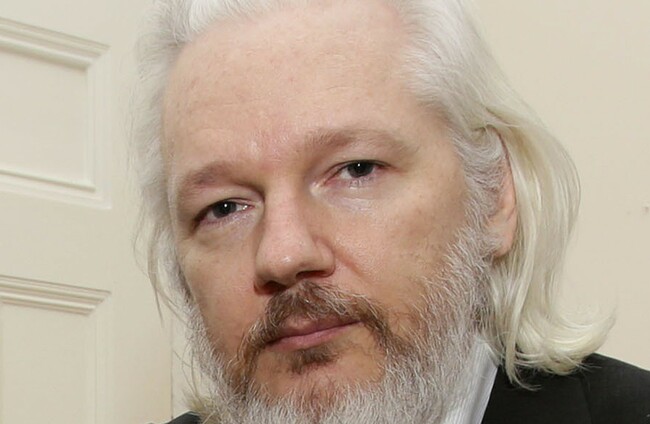
A UN WORKING Group on Arbitrary Detention has ruled that Julian Assange’s confinement in the Ecuadorian embassy in London amounts to illegal detention, Sweden’s foreign ministry said today.
“We can only note that the working panel has come to another conclusion than Swedish judicial authorities,” a ministry spokeswoman told AFP, a day before the panel was to formally publish its report.
The WikiLeaks founder, who is wanted for extradition on a rape accusation in Sweden and has lived in the embassy since June 2012, said earlier today that he expected to be treated as a free man if the panel rules in his favour.
Assange said he could leave the Ecuadorian embassy in London tomorrow pending an opinion by a UN panel on his alleged rape case — but Britain said it would have to arrest him.
In September 2014, Assange filed a complaint against Sweden and Britain to the UN Working Group on Arbitrary Detention, claiming his confinement in the embassy amounted to illegal detention.
“Should I prevail and the state parties be found to have acted unlawfully, I expect the immediate return of my passport and the termination of further attempts to arrest me,” he said in a statement today.
If the UN group rules against him he said “I shall exit the embassy at noon on Friday to accept arrest by British police as there is no meaningful prospect of further appeal”.
Arrest
The British government said it was under an obligation to arrest him in both eventualities.
“An allegation of rape is still outstanding and a European arrest warrant in place, so the UK continues to have a legal obligation to extradite Mr Assange to Sweden,” a government spokesman said.
We have been consistently clear that Mr Assange has never been arbitrarily detained by the UK but is, in fact, voluntarily avoiding lawful arrest by choosing to remain in the Ecuadorian embassy.
’A miserable existence’
The BBC reported that the UN panel would find in Assange’s favour, in what would be a non-binding decision, although WikiLeaks sent a tweet saying it was awaiting “official confirmation”.
“Hopefully, the British and Swedish authorities will allow him freedom,” Vaughan Smith, a friend and supporter of Assange, told AFP.
“He has a miserable existence, so of course he wants to get out,” he said.
The BBC report said the panel took its decision in December and had already informed both the Swedish and British governments.
The 44-year-old has been holed up in the embassy in west London since June 2012 in a bid to avoid extradition to Sweden over rape allegations, charges he has denied.
Ecuador has granted him asylum, but he faces immediate arrest if he steps onto British soil and for years police have been posted around the clock outside its doors at a cost of millions of pounds.
24-hour guard
In October last year, British police ended the 24-hour guard outside the embassy in Knightsbridge in west London but said they would strengthen a “covert plan” to prevent his departure.
Separately, the Australian fears he could eventually face extradition to the United States to be put on a trial over the leak of hundreds of thousands of classified military and diplomatic documents by his anti-secrecy group Wikileaks.
Assange founded Wikileaks in 2006, and its activities including the release of 500,000 secret military files on the wars in Afghanistan and Iraq and 250,000 diplomatic cables have infuriated the United States.
The main source of the leaks, US Army soldier Chelsea Manning, was sentenced to 35 years in prison for breaches of the Espionage Act.
Black stain
WikiLeaks has said Sweden’s handling of his case has left a “black stain” on the country’s human rights record.
Any decision by the UN group would not be legally binding, but Justice for Assange claims its rulings influenced the release from detention of prominent figures including Myanmar’s Aung San Suu Kyi and Washington Post journalist Jason Rezaian, who was held by Iran for 18 months.
A divisive figure, Assange has likened his confinement in the embassy, where he lives in a small room divided into an office and a living area, to living in a space station.
Previously he lived in the more impressive surroundings of an English country mansion owned by one of his supporters, documentary maker Vaughan Smith.

To embed this post, copy the code below on your site
















have your say