Sign in. It’s quick, free and it’s up to you.
An account is an optional way to support the work we do. Find out more.
Sign in. It’s quick, free and it’s up to you.
An account is an optional way to support the work we do. Find out more.
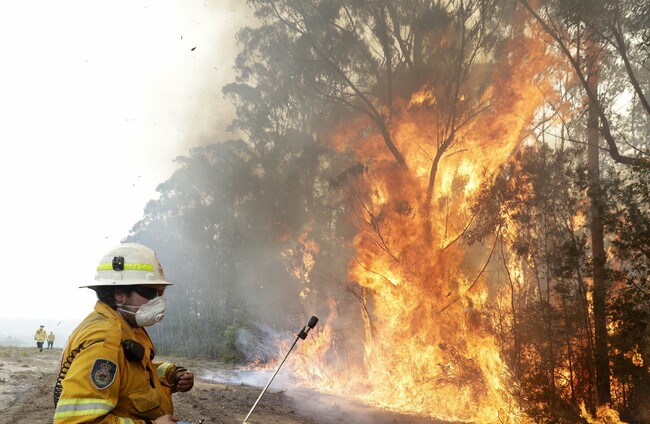
AUSTRALIAN AUTHORITIES HAVE issued new bushfire warnings and evacuation notices as hot weather returns to the southeast of the country, threatening further misery for thousands of people.
Officials have warned some areas are “just at the beginning” of the devastating crisis, which has killed at least 26 people, destroyed over 2,000 homes and scorched 80,000 square kilometres – an area the size of the island of Ireland.
The fires have flared up in the southeast of the country in a months-long crisis, killing nearly half a billion native animals in New South Wales alone, scientists estimate.
While bushfires are common in Australia’s arid summers, climate change has pushed up land and sea temperatures and led to more extremely hot days and severe fire seasons.
Australia experienced its driest and hottest year on record in 2019, with its highest average maximum temperature of 41.9 degrees Celsius recorded in mid-December.
In the south Australian town of Parndana on Kangaroo Island, soldiers went door-to-door advising residents to leave after a large blaze bore down on the area, with temperatures there soaring to 38 degrees Celsius.
That came less than 24 hours after police evacuated Vivonne Bay on the island, an area which was also being threatened by fires that were expected to burn for days.
“The conditions are such that it is continuing to present a significant risk to the firefighters who are working hard to control the fires, and to anyone else in the vicinity,” Country Fire Service chief Mark Jones said.
In the neighbouring state of Victoria, officials extended a “state of disaster” for a further 48 hours ahead of scorching temperatures that due to set in on Friday.
“It’s a very dangerous and dynamic situation that will confront us over the next 12, 24 and 36 hours,” Victoria Emergency Management commissioner Andrew Crisp said.
The state’s premier Daniel Andrews warned residents to brace for further devastation in what has already been a months-long crisis.
“We’re just at the beginning of what will be a really, really challenging summer,” he said.
‘Extreme’ danger
Despite cooler weather and rainfall providing some relief in some bushfire-affected areas this week, almost 150 fires were still burning in worst-hit state of New South Wales and in Victoria, the country’s most populated regions.
Vast areas in both states are facing “severe” fire danger Friday, with some areas expected to experience “extreme” conditions.
“Don’t get complacent with the rain that we’ve seen,” Victoria police minister Lisa Neville said.
“These fires are absolutely still moving, still growing in our landscape and they pose significant risk to communities.”
Firefighters have been taking advantage of this week’s milder weather as they raced to contain bushfires ahead of the Friday.
They have been clearing vegetation and carrying out controlled burns in an effort to protect areas like the coastal town of Eden, where a large bushfire is burning to the south.
On Thursday, New South Wales announced it would spend Aus$1.2 billion (€742 million) on restoring infrastructure in fire-ravaged areas.
That comes on top of a separate Aus$2 billion (€1.24 billion) national recovery fund earmarked to help devastated communities.
The bushfire toll has not been limited to human losses — the blazes have also wreaked wide-ranging environmental damage.
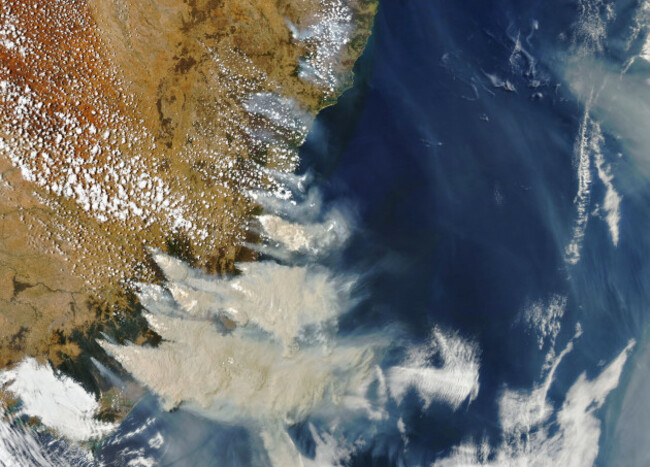
Bushfire smoke has shrouded Australia’s major cities in toxic haze for weeks, causing major public health concerns.
The smoke has also travelled more than 12,000 kilometres to Brazil and Argentina, according to weather authorities there.

To embed this post, copy the code below on your site













have your say